
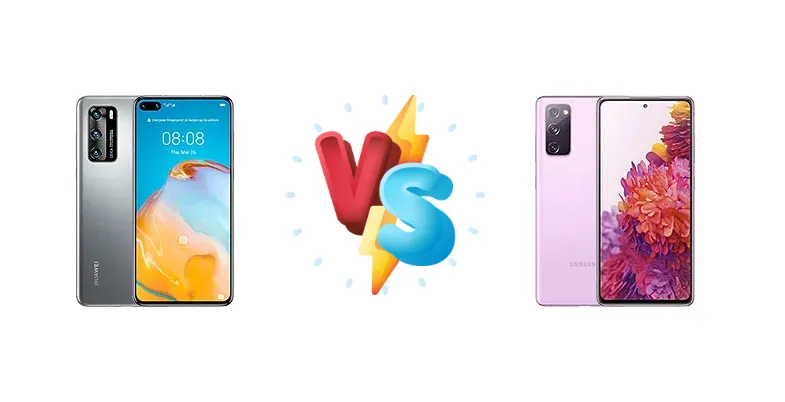
Huawei P40 vs. Samsung Galaxy S20 FE 2022: A Detailed Comparison of Flagship Alternatives
| Phones Images | |||||
|---|---|---|---|---|---|
|
🏆 Quick Verdict
For the average user prioritizing consistent performance and a more versatile camera system, the Samsung Galaxy S20 FE 2022 emerges as the better choice. While the Huawei P40 boasts excellent battery endurance, the Snapdragon 865’s superior GPU and wider software support make the S20 FE 2022 a more future-proof option.
| PHONES | ||
|---|---|---|
| Phone Names | Huawei P40 | Samsung Galaxy S20 FE 2022 |
| Network | ||
|---|---|---|
| 2G bands | GSM 850 / 900 / 1800 / 1900 | GSM 850 / 900 / 1800 / 1900 |
| 3G bands | HSDPA 800 / 850 / 900 / 1700(AWS) / 1900 / 2100 | HSDPA 850 / 900 / 1700(AWS) / 1900 / 2100 |
| 4G bands | 1, 2, 3, 4, 5, 6, 7, 8, 9, 12, 17, 18, 19, 20, 26, 28, 32, 34, 38, 39, 40, 41 | LTE |
| 5G bands | 1, 3, 28, 38, 41, 77, 78, 79 SA/NSA | SA/NSA/Sub6 |
| Speed | HSPA, LTE, 5G | HSPA 42.2/5.76 Mbps, LTE (5CA) Cat19 1800/200 Mbps, 5G |
| Technology | GSM / HSPA / LTE / 5G | GSM / CDMA / HSPA / EVDO / LTE / 5G |
| - | CDMA2000 1xEV-DO | |
| Launch | ||
|---|---|---|
| Announced | 2020, March 26 | 2022, April 01 |
| Status | Available. Released 2020, April 07 | Available. Released 2022, April 01 |
| Body | ||
|---|---|---|
| Build | Glass front, glass back, aluminum frame | Glass front (Gorilla Glass 3), plastic back, aluminum frame |
| Dimensions | 148.9 x 71.1 x 8.5 mm (5.86 x 2.80 x 0.33 in) | 159.8 x 74.5 x 8.4 mm (6.29 x 2.93 x 0.33 in) |
| SIM | · Nano-SIM + eSIM· Nano-SIM + Nano-SIM | Nano-SIM + Nano-SIM |
| Weight | 175 g (6.17 oz) | 190 g (6.70 oz) |
| IP53, dust and splash resistant | IP68 dust/water resistant (up to 1.5m for 30 min) | |
| Display | ||
|---|---|---|
| Protection | - | Corning Gorilla Glass 3 |
| Resolution | 1080 x 2340 pixels, 19.5:9 ratio (~422 ppi density) | 1080 x 2400 pixels, 20:9 ratio (~405 ppi density) |
| Size | 6.1 inches, 91.3 cm2 (~86.3% screen-to-body ratio) | 6.5 inches, 102.0 cm2 (~85.7% screen-to-body ratio) |
| Type | OLED | Super AMOLED, 120Hz, HDR10+ |
| - | Always-on display | |
| Platform | ||
|---|---|---|
| CPU | Octa-core (2x2.86 GHz Cortex-A76 & 2x2.36 GHz Cortex-A76 & 4x1.95 GHz Cortex-A55) | Octa-core (1x2.84 GHz Cortex-A77 & 3x2.42 GHz Cortex-A77 & 4x1.80 GHz Cortex-A55) |
| Chipset | Kirin 990 5G (7 nm+) | Qualcomm SM8250 Snapdragon 865 5G (7 nm+) |
| GPU | Mali-G76 MP16 | Adreno 650 |
| OS | Android 10, EMUI 12, no Google Play Services | Android 12, One UI 4.1 |
| Memory | ||
|---|---|---|
| Card slot | Nano Memory (uses shared SIM slot) | microSDXC (uses shared SIM slot) |
| Internal | 128GB 6GB RAM, 128GB 8GB RAM, 256GB 8GB RAM | 128GB 6GB RAM |
| UFS 3.0 | UFS 3.1 | |
| Main Camera | ||
|---|---|---|
| Features | Leica optics, color spectrum sensor, LED flash, panorama, HDR | LED flash, auto-HDR, panorama |
| Triple | 50 MP, f/1.9, 23mm (wide), 1/1.28", 1.22µm, multi-directional PDAF, OIS 8 MP, f/2.4, 80mm (telephoto), PDAF, OIS, 3x optical zoom 16 MP, f/2.2, 17mm (ultrawide), AF | 12 MP, f/1.8, 26mm (wide), 1/1.76", 1.8µm, dual pixel PDAF, OIS 8 MP, f/2.4, 76mm (telephoto), 1/4.5", 1.0µm, PDAF, OIS, 3x optical zoom 12 MP, f/2.2, 13mm, 123˚ (ultrawide), 1/3.0", 1.12µm |
| Video | 4K@30/60fps, 1080p@30/60fps, 720p@960fps; gyro-EIS | 4K@30/60fps, 1080p@30/60fps, gyro-EIS |
| Selfie camera | ||
|---|---|---|
| Features | HDR | HDR |
| Single | 32 MP, f/2.0, 26mm (wide), 1/2.8", 0.8µm IR TOF 3D, (biometrics sensor only) | 32 MP, f/2.2, 26mm (wide), 1/2.74", 0.8µm |
| Video | 4K@30/60fps, 1080p@30/60fps | 4K@30/60fps, 1080p@30/60fps, gyro-EIS |
| Sound | ||
|---|---|---|
| 3.5mm jack | No | No |
| 35mm jack | No | No |
| Loudspeaker | Yes | Yes, with stereo speakers |
| - | 32-bit/384kHz audio Tuned by AKG | |
| Comms | ||
|---|---|---|
| Bluetooth | 5.1, A2DP, LE | 5.0, A2DP, LE |
| NFC | Yes | Yes |
| Positioning | GPS (L1+L5), GLONASS (L1), BDS (B1I+B1c+B2a), GALILEO (E1+E5a), QZSS (L1+L5), NavIC | GPS, GLONASS, BDS, GALILEO |
| Radio | No | No |
| USB | USB Type-C 3.1, OTG | USB Type-C 3.2, OTG |
| WLAN | Wi-Fi 802.11 a/b/g/n/ac/6, dual-band, Wi-Fi Direct | Wi-Fi 802.11 a/b/g/n/ac/6, dual-band, Wi-Fi Direct |
| Features | ||
|---|---|---|
| Sensors | Infrared Face ID, fingerprint (under display, optical), accelerometer, gyro, proximity, compass | Fingerprint (under display, optical), accelerometer, gyro, compass |
| - | Virtual proximity sensing Bixby natural language commands and dictation Samsung Pay (Visa, MasterCard certified) | |
| Battery | ||
|---|---|---|
| Charging | 22.5W wired | 25W wired, PD3.0 15W wireless (Qi) 4.5W reverse wireless |
| Type | Li-Po 3800 mAh | Li-Ion 4500 mAh |
| Misc | ||
|---|---|---|
| Colors | Silver Frost, Blush Gold, Deep Sea Blue, Ice White, Black | Cloud White, Cloud Lavender, Cloud Navy |
| Models | ANA-AN00, ANA-TN00, ANA-NX9, ANA-LX4 | SM-G781NK, SM-G781NK22 |
| Price | About 520 EUR | About 520 EUR |
| Tests | ||
|---|---|---|
| Battery life | Endurance rating 89h | - |
| Camera | Photo / Video | - |
| Display | Contrast ratio: Infinite (nominal) | - |
| Loudspeaker | -28.9 LUFS (Average) | - |
| Performance | AnTuTu: 486583 (v8) GeekBench: 12619 (v4.4), 3148 (v5.1) GFXBench: 37fps (ES 3.1 onscreen) | - |
Huawei P40
- Exceptional Battery Endurance (89h)
- Potentially Vibrant Display
- Huawei’s Image Processing Strengths
- Limited Software Support & App Availability
- Older Chipset (Kirin 990)
- Slower Charging Speed
Samsung Galaxy S20 FE 2022
- Stronger GPU Performance (Snapdragon 865)
- Wider Software Support & App Compatibility
- Faster Charging (25W wired, 15W wireless)
- Potentially Lower Battery Endurance
- Samsung’s Software Bloat
- May Require Software Updates for Optimal Performance
Display Comparison
The Huawei P40 features a display capable of reaching 589 nits of peak brightness, providing adequate visibility outdoors. The S20 FE 2022’s display specifications aren’t provided, but Samsung typically excels in display technology. The P40’s ‘Infinite’ contrast ratio suggests a strong OLED panel, but without knowing the S20 FE’s contrast ratio, a direct comparison is difficult. The P40’s display is likely optimized for color vibrancy, while Samsung often leans towards more natural color calibration. Users sensitive to flicker may benefit from investigating the PWM dimming rates of both displays, as this data isn't provided.
Camera Comparison
Both devices are advertised as having strong camera capabilities, but specifics are limited. The P40’s camera is described as ‘Photo / Video’, lacking detail. The S20 FE 2022’s camera specs are also absent. However, Samsung generally prioritizes versatility with multiple lenses, while Huawei often focuses on computational photography and image processing. Without sensor size or aperture information, it’s difficult to assess low-light performance. The S20 FE 2022’s Snapdragon ISP is known for its robust image processing pipeline, potentially offering better dynamic range and detail in challenging conditions. The absence of details regarding OIS on either device makes it impossible to compare stabilization performance.
Performance
The core difference lies in the chipsets: Huawei’s Kirin 990 5G (7nm+) versus the Qualcomm Snapdragon 865 5G (7nm+). While both are fabricated on a 7nm+ process, the Snapdragon 865 generally exhibits superior GPU performance, crucial for gaming and graphically intensive tasks. The Kirin 990’s CPU configuration (2x2.86 GHz Cortex-A76, 2x2.36 GHz Cortex-A76, 4x1.95 GHz Cortex-A55) is paired with the Snapdragon 865’s (1x2.84 GHz Cortex-A77, 3x2.42 GHz Cortex-A77, 4x1.80 GHz Cortex-A55). The Cortex-A77 in the Snapdragon 865 offers a slight architectural advantage. The S20 FE 2022 benefits from Qualcomm’s optimized drivers and software integration, potentially leading to more consistent performance and better thermal management.
Battery Life
The Huawei P40 boasts an impressive endurance rating of 89 hours, indicating excellent battery life. It supports 22.5W wired charging. The Samsung Galaxy S20 FE 2022 offers 25W wired charging with PD3.0, 15W wireless charging (Qi), and 4.5W reverse wireless charging. While the P40 has a higher endurance rating, the S20 FE 2022’s faster charging speeds and wireless charging capabilities offer greater convenience. The S20 FE 2022’s PD3.0 support also allows for faster charging with compatible chargers. The P40’s 22.5W charging, while respectable, is slower than the S20 FE 2022’s peak charging rate.
Buying Guide
Buy the Huawei P40 if you prioritize exceptional battery life and are comfortable within the Huawei ecosystem, potentially navigating app availability challenges. Buy the Samsung Galaxy S20 FE 2022 if you value a more open software experience, strong gaming performance, and a well-rounded camera system with broader compatibility and long-term software support.