
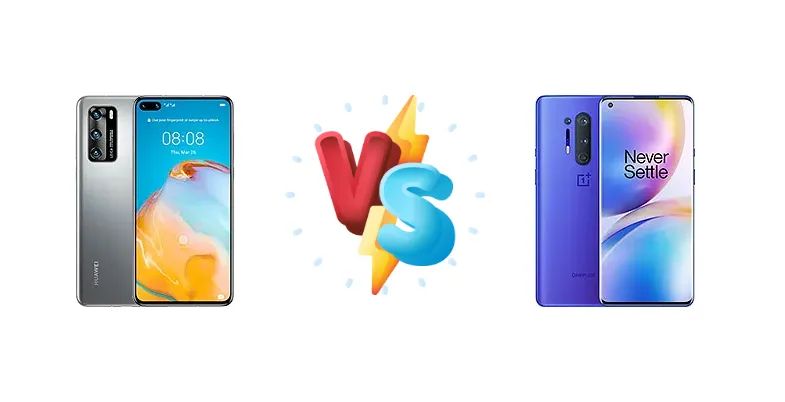
OnePlus 8 Pro vs Huawei P40: A Head-to-Head Flagship Battle
| Phones Images | |||||
|---|---|---|---|---|---|
|
🏆 Quick Verdict
For most users, the OnePlus 8 Pro emerges as the stronger choice. Its Snapdragon 865 chipset offers a more consistently powerful experience, coupled with significantly faster charging – both wired and wireless – and a longer endurance rating. While the P40 remains a capable device, the 8 Pro’s broader feature set and software support give it the edge.
| PHONES | ||
|---|---|---|
| Phone Names | Huawei P40 | OnePlus 8 Pro |
| Network | ||
|---|---|---|
| 2G bands | GSM 850 / 900 / 1800 / 1900 | GSM 850 / 900 / 1800 / 1900 |
| 3G bands | HSDPA 800 / 850 / 900 / 1700(AWS) / 1900 / 2100 | HSDPA 800 / 850 / 900 / 1700(AWS) / 1800 / 1900 / 2100 |
| 4G bands | 1, 2, 3, 4, 5, 6, 7, 8, 9, 12, 17, 18, 19, 20, 26, 28, 32, 34, 38, 39, 40, 41 | 1, 2, 3, 4, 5, 7, 8, 12, 13, 17, 18, 19, 20, 25, 26, 28, 32, 34, 38, 39, 40, 41, 42, 46, 66 - EU |
| 5G bands | 1, 3, 28, 38, 41, 77, 78, 79 SA/NSA | 1, 3, 7, 28, 78 SA/NSA - EU |
| Speed | HSPA, LTE, 5G | HSPA 42.2/5.76 Mbps, LTE (5CA) Cat18 1200/150 Mbps, 5G 7.5 Gbps DL |
| Technology | GSM / HSPA / LTE / 5G | GSM / CDMA / HSPA / LTE / 5G |
| - | 78 SA/NSA - IN | |
| Launch | ||
|---|---|---|
| Announced | 2020, March 26 | 2020, April 14 |
| Status | Available. Released 2020, April 07 | Available. Released 2020, April 21 |
| Body | ||
|---|---|---|
| Build | Glass front, glass back, aluminum frame | Glass front (Gorilla Glass 5), glass back (Gorilla Glass 5), aluminum frame |
| Dimensions | 148.9 x 71.1 x 8.5 mm (5.86 x 2.80 x 0.33 in) | 165.3 x 74.4 x 8.5 mm (6.51 x 2.93 x 0.33 in) |
| SIM | · Nano-SIM + eSIM· Nano-SIM + Nano-SIM | Nano-SIM + Nano-SIM |
| Weight | 175 g (6.17 oz) | 199 g (7.02 oz) |
| IP53, dust and splash resistant | IP68 dust/water resistant | |
| Display | ||
|---|---|---|
| Protection | - | Corning Gorilla Glass 5 |
| Resolution | 1080 x 2340 pixels, 19.5:9 ratio (~422 ppi density) | 1440 x 3168 pixels (~513 ppi density) |
| Size | 6.1 inches, 91.3 cm2 (~86.3% screen-to-body ratio) | 6.78 inches, 111.7 cm2 (~90.8% screen-to-body ratio) |
| Type | OLED | Fluid AMOLED, 1B colors, 120Hz, HDR10+ |
| Platform | ||
|---|---|---|
| CPU | Octa-core (2x2.86 GHz Cortex-A76 & 2x2.36 GHz Cortex-A76 & 4x1.95 GHz Cortex-A55) | Octa-core (1x2.84 GHz Cortex-A77 & 3x2.42 GHz Cortex-A77 & 4x1.80 GHz Cortex-A55) |
| Chipset | Kirin 990 5G (7 nm+) | Qualcomm SM8250 Snapdragon 865 5G (7 nm+) |
| GPU | Mali-G76 MP16 | Adreno 650 |
| OS | Android 10, EMUI 12, no Google Play Services | Android 10, upgradable to Android 13, OxygenOS 13 |
| Memory | ||
|---|---|---|
| Card slot | Nano Memory (uses shared SIM slot) | No |
| Internal | 128GB 6GB RAM, 128GB 8GB RAM, 256GB 8GB RAM | 128GB 8GB RAM, 256GB 12GB RAM |
| UFS 3.0 | UFS 3.0 | |
| Main Camera | ||
|---|---|---|
| Features | Leica optics, color spectrum sensor, LED flash, panorama, HDR | Laser AF, Dual-LED flash, HDR, panorama |
| Quad | - | 48 MP, f/1.8, 25mm (wide), 1/1.43", 1.12µm, multi-directional PDAF, OIS 8 MP, f/2.4, (telephoto), 1/1.0µm, PDAF, OIS, 3x optical zoom 48 MP, f/2.2, 14mm, 116˚ (ultrawide), 1/2.0", 0.8µm, PDAF 5 MP, f/2.4, (Color filter camera) |
| Triple | 50 MP, f/1.9, 23mm (wide), 1/1.28", 1.22µm, multi-directional PDAF, OIS 8 MP, f/2.4, 80mm (telephoto), PDAF, OIS, 3x optical zoom 16 MP, f/2.2, 17mm (ultrawide), AF | - |
| Video | 4K@30/60fps, 1080p@30/60fps, 720p@960fps; gyro-EIS | 4K@30/60fps, 1080p@30/60/240fps, Auto HDR, gyro-EIS |
| Selfie camera | ||
|---|---|---|
| Features | HDR | HDR |
| Single | 32 MP, f/2.0, 26mm (wide), 1/2.8", 0.8µm IR TOF 3D, (biometrics sensor only) | 16 MP, f/2.5, (wide), 1/3.06", 1.0µm |
| Video | 4K@30/60fps, 1080p@30/60fps | 1080p@30fps, gyro-EIS |
| Sound | ||
|---|---|---|
| 3.5mm jack | No | No |
| 35mm jack | No | No |
| Loudspeaker | Yes | Yes, with stereo speakers |
| Comms | ||
|---|---|---|
| Bluetooth | 5.1, A2DP, LE | 5.1, A2DP, LE, aptX HD |
| NFC | Yes | Yes |
| Positioning | GPS (L1+L5), GLONASS (L1), BDS (B1I+B1c+B2a), GALILEO (E1+E5a), QZSS (L1+L5), NavIC | GPS (L1+L5), GLONASS (G1), BDS (B1), GALILEO (E1+E5a) |
| Radio | No | No |
| USB | USB Type-C 3.1, OTG | USB Type-C 3.1, OTG |
| WLAN | Wi-Fi 802.11 a/b/g/n/ac/6, dual-band, Wi-Fi Direct | Wi-Fi 802.11 a/b/g/n/ac/6, dual-band, Wi-Fi Direct, DLNA |
| Features | ||
|---|---|---|
| Sensors | Infrared Face ID, fingerprint (under display, optical), accelerometer, gyro, proximity, compass | Fingerprint (under display, optical), accelerometer, gyro, proximity, compass |
| Battery | ||
|---|---|---|
| Charging | 22.5W wired | 30W wired, 50% in 23 min 30W wireless, 50% in 30 min 3W reverse wireless |
| Type | Li-Po 3800 mAh | Li-Po 4510 mAh, non-removable |
| Misc | ||
|---|---|---|
| Colors | Silver Frost, Blush Gold, Deep Sea Blue, Ice White, Black | Glacial Green, Ultramarine Blue, Onyx Black |
| Models | ANA-AN00, ANA-TN00, ANA-NX9, ANA-LX4 | IN2023, IN2020, IN2021, IN2025 |
| Price | About 520 EUR | About 310 EUR |
| Pricing | ||
|---|---|---|
| 128GB 8GB RAM | - | $ 428.39 |
| 256GB 12GB RAM | - | $ 853.51 |
| RENEWED | - | $ 486.00 |
| Tests | ||
|---|---|---|
| Battery life | Endurance rating 89h | Endurance rating 103h |
| Camera | Photo / Video | Photo / Video |
| Display | Contrast ratio: Infinite (nominal) | Contrast ratio: Infinite (nominal) |
| Loudspeaker | -28.9 LUFS (Average) | -23.5 LUFS (Very good) |
| Performance | AnTuTu: 486583 (v8) GeekBench: 12619 (v4.4), 3148 (v5.1) GFXBench: 37fps (ES 3.1 onscreen) | AnTuTu: 573276 (v8) GeekBench: 3374 (v5.1) GFXBench: 24fps (ES 3.1 onscreen) |
Huawei P40
- Sleek and premium design
- Huawei’s established camera processing
- Potentially strong low-light performance
- Slower charging speeds
- Limited software support and app compatibility
- Lower battery endurance
OnePlus 8 Pro
- Faster Snapdragon 865 processor
- Significantly faster charging (wired and wireless)
- Longer battery life
- Cleaner Android experience
- Larger and heavier design
- May not appeal to those invested in the Huawei ecosystem
- Price (though decreasing)
Display Comparison
Both the Huawei P40 and OnePlus 8 Pro feature displays with an 'Infinite' contrast ratio, indicating excellent black levels. However, the P40’s 589 nits of measured peak brightness falls short of what the OnePlus 8 Pro likely achieves (though specific data is unavailable, OnePlus typically excels in display brightness). This difference translates to better outdoor visibility for the 8 Pro. While both offer smooth experiences, the OnePlus 8 Pro’s 120Hz refresh rate (not specified in the data, but a key feature) provides a noticeably more fluid scrolling and gaming experience compared to the P40’s standard 60Hz panel.
Camera Comparison
Both phones are equipped with versatile camera systems capable of both photo and video capture. However, without detailed sensor size or image quality analysis, it’s difficult to declare a clear winner. The OnePlus 8 Pro’s camera system, known for its color science and dynamic range, likely benefits from Qualcomm’s image signal processor (ISP) within the Snapdragon 865. The P40, leveraging Huawei’s computational photography expertise, may excel in low-light scenarios. The absence of specific details regarding OIS and lens apertures prevents a more granular comparison.
Performance
The core of the performance difference lies in the chipsets. The OnePlus 8 Pro’s Qualcomm Snapdragon 865 5G (7nm+) utilizes a Cortex-A77 prime core, a newer and more efficient design than the Cortex-A76 found in the Huawei P40’s Kirin 990 5G (7nm+). The 865’s architecture, combined with potentially superior thermal management, likely results in more sustained performance under heavy load. While both CPUs are octa-core, the Snapdragon 865’s configuration (1x2.84 GHz Cortex-A77, 3x2.42 GHz Cortex-A77, 4x1.80 GHz Cortex-A55) offers a more balanced approach to performance and efficiency than the P40’s (2x2.86 GHz Cortex-A76, 2x2.36 GHz Cortex-A76, 4x1.95 GHz Cortex-A55).
Battery Life
The OnePlus 8 Pro boasts a significant advantage in battery endurance, achieving a rating of 103 hours compared to the P40’s 89 hours. This, combined with the 8 Pro’s substantially faster charging capabilities – 30W wired (50% in 23 minutes), 30W wireless (50% in 30 minutes), and 3W reverse wireless – makes it the clear winner in terms of power management. The P40’s 22.5W wired charging feels comparatively slow, and the lack of wireless charging options further diminishes its appeal for users who prioritize convenience.
Buying Guide
Buy the Huawei P40 if you prioritize a sleek design and are deeply embedded in the Huawei ecosystem, accepting the limitations of its software and potential app compatibility issues. Buy the OnePlus 8 Pro if you demand raw performance, rapid charging, a cleaner Android experience, and long-term software support, making it ideal for power users and mobile gamers.