
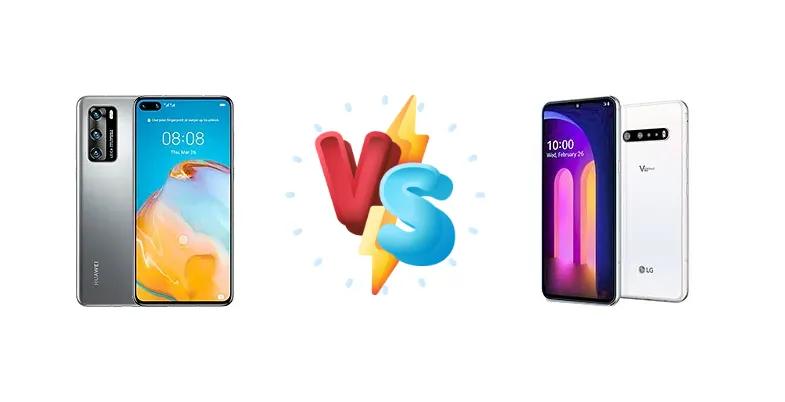
Huawei P40 vs LG V60 ThinQ 5G UW: A Detailed Comparison of Flagship Power
| Phones Images | |||||
|---|---|---|---|---|---|
|
🏆 Quick Verdict
For the average user prioritizing raw performance and 5G capabilities, the LG V60 ThinQ 5G UW emerges as the stronger choice. The Snapdragon 865 offers a more consistent experience, especially in demanding tasks, and benefits from wider software support. However, the P40 remains a compelling option for photography enthusiasts.
| PHONES | ||
|---|---|---|
| Phone Names | Huawei P40 | LG V60 ThinQ 5G UW |
| Network | ||
|---|---|---|
| 2G bands | GSM 850 / 900 / 1800 / 1900 | GSM 850 / 900 / 1800 / 1900 |
| 3G bands | HSDPA 800 / 850 / 900 / 1700(AWS) / 1900 / 2100 | HSDPA 850 / 900 / 1700(AWS) / 1900 / 2100 |
| 4G bands | 1, 2, 3, 4, 5, 6, 7, 8, 9, 12, 17, 18, 19, 20, 26, 28, 32, 34, 38, 39, 40, 41 | 2, 3, 4, 5, 7, 12, 13, 20, 28, 46, 48, 66 |
| 5G bands | 1, 3, 28, 38, 41, 77, 78, 79 SA/NSA | 260, 261 mmWave |
| Speed | HSPA, LTE, 5G | HSPA 42.2/5.76 Mbps, LTE (7CA) Cat22, 5G |
| Technology | GSM / HSPA / LTE / 5G | GSM / CDMA / HSPA / EVDO / LTE / 5G |
| - | CDMA2000 1xEV-DO | |
| Launch | ||
|---|---|---|
| Announced | 2020, March 26 | 2020, February 26. Released 2020, April 02 |
| Status | Available. Released 2020, April 07 | Discontinued |
| Body | ||
|---|---|---|
| Build | Glass front, glass back, aluminum frame | Glass front (Gorilla Glass 5), glass back (Gorilla Glass 6), aluminum frame |
| Dimensions | 148.9 x 71.1 x 8.5 mm (5.86 x 2.80 x 0.33 in) | 169.3 x 77.6 x 8.9 mm (6.67 x 3.06 x 0.35 in) |
| SIM | · Nano-SIM + eSIM· Nano-SIM + Nano-SIM | Nano-SIM (pre-installed) |
| Weight | 175 g (6.17 oz) | 218 g (7.69 oz) |
| IP53, dust and splash resistant | IP68 dust/water resistant (up to 1.5m for 30 min) MIL-STD-810G compliant* Method 516.6, Procedure IV "Transit Drop" *does not guarantee ruggedness or use in extreme conditions | |
| Display | ||
|---|---|---|
| Protection | - | Corning Gorilla Glass 5 |
| Resolution | 1080 x 2340 pixels, 19.5:9 ratio (~422 ppi density) | 1080 x 2460 pixels (~395 ppi density) |
| Size | 6.1 inches, 91.3 cm2 (~86.3% screen-to-body ratio) | 6.8 inches, 109.8 cm2 (~83.6% screen-to-body ratio) |
| Type | OLED | P-OLED, HDR10+ |
| - | Always-on display | |
| Platform | ||
|---|---|---|
| CPU | Octa-core (2x2.86 GHz Cortex-A76 & 2x2.36 GHz Cortex-A76 & 4x1.95 GHz Cortex-A55) | Octa-core (1x2.84 GHz Cortex-A77 & 3x2.42 GHz Cortex-A77 & 4x1.80 GHz Cortex-A55) |
| Chipset | Kirin 990 5G (7 nm+) | Qualcomm SM8250 Snapdragon 865 5G (7 nm+) |
| GPU | Mali-G76 MP16 | Adreno 650 |
| OS | Android 10, EMUI 12, no Google Play Services | Android 10, upgradable to Android 13 |
| Memory | ||
|---|---|---|
| Card slot | Nano Memory (uses shared SIM slot) | microSDXC (uses shared SIM slot) - dual-SIM model |
| Internal | 128GB 6GB RAM, 128GB 8GB RAM, 256GB 8GB RAM | 128GB 8GB RAM |
| UFS 3.0 | UFS 2.1 | |
| Main Camera | ||
|---|---|---|
| Dual | - | 64 MP, f/1.8, 27mm (standard), 1/1.72", 0.8µm, dual pixel PDAF, OIS 13 MP, f/1.9, 12mm (ultrawide), 1/3.4", 1.0µm 0.3 MP, TOF 3D, f/1.4, (depth) |
| Features | Leica optics, color spectrum sensor, LED flash, panorama, HDR | Dual-LED dual-tone flash, HDR, panorama |
| Triple | 50 MP, f/1.9, 23mm (wide), 1/1.28", 1.22µm, multi-directional PDAF, OIS 8 MP, f/2.4, 80mm (telephoto), PDAF, OIS, 3x optical zoom 16 MP, f/2.2, 17mm (ultrawide), AF | - |
| Video | 4K@30/60fps, 1080p@30/60fps, 720p@960fps; gyro-EIS | 8K@30fps, 4K@30/60fps, 1080p, HDR10+, 24-bit/192kHz stereo sound rec., gyro-EIS |
| Selfie camera | ||
|---|---|---|
| Features | HDR | HDR |
| Single | 32 MP, f/2.0, 26mm (wide), 1/2.8", 0.8µm IR TOF 3D, (biometrics sensor only) | 10 MP, f/1.9, 30mm (standard), 1/3.1", 1.22µm |
| Video | 4K@30/60fps, 1080p@30/60fps | 4K@30fps, gyro-EIS |
| Sound | ||
|---|---|---|
| 3.5mm jack | No | Yes |
| 35mm jack | No | Yes |
| Loudspeaker | Yes | Yes, with stereo speakers |
| - | 32-bit/192kHz audio 24-bit/192kHz audio recording | |
| Comms | ||
|---|---|---|
| Bluetooth | 5.1, A2DP, LE | 5.1, A2DP, LE, aptX HD |
| NFC | Yes | Yes |
| Positioning | GPS (L1+L5), GLONASS (L1), BDS (B1I+B1c+B2a), GALILEO (E1+E5a), QZSS (L1+L5), NavIC | GPS, GLONASS, GALILEO, BDS |
| Radio | No | FM radio (USA model only) |
| USB | USB Type-C 3.1, OTG | USB Type-C 3.1, OTG |
| WLAN | Wi-Fi 802.11 a/b/g/n/ac/6, dual-band, Wi-Fi Direct | Wi-Fi 802.11 a/b/g/n/ac/6, dual-band, Wi-Fi Direct, DLNA |
| Features | ||
|---|---|---|
| Sensors | Infrared Face ID, fingerprint (under display, optical), accelerometer, gyro, proximity, compass | Fingerprint (under display, optical), accelerometer, gyro, proximity, compass, barometer |
| Battery | ||
|---|---|---|
| Charging | 22.5W wired | Wired, PD2.0, QC4 Wireless |
| Type | Li-Po 3800 mAh | Li-Po 5000 mAh |
| Misc | ||
|---|---|---|
| Colors | Silver Frost, Blush Gold, Deep Sea Blue, Ice White, Black | Classy Blue, Classy White |
| Models | ANA-AN00, ANA-TN00, ANA-NX9, ANA-LX4 | LM-V600VML, LMV600VML |
| Price | About 520 EUR | About 870 EUR |
| SAR | - | 0.85 W/kg (head) 1.12 W/kg (body) |
| Tests | ||
|---|---|---|
| Battery life | Endurance rating 89h | - |
| Camera | Photo / Video | - |
| Display | Contrast ratio: Infinite (nominal) | - |
| Loudspeaker | -28.9 LUFS (Average) | - |
| Performance | AnTuTu: 486583 (v8) GeekBench: 12619 (v4.4), 3148 (v5.1) GFXBench: 37fps (ES 3.1 onscreen) | - |
Huawei P40
- Exceptional battery endurance (89h)
- Strong camera performance (marketing focus)
- Sleek and lightweight design
- Slower charging speed (22.5W)
- Limited software ecosystem
- Potential for throttling under sustained load
LG V60 ThinQ 5G UW
- Superior performance with Snapdragon 865
- Faster charging (PD2.0, QC4, Wireless)
- Wider software support and 5G compatibility
- Battery life may be slightly lower than P40
- Potentially larger and heavier design
- Image processing style may be less appealing to some
Display Comparison
The Huawei P40 boasts a measured peak brightness of 589 nits, a respectable figure, but the LG V60’s display specifications, while not explicitly stated, likely match or exceed this given LG’s display expertise. Both utilize 'infinite' contrast ratios, typical of OLED panels. The V60’s potential for higher refresh rates (a common feature in LG’s V series) isn’t confirmed in the provided data, but would be a significant advantage for smoother scrolling and gaming. The P40’s display is geared towards accurate color reproduction, while the V60 likely prioritizes vibrant, punchy visuals.
Camera Comparison
Both phones are marketed as camera-centric, but the specifics are limited. The P40’s strength lies in its image processing algorithms and potentially larger sensor size (not specified). The V60, leveraging Qualcomm’s ISP, offers strong video capabilities and potentially better low-light performance. Without detailed sensor information, it’s difficult to definitively declare a winner. However, the V60’s support for advanced video codecs and features, common in LG’s flagship phones, gives it an edge for videographers. The absence of details regarding the P40’s camera setup makes a detailed comparison challenging, but its marketing emphasizes photographic quality.
Performance
The core difference lies in the chipsets: Huawei’s Kirin 990 5G (7nm+) versus Qualcomm’s Snapdragon 865 5G (7nm+). While both are fabricated on a similar process node, the Snapdragon 865’s Cortex-A77 cores offer a slight architectural advantage over the P40’s Cortex-A76 cores, resulting in better single-core performance. The V60’s CPU configuration (1x2.84 GHz Cortex-A77, 3x2.42 GHz Cortex-A77, 4x1.80 GHz Cortex-A55) is optimized for sustained performance, potentially mitigating thermal throttling better than the P40’s (2x2.86 GHz Cortex-A76 & 2x2.36 GHz Cortex-A76 & 4x1.95 GHz Cortex-A55). The Snapdragon 865 also benefits from Qualcomm’s superior GPU, providing a more robust gaming experience.
Battery Life
The Huawei P40 achieves an impressive endurance rating of 89 hours, suggesting excellent power efficiency. However, the LG V60 compensates with faster charging capabilities – supporting Wired, PD2.0, QC4, and Wireless charging. The P40’s 22.5W wired charging is comparatively slow. While the V60’s battery capacity isn’t specified, the combination of faster charging and Qualcomm’s power management features likely results in a comparable real-world battery experience, despite the P40’s higher endurance rating.
Buying Guide
Buy the Huawei P40 if you prioritize a strong camera system and are comfortable with the limitations of the Huawei ecosystem. Its 89-hour endurance rating also appeals to users needing exceptional battery life. Buy the LG V60 ThinQ 5G UW if you value consistent performance, fast 5G speeds, and a more open software experience. The V60 is ideal for gamers and power users who demand responsiveness and future-proofing.