
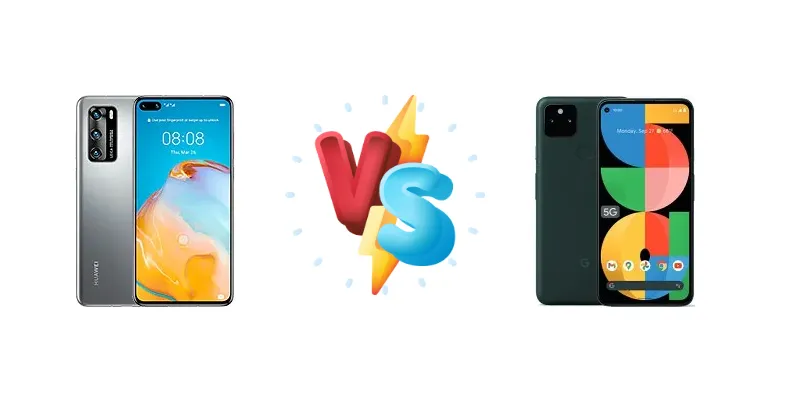
Huawei P40 vs. Google Pixel 5a 5G: A Detailed Comparison of Flagship Features and Mid-Range Value
| Phones Images | |||||
|---|---|---|---|---|---|
|
🏆 Quick Verdict
For the average user prioritizing battery life and consistent software support, the Google Pixel 5a 5G is the better choice. Its 122-hour endurance rating significantly surpasses the P40’s 89 hours, and Google’s software updates provide long-term security and feature enhancements. However, the P40’s Kirin 990 5G offers a performance edge for demanding tasks.
| PHONES | ||
|---|---|---|
| Phone Names | Huawei P40 | Google Pixel 5a 5G |
| Network | ||
|---|---|---|
| 2G bands | GSM 850 / 900 / 1800 / 1900 | GSM 850 / 900 / 1800 / 1900 |
| 3G bands | HSDPA 800 / 850 / 900 / 1700(AWS) / 1900 / 2100 | HSDPA 850 / 900 / 1700(AWS) / 1900 / 2100 |
| 4G bands | 1, 2, 3, 4, 5, 6, 7, 8, 9, 12, 17, 18, 19, 20, 26, 28, 32, 34, 38, 39, 40, 41 | 1, 2, 3, 4, 5, 7, 8, 12, 13, 14, 17, 18, 19, 20, 25, 26, 28, 29, 30, 32, 38, 39, 40, 41, 42, 46, 48, 66, 71 |
| 5G bands | 1, 3, 28, 38, 41, 77, 78, 79 SA/NSA | 1, 2, 5, 12, 25, 28, 41, 66, 71, 77, 78 SA/NSA/Sub6 |
| Speed | HSPA, LTE, 5G | HSPA, LTE, 5G |
| Technology | GSM / HSPA / LTE / 5G | GSM / HSPA / EVDO / LTE / 5G |
| - | CDMA2000 1xEV-DO | |
| Launch | ||
|---|---|---|
| Announced | 2020, March 26 | 2021, August 17 |
| Status | Available. Released 2020, April 07 | Available. Released 2021, August 26 |
| Body | ||
|---|---|---|
| Build | Glass front, glass back, aluminum frame | Glass front (Gorilla Glass 3), aluminum frame, aluminum back |
| Dimensions | 148.9 x 71.1 x 8.5 mm (5.86 x 2.80 x 0.33 in) | 156.2 x 73.2 x 8.8 mm (6.15 x 2.88 x 0.35 in) |
| SIM | · Nano-SIM + eSIM· Nano-SIM + Nano-SIM | Nano-SIM + eSIM |
| Weight | 175 g (6.17 oz) | 183 g (6.46 oz) |
| IP53, dust and splash resistant | IP67 dust/water resistant (up to 1m for 30 min) | |
| Display | ||
|---|---|---|
| Protection | - | Corning Gorilla Glass 3 |
| Resolution | 1080 x 2340 pixels, 19.5:9 ratio (~422 ppi density) | 1080 x 2400 pixels, 20:9 ratio (~415 ppi density) |
| Size | 6.1 inches, 91.3 cm2 (~86.3% screen-to-body ratio) | 6.34 inches, 97.0 cm2 (~84.9% screen-to-body ratio) |
| Type | OLED | OLED, HDR |
| - | Always-on display | |
| Platform | ||
|---|---|---|
| CPU | Octa-core (2x2.86 GHz Cortex-A76 & 2x2.36 GHz Cortex-A76 & 4x1.95 GHz Cortex-A55) | Octa-core (1x2.4 GHz Kryo 475 Prime & 1x2.2 GHz Kryo 475 Gold & 6x1.8 GHz Kryo 475 Silver) |
| Chipset | Kirin 990 5G (7 nm+) | Qualcomm SM7250 Snapdragon 765G 5G (7 nm) |
| GPU | Mali-G76 MP16 | Adreno 620 |
| OS | Android 10, EMUI 12, no Google Play Services | Android 11, upgradable to Android 14 |
| Memory | ||
|---|---|---|
| Card slot | Nano Memory (uses shared SIM slot) | No |
| Internal | 128GB 6GB RAM, 128GB 8GB RAM, 256GB 8GB RAM | 128GB 6GB RAM |
| UFS 3.0 | - | |
| Main Camera | ||
|---|---|---|
| Dual | - | 12.2 MP, f/1.7, 27mm, (wide), 1/2.55", 1.4µm, dual pixel PDAF, OIS 16 MP, f/2.2, 119˚ (ultrawide), 1.0µm |
| Features | Leica optics, color spectrum sensor, LED flash, panorama, HDR | LED flash, Pixel Shift, Auto-HDR, panorama |
| Single | - | 8 MP, f/2.0, 24mm (wide), 1.12µm |
| Triple | 50 MP, f/1.9, 23mm (wide), 1/1.28", 1.22µm, multi-directional PDAF, OIS 8 MP, f/2.4, 80mm (telephoto), PDAF, OIS, 3x optical zoom 16 MP, f/2.2, 17mm (ultrawide), AF | - |
| Video | 4K@30/60fps, 1080p@30/60fps, 720p@960fps; gyro-EIS | 4K@30/60fps, 1080p@30/60/120/240fps; gyro-EIS |
| Selfie camera | ||
|---|---|---|
| Features | HDR | HDR |
| Single | 32 MP, f/2.0, 26mm (wide), 1/2.8", 0.8µm IR TOF 3D, (biometrics sensor only) | 8 MP, f/2.0, 24mm (wide), 1.12µm |
| Video | 4K@30/60fps, 1080p@30/60fps | 1080p@30fps |
| Sound | ||
|---|---|---|
| 3.5mm jack | No | Yes |
| 35mm jack | No | Yes |
| Loudspeaker | Yes | Yes, with stereo speakers |
| Comms | ||
|---|---|---|
| Bluetooth | 5.1, A2DP, LE | 5.0, A2DP, LE, aptX HD |
| NFC | Yes | Yes |
| Positioning | GPS (L1+L5), GLONASS (L1), BDS (B1I+B1c+B2a), GALILEO (E1+E5a), QZSS (L1+L5), NavIC | GPS, GLONASS, GALILEO, QZSS, BDS |
| Radio | No | No |
| USB | USB Type-C 3.1, OTG | USB Type-C 3.1 |
| WLAN | Wi-Fi 802.11 a/b/g/n/ac/6, dual-band, Wi-Fi Direct | Wi-Fi 802.11 a/b/g/n/ac, dual-band, Wi-Fi Direct |
| Features | ||
|---|---|---|
| Sensors | Infrared Face ID, fingerprint (under display, optical), accelerometer, gyro, proximity, compass | Fingerprint (rear-mounted), accelerometer, gyro, proximity, compass, barometer |
| Battery | ||
|---|---|---|
| Charging | 22.5W wired | 18W wired, PD2.0 |
| Type | Li-Po 3800 mAh | Li-Po 4680 mAh |
| Misc | ||
|---|---|---|
| Colors | Silver Frost, Blush Gold, Deep Sea Blue, Ice White, Black | Mostly Black |
| Models | ANA-AN00, ANA-TN00, ANA-NX9, ANA-LX4 | G1F8F, G4S1M |
| Price | About 520 EUR | $ 189.00 / C$ 249.99 |
| Tests | ||
|---|---|---|
| Battery life | Endurance rating 89h | Endurance rating 122h |
| Camera | Photo / Video | - |
| Display | Contrast ratio: Infinite (nominal) | Contrast ratio: Infinite (nominal) |
| Loudspeaker | -28.9 LUFS (Average) | - |
| Performance | AnTuTu: 486583 (v8) GeekBench: 12619 (v4.4), 3148 (v5.1) GFXBench: 37fps (ES 3.1 onscreen) | AnTuTu: 291303 (v8) GeekBench: 1337 (v5.1) GFXBench: 19fps (ES 3.1 onscreen) |
Huawei P40
- More powerful processor for demanding tasks
- Faster wired charging speed
- Potentially more advanced camera features (depending on implementation)
- Significantly shorter battery life
- Limited access to Google Mobile Services
- Software update uncertainty
Google Pixel 5a 5G
- Exceptional battery life
- Clean Android experience with guaranteed updates
- Excellent camera image processing
- Less powerful processor compared to the P40
- Slower wired charging speed
- Display not as bright as the P40
Display Comparison
The Pixel 5a 5G boasts a brighter display, reaching 861 nits compared to the P40’s 589 nits, making it significantly more usable outdoors under direct sunlight. Both displays share an 'Infinite' (nominal) contrast ratio, suggesting deep blacks typical of OLED panels. While neither specifies refresh rate, the P40’s display technology is less discussed, implying it lacks the advanced features like LTPO found in newer flagships, potentially impacting power efficiency. The Pixel 5a 5G’s higher brightness is a clear advantage for everyday visibility.
Camera Comparison
Both devices are marketed for their camera capabilities, but approach image processing differently. The P40’s camera system, while details are limited to 'Photo / Video', likely leverages Huawei’s extensive computational photography expertise. The Pixel 5a 5G, renowned for its software-driven image processing, excels in dynamic range and detail, particularly in challenging lighting conditions. Without specific sensor size or aperture information, it’s difficult to definitively declare a winner. However, Google’s consistent image quality and user-friendly camera interface give it an edge for point-and-shoot photography. The absence of detailed camera specs for the P40 makes a direct comparison challenging.
Performance
The Huawei P40’s Kirin 990 5G (7nm+) chipset, with its octa-core CPU configuration (2x2.86 GHz Cortex-A76, 2x2.36 GHz Cortex-A76, 4x1.95 GHz Cortex-A55), offers a theoretical performance advantage over the Pixel 5a 5G’s Qualcomm Snapdragon 765G (7nm). The Kirin 990 5G’s higher clock speeds on its prime cores translate to faster single-core performance, beneficial for responsive app launching. However, the Snapdragon 765G’s architecture, with its Kryo cores (1x2.4 GHz Prime, 1x2.2 GHz Gold, 6x1.8 GHz Silver), is optimized for efficiency, potentially leading to better sustained performance under load. The P40’s chipset benefits from the more advanced 7nm+ node, but thermal management is a key factor not specified in the data.
Battery Life
The Google Pixel 5a 5G dominates in battery endurance with a rating of 122 hours, significantly exceeding the Huawei P40’s 89 hours. While the P40’s 22.5W wired charging is faster than the Pixel 5a 5G’s 18W charging with PD2.0, the Pixel’s superior battery life minimizes the need for frequent top-ups. The Snapdragon 765G’s efficiency contributes to the Pixel 5a 5G’s longer runtime, offsetting the P40’s faster charging speed. The Pixel 5a 5G’s battery life is a major selling point for users prioritizing all-day usage.
Buying Guide
Buy the Huawei P40 if you prioritize raw processing power for tasks like video editing or gaming, and are comfortable with the potential limitations of the Huawei ecosystem due to the lack of full Google Mobile Services. Buy the Google Pixel 5a 5G if you value exceptional battery life, a clean Android experience with guaranteed updates, and Google’s renowned camera processing, all at a more affordable price.