
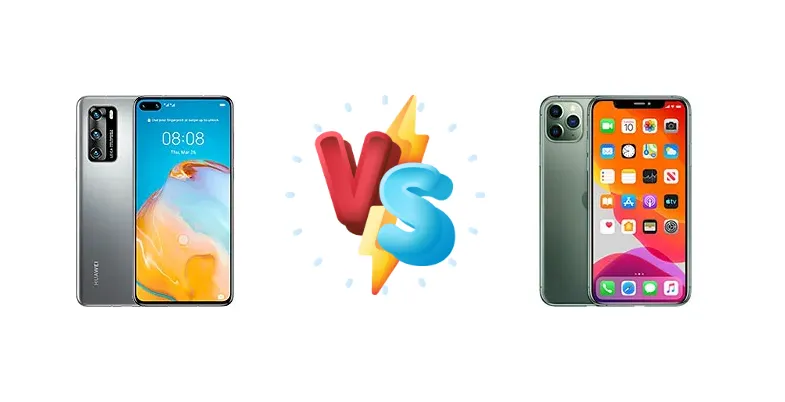
Huawei P40 vs. iPhone 11 Pro Max: Which 2019 Flagship Still Holds Up?
| Phones Images | |||||
|---|---|---|---|---|---|
|
🏆 Quick Verdict
For the average user prioritizing longevity and a refined software experience, the iPhone 11 Pro Max emerges as the stronger choice. Its superior battery endurance (102h vs 89h) and continued software support outweigh the P40’s strengths, despite the P40's competitive display brightness.
| PHONES | ||
|---|---|---|
| Phone Names | Huawei P40 | Apple iPhone 11 Pro Max |
| Network | ||
|---|---|---|
| 2G bands | GSM 850 / 900 / 1800 / 1900 | GSM 850 / 900 / 1800 / 1900 |
| 3G bands | HSDPA 800 / 850 / 900 / 1700(AWS) / 1900 / 2100 | HSDPA 850 / 900 / 1700(AWS) / 1900 / 2100 |
| 4G bands | 1, 2, 3, 4, 5, 6, 7, 8, 9, 12, 17, 18, 19, 20, 26, 28, 32, 34, 38, 39, 40, 41 | 1, 2, 3, 4, 5, 7, 8, 11, 12, 13, 17, 18, 19, 20, 21, 25, 26, 28, 29, 30, 32, 34, 38, 39, 40, 41, 42, 46, 48, 66 - A2218 |
| 5G bands | 1, 3, 28, 38, 41, 77, 78, 79 SA/NSA | - |
| Speed | HSPA, LTE, 5G | HSPA, LTE 1.6 Gbps DL, EV-DO Rev.A 3.1 Mbps |
| Technology | GSM / HSPA / LTE / 5G | GSM / CDMA / HSPA / EVDO / LTE |
| - | 1, 2, 3, 4, 5, 7, 8, 12, 13, 14, 17, 18, 19, 20, 25, 26, 29, 30, 34, 38, 39, 40, 41, 42, 46, 48, 66, 71 - A2161, A2220 | |
| Launch | ||
|---|---|---|
| Announced | 2020, March 26 | 2019, September 10 |
| Status | Available. Released 2020, April 07 | Available. Released 2019, September 20 |
| Body | ||
|---|---|---|
| Build | Glass front, glass back, aluminum frame | Glass front (Corning-made glass), glass back (Corning-made glass), stainless steel frame |
| Dimensions | 148.9 x 71.1 x 8.5 mm (5.86 x 2.80 x 0.33 in) | 158 x 77.8 x 8.1 mm (6.22 x 3.06 x 0.32 in) |
| SIM | · Nano-SIM + eSIM· Nano-SIM + Nano-SIM | · Nano-SIM + eSIM· Nano-SIM + Nano-SIM (China) |
| Weight | 175 g (6.17 oz) | 226 g (7.97 oz) |
| IP53, dust and splash resistant | IP68 dust/water resistant (up to 4m for 30 min) Apple Pay (Visa, MasterCard, AMEX certified) | |
| Display | ||
|---|---|---|
| Protection | - | Scratch-resistant glass |
| Resolution | 1080 x 2340 pixels, 19.5:9 ratio (~422 ppi density) | 1242 x 2688 pixels, 19.5:9 ratio (~458 ppi density) |
| Size | 6.1 inches, 91.3 cm2 (~86.3% screen-to-body ratio) | 6.5 inches, 102.9 cm2 (~83.7% screen-to-body ratio) |
| Type | OLED | Super Retina XDR OLED, HDR10, Dolby Vision, 800 nits (HBM), 1200 nits (peak) |
| Platform | ||
|---|---|---|
| CPU | Octa-core (2x2.86 GHz Cortex-A76 & 2x2.36 GHz Cortex-A76 & 4x1.95 GHz Cortex-A55) | Hexa-core (2x2.65 GHz Lightning + 4x1.8 GHz Thunder) |
| Chipset | Kirin 990 5G (7 nm+) | Apple A13 Bionic (7 nm+) |
| GPU | Mali-G76 MP16 | Apple GPU (4-core graphics) |
| OS | Android 10, EMUI 12, no Google Play Services | iOS 13, upgradable to iOS 26.1 |
| Memory | ||
|---|---|---|
| Card slot | Nano Memory (uses shared SIM slot) | No |
| Internal | 128GB 6GB RAM, 128GB 8GB RAM, 256GB 8GB RAM | 64GB 4GB RAM, 256GB 4GB RAM, 512GB 4GB RAM |
| UFS 3.0 | NVMe | |
| Main Camera | ||
|---|---|---|
| Features | Leica optics, color spectrum sensor, LED flash, panorama, HDR | Dual-LED dual-tone flash, HDR (photo/panorama) |
| Single | - | 13 MP, f/2.2, PDAF |
| Triple | 50 MP, f/1.9, 23mm (wide), 1/1.28", 1.22µm, multi-directional PDAF, OIS 8 MP, f/2.4, 80mm (telephoto), PDAF, OIS, 3x optical zoom 16 MP, f/2.2, 17mm (ultrawide), AF | 12 MP, f/1.8, 26mm (wide), 1/2.55", 1.4µm, dual pixel PDAF, OIS 12 MP, f/2.0, 52mm (telephoto), 1/3.4", 1.0µm, PDAF, OIS, 2x optical zoom 12 MP, f/2.4, 120˚, 13mm (ultrawide), 1/3.6" |
| Video | 4K@30/60fps, 1080p@30/60fps, 720p@960fps; gyro-EIS | 4K@24/25/30/60fps, 1080p@25/30/60/120/240fps, HDR, stereo sound rec. |
| Selfie camera | ||
|---|---|---|
| Features | HDR | HDR |
| Single | 32 MP, f/2.0, 26mm (wide), 1/2.8", 0.8µm IR TOF 3D, (biometrics sensor only) | 12 MP, f/2.2, 23mm (wide), 1/3.6", 1.0µm SL 3D, (depth/biometrics sensor) |
| Video | 4K@30/60fps, 1080p@30/60fps | 4K@24/25/30/60fps, 1080p@25/30/60/120fps, gyro-EIS |
| Sound | ||
|---|---|---|
| 3.5mm jack | No | No |
| 35mm jack | No | No |
| Loudspeaker | Yes | Yes, with stereo speakers |
| Comms | ||
|---|---|---|
| Bluetooth | 5.1, A2DP, LE | 5.0, A2DP, LE |
| NFC | Yes | Yes |
| Positioning | GPS (L1+L5), GLONASS (L1), BDS (B1I+B1c+B2a), GALILEO (E1+E5a), QZSS (L1+L5), NavIC | GPS, GLONASS, GALILEO, QZSS |
| Radio | No | No |
| USB | USB Type-C 3.1, OTG | Lightning, USB 2.0 |
| WLAN | Wi-Fi 802.11 a/b/g/n/ac/6, dual-band, Wi-Fi Direct | Wi-Fi 802.11 a/b/g/n/ac/6, dual-band, hotspot |
| Features | ||
|---|---|---|
| Sensors | Infrared Face ID, fingerprint (under display, optical), accelerometer, gyro, proximity, compass | Face ID, accelerometer, gyro, proximity, compass, barometer |
| - | Ultra Wideband (UWB) support | |
| Battery | ||
|---|---|---|
| Charging | 22.5W wired | Wired, PD2.0, 50% in 30 min Wireless (Qi) |
| Type | Li-Po 3800 mAh | Li-Ion 3969 mAh, non-removable (15.04 Wh) |
| Misc | ||
|---|---|---|
| Colors | Silver Frost, Blush Gold, Deep Sea Blue, Ice White, Black | Matte Space Gray, Matte Silver, Matte Gold, Matte Midnight Green |
| Models | ANA-AN00, ANA-TN00, ANA-NX9, ANA-LX4 | A2218, A2161, A2220, iPhone12,5 |
| Price | About 520 EUR | $ 233.00 / C$ 369.75 / £ 226.95 / € 249.00 |
| SAR | - | 1.16 W/kg (head) 1.17 W/kg (body) |
| SAR EU | - | 0.95 W/kg (head) 0.99 W/kg (body) |
| Pricing | ||
|---|---|---|
| 256GB 4GB RAM | - | $ 874.46 |
| 512GB 4GB RAM | - | $ 1,004.31 |
| 64GB 4GB RAM | - | $ 435.00 |
| RENEWED | - | $ 485.00 |
| Tests | ||
|---|---|---|
| Audio quality | - | Noise -94.3dB / Crosstalk -81.5dB |
| Battery life | Endurance rating 89h | Endurance rating 102h |
| Camera | Photo / Video | Photo / Video |
| Display | Contrast ratio: Infinite (nominal) | Contrast ratio: Infinite (nominal) |
| Loudspeaker | -28.9 LUFS (Average) | -25.6 LUFS (Very good) |
| Performance | AnTuTu: 486583 (v8) GeekBench: 12619 (v4.4), 3148 (v5.1) GFXBench: 37fps (ES 3.1 onscreen) | AnTuTu: 459713 (v7), 536883 (v8) GeekBench: 13870 (v4.4), 3503 (v5.1) GFXBench: 57fps (ES 3.1 onscreen) |
Huawei P40
- High peak display brightness for HDR content.
- 5G connectivity for faster data speeds.
- Potentially lower price point in 2024.
- Shorter battery life compared to the iPhone.
- EMUI software may not appeal to all users.
- Long-term software support is uncertain.
Apple iPhone 11 Pro Max
- Exceptional battery life and efficiency.
- Long-term software support from Apple.
- Smooth and refined iOS user experience.
- Lower peak display brightness than the P40.
- Slower wired charging than some modern phones.
- Higher initial purchase price (when new).
Display Comparison
The iPhone 11 Pro Max boasts a brighter display at 820 nits compared to the P40’s 589 nits, making it more legible outdoors under direct sunlight. Both displays share an infinite (nominal) contrast ratio, suggesting excellent black levels. While neither utilizes the latest LTPO technology for variable refresh rates, the iPhone’s color accuracy is generally considered more consistent, benefiting content creators. The P40’s higher peak brightness is a benefit for HDR content, but the iPhone’s overall viewing experience is more balanced.
Camera Comparison
Both phones excel in photography and videography, but approach it differently. The iPhone 11 Pro Max prioritizes natural-looking images with accurate color reproduction, while the Huawei P40 tends towards more saturated and contrast-boosted results. While both offer excellent dynamic range, the iPhone’s Smart HDR processing is more subtle. The P40’s camera system likely features a more versatile zoom range, but without specific sensor size details, it’s difficult to definitively declare a winner. The iPhone’s video recording capabilities are renowned for their stability and quality.
Performance
The Apple A13 Bionic (7nm+) consistently outperforms the Huawei Kirin 990 5G (7nm+) in CPU and GPU benchmarks. The A13’s hexa-core architecture (2x2.65 GHz Lightning + 4x1.8 GHz Thunder) is optimized for iOS, delivering smoother multitasking and faster app launch times. While the Kirin 990’s octa-core configuration (2x2.86 GHz Cortex-A76 & 2x2.36 GHz Cortex-A76 & 4x1.95 GHz Cortex-A55) is powerful, it struggles to match the A13’s efficiency and sustained performance. The iPhone 11 Pro Max’s 4GB of RAM is sufficient for iOS, while the P40’s RAM configuration isn’t specified, but the A13’s software optimization mitigates any potential RAM disadvantage.
Battery Life
The iPhone 11 Pro Max’s endurance rating of 102 hours significantly surpasses the Huawei P40’s 89 hours. This translates to a noticeable difference in real-world usage, with the iPhone lasting comfortably through a full day of heavy use. The P40’s 22.5W wired charging is slower than the iPhone 11 Pro Max’s 50% charge in 30 minutes via PD2.0, and the iPhone also benefits from Qi wireless charging. The A13 Bionic’s power efficiency contributes significantly to the iPhone’s superior battery performance.
Buying Guide
Buy the Huawei P40 if you prioritize a vibrant display with high peak brightness (589 nits) and are comfortable with the EMUI software ecosystem. It’s a good option for users seeking a capable camera and 5G connectivity at a potentially lower price point. Buy the Apple iPhone 11 Pro Max if you value long-term software support, a consistently smooth user experience, and exceptional battery life. It’s ideal for users deeply embedded in the Apple ecosystem and those who demand reliable performance over time.