
Huawei P40 Pro vs Samsung Galaxy S21 Ultra 5G: Which Flagship Reigns Supreme?
| Phones Images | |||||
|---|---|---|---|---|---|
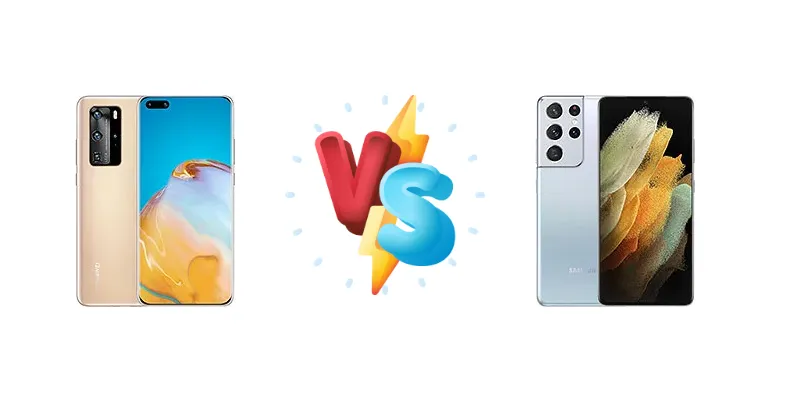
|
🏆 Quick Verdict
For the average user prioritizing longevity and a more refined software experience, the Samsung Galaxy S21 Ultra 5G is the superior choice. Its significantly longer battery life (114h vs 94h) and brighter display (1023 nits) outweigh the P40 Pro’s lower price point, especially considering the ongoing software limitations on Huawei devices.
| PHONES | ||
|---|---|---|
| Phone Names | Huawei P40 Pro | Samsung Galaxy S21 Ultra 5G |
| Network | ||
|---|---|---|
| 2G bands | GSM 850 / 900 / 1800 / 1900 | GSM 850 / 900 / 1800 / 1900 |
| 3G bands | HSDPA 800 / 850 / 900 / 1700(AWS) / 1900 / 2100 | HSDPA 850 / 900 / 1700(AWS) / 1900 / 2100 |
| 4G bands | 1, 2, 3, 4, 5, 6, 7, 8, 9, 12, 17, 18, 19, 20, 26, 28, 32, 34, 38, 39, 40, 41 - ELS-NX9 | 1, 2, 3, 4, 5, 7, 8, 12, 13, 14, 18, 19, 20, 25, 26, 28, 30, 38, 39, 40, 41, 46, 48, 66, 71 - SM-G998U1 |
| 5G bands | 1, 3, 28, 38, 41, 77, 78, 79 SA/NSA - ELS-NX9 | 2, 5, 25, 41, 66, 71, 260, 261 SA/NSA/Sub6/mmWave - SM-G998U1 |
| Speed | HSPA, LTE, 5G | HSPA 42.2/5.76 Mbps, LTE (7CA) Cat20 2000/200 Mbps, 5G (5+ Gbps DL) |
| Technology | GSM / HSPA / LTE / 5G | GSM / CDMA / HSPA / EVDO / LTE / 5G |
| - | 1, 3, 5, 7, 8, 20, 28, 38, 40, 41, 66, 77, 78 SA/NSA/Sub6 - SM-G998B | |
| Launch | ||
|---|---|---|
| Announced | 2020, March 26 | 2021, January 14 |
| Status | Available. Released 2020, April 07 | Available. Released 2021, January 29 |
| Body | ||
|---|---|---|
| Build | Glass front, glass back, aluminum frame | Glass front (Gorilla Glass Victus), glass back (Gorilla Glass Victus), aluminum frame |
| Dimensions | 158.2 x 72.6 x 9 mm (6.23 x 2.86 x 0.35 in) | 165.1 x 75.6 x 8.9 mm (6.5 x 2.98 x 0.35 in) |
| SIM | · Nano-SIM + eSIM· Nano-SIM + Nano-SIM | · Nano-SIM + eSIM· Nano-SIM + Nano-SIM + eSIM (max 2 at a time) |
| Weight | 209 g (7.37 oz) | 227 g (Sub6), 229 g (mmWave) (8.01 oz) |
| - | IP68 dust/water resistant (up to 1.5m for 30 min) Stylus support | |
| Display | ||
|---|---|---|
| Protection | - | Corning Gorilla Glass Victus |
| Resolution | 1200 x 2640 pixels (~441 ppi density) | 1440 x 3200 pixels, 20:9 ratio (~515 ppi density) |
| Size | 6.58 inches, 105.2 cm2 (~91.6% screen-to-body ratio) | 6.8 inches, 112.1 cm2 (~89.8% screen-to-body ratio) |
| Type | OLED, 90Hz, HDR10 | Dynamic AMOLED 2X, 120Hz, HDR10+, 1500 nits (peak) |
| - | Always-on display | |
| Platform | ||
|---|---|---|
| CPU | Octa-core (2x2.86 GHz Cortex-A76 & 2x2.36 GHz Cortex-A76 & 4x1.95 GHz Cortex-A55) | Octa-core (1x2.9 GHz Cortex-X1 & 3x2.80 GHz Cortex-A78 & 4x2.2 GHz Cortex-A55) - InternationalOcta-core (1x2.84 GHz Cortex-X1 & 3x2.42 GHz Cortex-A78 & 4x1.80 GHz Cortex-A55) - USA/China |
| Chipset | Kirin 990 5G (7 nm+) | Exynos 2100 (5 nm) - InternationalQualcomm SM8350 Snapdragon 888 5G (5 nm) - USA/China |
| GPU | Mali-G76 MP16 | Mali-G78 MP14 - InternationalAdreno 660 - USA/China |
| OS | Android 10, EMUI 12, no Google Play Services | Android 11, up to 4 major Android upgrades, One UI 6.1 |
| Memory | ||
|---|---|---|
| Card slot | Nano Memory (uses shared SIM slot) | No |
| Internal | 128GB 8GB RAM, 256GB 8GB RAM, 512GB 8GB RAM | 128GB 8GB RAM, 128GB 12GB RAM, 256GB 12GB RAM, 256GB 16GB RAM, 512GB 12GB RAM, 512GB 16GB RAM |
| - | UFS 3.1 | |
| Main Camera | ||
|---|---|---|
| Features | Leica optics, color spectrum sensor, LED flash, panorama, HDR | Laser AF, LED flash, auto-HDR, panorama |
| Quad | - | 108 MP, f/1.8, 24mm (wide), 1/1.33", 0.8µm, PDAF, OIS 10 MP, f/2.4, 72mm (telephoto), 1/3.24", 1.22µm, dual pixel PDAF, OIS, 3x optical zoom 10 MP, f/4.9, 240mm (periscope telephoto), 1/3.24", 1.22µm, dual pixel PDAF, OIS, 10x optical zoom 12 MP, f/2.2, 13mm (ultrawide), 1/2.55", 1.4µm, dual pixel PDAF, Super Steady video |
| Triple | 50 MP, f/1.9, 23mm (wide), 1/1.28", 1.22µm, dual pixel PDAF, OIS 12 MP, f/3.4, 125mm (periscope telephoto), PDAF, OIS, 5x optical zoom 40 MP, f/1.8, 18mm (ultrawide), 1/1.54", PDAF TOF 3D, (depth) | - |
| Video | 4K@30/60fps, 1080p@30/60fps, 720@7680fps, 1080p@960fps, HDR; gyro-EIS | 8K@24fps, 4K@30/60fps, 1080p@30/60/120/240fps, HDR10+, stereo sound rec., gyro-EIS |
| Selfie camera | ||
|---|---|---|
| Features | HDR | HDR |
| Single | 32 MP, f/2.2, 26mm (wide), 1/2.8", 0.8µm, AF IR TOF 3D, (depth/biometrics sensor) | 40 MP, f/2.2, 26mm (wide), 1/2.8", 0.7µm, PDAF |
| Video | 4K@30/60fps, 1080p@30/60fps | 4K@30/60fps, 1080p@30fps |
| Sound | ||
|---|---|---|
| 3.5mm jack | No | No |
| 35mm jack | No | No |
| Loudspeaker | Yes | Yes, with stereo speakers |
| - | 32-bit/384kHz audio Tuned by AKG | |
| Comms | ||
|---|---|---|
| Bluetooth | 5.1, A2DP, LE | 5.2, A2DP, LE |
| Infrared port | Yes | - |
| NFC | Yes | Yes |
| Positioning | GPS (L1+L5), GLONASS (L1), BDS (B1I+B1c+B2a), GALILEO (E1+E5a), QZSS (L1+L5), NavIC | GPS, GLONASS, BDS, GALILEO |
| Radio | No | FM radio (Snapdragon model only; market/operator dependent) |
| USB | USB Type-C 3.1, OTG | USB Type-C 3.2, OTG |
| WLAN | Wi-Fi 802.11 a/b/g/n/ac/6, dual-band, Wi-Fi Direct | Wi-Fi 802.11 a/b/g/n/ac/6e, dual-band, Wi-Fi Direct |
| Features | ||
|---|---|---|
| Sensors | Infrared Face ID, fingerprint (under display, optical), accelerometer, gyro, proximity, compass | Fingerprint (under display, ultrasonic), accelerometer, gyro, proximity, compass, barometer |
| - | Samsung DeX, Samsung Wireless DeX (desktop experience support) Bixby natural language commands and dictation Samsung Pay (Visa, MasterCard certified) Ultra Wideband (UWB) support | |
| Battery | ||
|---|---|---|
| Charging | 40W wired 27W wireless 27W reverse wireless | 25W wired, PD3.0 15W wireless (Qi) 4.5W reverse wireless |
| Type | Li-Po 4200 mAh | Li-Ion 5000 mAh |
| Misc | ||
|---|---|---|
| Colors | Silver Frost, Blush Gold, Deep Sea Blue, Ice White, Black | Phantom Black, Phantom Silver, Phantom Titanium, Phantom Navy, Phantom Brown, Navy |
| Models | ELS-NX9, ELS-N04, ELS-AN00, ELS-TN00 | SM-G998B, SM-G998B/DS, SM-G998U, SM-G998U1, SM-G998W, SM-G998N, SM-G9980 |
| Price | € 360.00 / £ 335.00 | $ 240.01 / C$ 353.20 / £ 202.99 / € 264.99 |
| SAR | - | 0.77 W/kg (head) 1.02 W/kg (body) |
| SAR EU | - | 0.71 W/kg (head) 1.58 W/kg (body) |
| Pricing | ||
|---|---|---|
| 128GB 12GB RAM | - | $ 384.99 |
| 256GB 12GB RAM | - | $ 998.00 |
| 256GB 8GB RAM | $ 714.88 | - |
| 512GB 12GB RAM | - | $ 1,179.99 |
| RENEWED | $ 680.00 | $ 459.00 |
| Tests | ||
|---|---|---|
| Battery life | Endurance rating 94h | Endurance rating 114h |
| Camera | Photo / Video | Photo / Video |
| Display | Contrast ratio: Infinite (nominal) | Contrast ratio: Infinite (nominal) |
| Loudspeaker | -27.5 LUFS (Good) | -25.5 LUFS (Very good) |
| Performance | AnTuTu: 496356 (v8) GeekBench: 12848 (v4.4), 3197 (v5.1) GFXBench: 31fps (ES 3.1 onscreen) | AnTuTu: 657150 (v8) GeekBench: 3518 (v5.1) GFXBench: 33fps (ES 3.1 onscreen) |
Huawei P40 Pro
- More affordable price point
- Fast 40W wired charging
- Excellent camera performance for the price
- Older chipset (Kirin 990)
- Limited software support and ecosystem
- Shorter battery life
Samsung Galaxy S21 Ultra 5G
- Superior chipset (Exynos 2100/Snapdragon 888)
- Brighter and more vibrant display
- Longer battery life and efficient power management
- Higher price tag
- Slower wired charging (25W)
- Larger and heavier design
Display Comparison
The Samsung Galaxy S21 Ultra 5G boasts a substantial advantage in display technology, achieving a measured peak brightness of 1023 nits compared to the P40 Pro’s ‘Infinite’ (nominal) contrast ratio. While both displays offer excellent contrast, the S21 Ultra’s higher brightness translates to better visibility in direct sunlight. Both devices share an infinite contrast ratio, but the S21 Ultra’s panel likely benefits from dynamic tone mapping for a more visually engaging experience. The S21 Ultra’s larger size and higher resolution also contribute to a sharper image.
Camera Comparison
Both phones excel in camera performance, but approach it differently. While both offer photo and video capabilities, the S21 Ultra’s larger sensor size and advanced image processing algorithms provide greater detail and dynamic range. The S21 Ultra’s versatility is also enhanced by its multiple lenses, including a telephoto lens with impressive zoom capabilities. The P40 Pro’s camera is still excellent, but the S21 Ultra’s superior hardware and software processing give it an edge in challenging lighting conditions and overall image quality. The P40 Pro's 2MP time-of-flight sensor is largely overshadowed by the S21 Ultra's more robust autofocus system.
Performance
The chipset battle pits Huawei’s Kirin 990 5G (7nm+) against Samsung’s Exynos 2100 (5nm) or Qualcomm Snapdragon 888 5G (5nm), depending on the region. The Exynos 2100 and Snapdragon 888, built on a smaller 5nm process, offer superior power efficiency and performance compared to the Kirin 990. The S21 Ultra’s CPU configuration, featuring a Cortex-X1 prime core, provides a noticeable boost in single-core performance. The S21 Ultra’s 12GB of RAM (compared to the P40 Pro’s 8GB) further enhances multitasking capabilities. While the Kirin 990 is still capable, the newer chipsets in the S21 Ultra deliver a smoother, more responsive experience, particularly in demanding applications and games.
Battery Life
The Samsung Galaxy S21 Ultra 5G delivers a significantly longer endurance rating of 114 hours compared to the Huawei P40 Pro’s 94 hours. This difference is attributable to the S21 Ultra’s larger battery capacity and the more efficient 5nm chipset. While the P40 Pro offers faster wired charging at 40W, the S21 Ultra’s 25W charging, coupled with its longer battery life, provides a more practical solution for all-day use. The P40 Pro’s 27W wireless and reverse wireless charging capabilities are also impressive, but the S21 Ultra’s 15W wireless charging is sufficient for most users.
Buying Guide
Buy the Huawei P40 Pro if you need a capable flagship camera system at a significantly lower price and are comfortable with the limitations of Huawei’s ecosystem and potential software updates. Buy the Samsung Galaxy S21 Ultra 5G if you prioritize a brighter, more vibrant display, longer battery life, a more versatile chipset (Snapdragon or Exynos), and a guaranteed, feature-rich software experience with consistent updates.