
Huawei P40 Pro vs. Google Pixel 5a 5G: A Detailed Comparison
| Phones Images | |||||
|---|---|---|---|---|---|
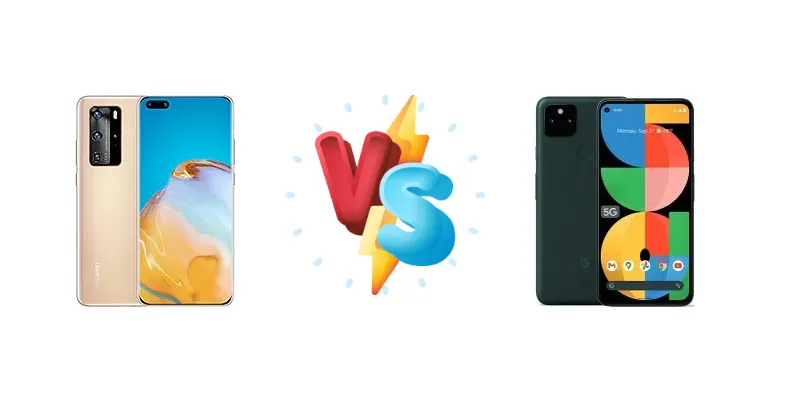
|
🏆 Quick Verdict
For the average user prioritizing longevity and a consistently reliable experience, the Google Pixel 5a 5G is the better choice. Its 122-hour endurance rating significantly outpaces the P40 Pro’s 94 hours, and Google’s software support is a major advantage. However, the P40 Pro still holds appeal for photography enthusiasts seeking a more versatile camera system.
| PHONES | ||
|---|---|---|
| Phone Names | Huawei P40 Pro | Google Pixel 5a 5G |
| Network | ||
|---|---|---|
| 2G bands | GSM 850 / 900 / 1800 / 1900 | GSM 850 / 900 / 1800 / 1900 |
| 3G bands | HSDPA 800 / 850 / 900 / 1700(AWS) / 1900 / 2100 | HSDPA 850 / 900 / 1700(AWS) / 1900 / 2100 |
| 4G bands | 1, 2, 3, 4, 5, 6, 7, 8, 9, 12, 17, 18, 19, 20, 26, 28, 32, 34, 38, 39, 40, 41 - ELS-NX9 | 1, 2, 3, 4, 5, 7, 8, 12, 13, 14, 17, 18, 19, 20, 25, 26, 28, 29, 30, 32, 38, 39, 40, 41, 42, 46, 48, 66, 71 |
| 5G bands | 1, 3, 28, 38, 41, 77, 78, 79 SA/NSA - ELS-NX9 | 1, 2, 5, 12, 25, 28, 41, 66, 71, 77, 78 SA/NSA/Sub6 |
| Speed | HSPA, LTE, 5G | HSPA, LTE, 5G |
| Technology | GSM / HSPA / LTE / 5G | GSM / HSPA / EVDO / LTE / 5G |
| - | CDMA2000 1xEV-DO | |
| Launch | ||
|---|---|---|
| Announced | 2020, March 26 | 2021, August 17 |
| Status | Available. Released 2020, April 07 | Available. Released 2021, August 26 |
| Body | ||
|---|---|---|
| Build | Glass front, glass back, aluminum frame | Glass front (Gorilla Glass 3), aluminum frame, aluminum back |
| Dimensions | 158.2 x 72.6 x 9 mm (6.23 x 2.86 x 0.35 in) | 156.2 x 73.2 x 8.8 mm (6.15 x 2.88 x 0.35 in) |
| SIM | · Nano-SIM + eSIM· Nano-SIM + Nano-SIM | Nano-SIM + eSIM |
| Weight | 209 g (7.37 oz) | 183 g (6.46 oz) |
| - | IP67 dust/water resistant (up to 1m for 30 min) | |
| Display | ||
|---|---|---|
| Protection | - | Corning Gorilla Glass 3 |
| Resolution | 1200 x 2640 pixels (~441 ppi density) | 1080 x 2400 pixels, 20:9 ratio (~415 ppi density) |
| Size | 6.58 inches, 105.2 cm2 (~91.6% screen-to-body ratio) | 6.34 inches, 97.0 cm2 (~84.9% screen-to-body ratio) |
| Type | OLED, 90Hz, HDR10 | OLED, HDR |
| - | Always-on display | |
| Platform | ||
|---|---|---|
| CPU | Octa-core (2x2.86 GHz Cortex-A76 & 2x2.36 GHz Cortex-A76 & 4x1.95 GHz Cortex-A55) | Octa-core (1x2.4 GHz Kryo 475 Prime & 1x2.2 GHz Kryo 475 Gold & 6x1.8 GHz Kryo 475 Silver) |
| Chipset | Kirin 990 5G (7 nm+) | Qualcomm SM7250 Snapdragon 765G 5G (7 nm) |
| GPU | Mali-G76 MP16 | Adreno 620 |
| OS | Android 10, EMUI 12, no Google Play Services | Android 11, upgradable to Android 14 |
| Memory | ||
|---|---|---|
| Card slot | Nano Memory (uses shared SIM slot) | No |
| Internal | 128GB 8GB RAM, 256GB 8GB RAM, 512GB 8GB RAM | 128GB 6GB RAM |
| Main Camera | ||
|---|---|---|
| Dual | - | 12.2 MP, f/1.7, 27mm, (wide), 1/2.55", 1.4µm, dual pixel PDAF, OIS 16 MP, f/2.2, 119˚ (ultrawide), 1.0µm |
| Features | Leica optics, color spectrum sensor, LED flash, panorama, HDR | LED flash, Pixel Shift, Auto-HDR, panorama |
| Single | - | 8 MP, f/2.0, 24mm (wide), 1.12µm |
| Triple | 50 MP, f/1.9, 23mm (wide), 1/1.28", 1.22µm, dual pixel PDAF, OIS 12 MP, f/3.4, 125mm (periscope telephoto), PDAF, OIS, 5x optical zoom 40 MP, f/1.8, 18mm (ultrawide), 1/1.54", PDAF TOF 3D, (depth) | - |
| Video | 4K@30/60fps, 1080p@30/60fps, 720@7680fps, 1080p@960fps, HDR; gyro-EIS | 4K@30/60fps, 1080p@30/60/120/240fps; gyro-EIS |
| Selfie camera | ||
|---|---|---|
| Features | HDR | HDR |
| Single | 32 MP, f/2.2, 26mm (wide), 1/2.8", 0.8µm, AF IR TOF 3D, (depth/biometrics sensor) | 8 MP, f/2.0, 24mm (wide), 1.12µm |
| Video | 4K@30/60fps, 1080p@30/60fps | 1080p@30fps |
| Sound | ||
|---|---|---|
| 3.5mm jack | No | Yes |
| 35mm jack | No | Yes |
| Loudspeaker | Yes | Yes, with stereo speakers |
| Comms | ||
|---|---|---|
| Bluetooth | 5.1, A2DP, LE | 5.0, A2DP, LE, aptX HD |
| Infrared port | Yes | - |
| NFC | Yes | Yes |
| Positioning | GPS (L1+L5), GLONASS (L1), BDS (B1I+B1c+B2a), GALILEO (E1+E5a), QZSS (L1+L5), NavIC | GPS, GLONASS, GALILEO, QZSS, BDS |
| Radio | No | No |
| USB | USB Type-C 3.1, OTG | USB Type-C 3.1 |
| WLAN | Wi-Fi 802.11 a/b/g/n/ac/6, dual-band, Wi-Fi Direct | Wi-Fi 802.11 a/b/g/n/ac, dual-band, Wi-Fi Direct |
| Features | ||
|---|---|---|
| Sensors | Infrared Face ID, fingerprint (under display, optical), accelerometer, gyro, proximity, compass | Fingerprint (rear-mounted), accelerometer, gyro, proximity, compass, barometer |
| Battery | ||
|---|---|---|
| Charging | 40W wired 27W wireless 27W reverse wireless | 18W wired, PD2.0 |
| Type | Li-Po 4200 mAh | Li-Po 4680 mAh |
| Misc | ||
|---|---|---|
| Colors | Silver Frost, Blush Gold, Deep Sea Blue, Ice White, Black | Mostly Black |
| Models | ELS-NX9, ELS-N04, ELS-AN00, ELS-TN00 | G1F8F, G4S1M |
| Price | € 360.00 / £ 335.00 | $ 189.00 / C$ 249.99 |
| Pricing | ||
|---|---|---|
| 256GB 8GB RAM | $ 714.88 | - |
| RENEWED | $ 680.00 | - |
| Tests | ||
|---|---|---|
| Battery life | Endurance rating 94h | Endurance rating 122h |
| Camera | Photo / Video | - |
| Display | Contrast ratio: Infinite (nominal) | Contrast ratio: Infinite (nominal) |
| Loudspeaker | -27.5 LUFS (Good) | - |
| Performance | AnTuTu: 496356 (v8) GeekBench: 12848 (v4.4), 3197 (v5.1) GFXBench: 31fps (ES 3.1 onscreen) | AnTuTu: 291303 (v8) GeekBench: 1337 (v5.1) GFXBench: 19fps (ES 3.1 onscreen) |
Huawei P40 Pro
- Faster 40W wired and wireless charging
- More versatile camera system with advanced zoom
- Potentially higher peak performance in demanding tasks
- Lower battery endurance (94h)
- Software concerns due to Huawei’s restrictions
- Higher price point
Google Pixel 5a 5G
- Exceptional battery life (122h)
- Clean Android experience with guaranteed updates
- More affordable price
- Slower 18W charging
- Less versatile camera system
- Less powerful chipset for intensive tasks
Display Comparison
Both phones feature displays with an 'Infinite' contrast ratio, suggesting excellent black levels. However, the Pixel 5a 5G boasts a measured peak brightness of 861 nits, a substantial advantage over the P40 Pro’s unspecified brightness. This translates to better visibility in direct sunlight. While both likely utilize OLED panels, the Pixel 5a 5G’s higher brightness makes it the more practical choice for outdoor use. The P40 Pro’s curved display edges, while aesthetically pleasing, may be more prone to accidental touches compared to the Pixel 5a 5G’s flatter screen.
Camera Comparison
The P40 Pro’s camera system is its standout feature, offering a more versatile setup with advanced zoom capabilities. While specific sensor details are missing, the P40 Pro’s focus on photo and video quality is evident. The Pixel 5a 5G, however, excels in computational photography, leveraging Google’s image processing algorithms to produce consistently excellent results, particularly in challenging lighting conditions. The Pixel’s strength lies in its ability to deliver natural-looking images with accurate colors and dynamic range. The P40 Pro likely offers more manual control and creative options, appealing to photography enthusiasts. Ignoring the often-underperforming 2MP macro lenses on both devices, the core camera experience differs in philosophy: versatility versus consistent quality.
Performance
The Huawei P40 Pro’s Kirin 990 5G (7nm+) chipset, with its octa-core CPU configuration, was a flagship processor in its time. However, the Google Pixel 5a 5G’s Snapdragon 765G (7nm) offers a surprisingly competitive experience. While the Kirin 990 5G has a higher clock speed on its prime cores (2.86 GHz vs 2.4 GHz), the Snapdragon 765G benefits from Qualcomm’s optimized software and efficient architecture. The P40 Pro’s 8GB of RAM is matched by the Pixel 5a 5G, ensuring smooth multitasking. The real-world performance difference will be noticeable in demanding tasks like video editing, where the Kirin 990 5G may have a slight edge, but for everyday use, both phones feel responsive.
Battery Life
The Google Pixel 5a 5G’s endurance rating of 122 hours is a significant win over the Huawei P40 Pro’s 94 hours. This translates to a full day of heavy use, or even two days of moderate use, on the Pixel 5a 5G. While the P40 Pro supports faster 40W wired charging, compared to the Pixel 5a 5G’s 18W PD2.0 charging, the Pixel’s superior battery life reduces the need for frequent top-ups. The P40 Pro also offers 27W wireless and reverse wireless charging, features absent on the Pixel 5a 5G, but these are niche benefits for most users.
Buying Guide
Buy the Huawei P40 Pro if you need a highly capable camera system with advanced zoom capabilities and don't mind potential software limitations. Its 40W charging and wireless charging are also significant benefits. Buy the Google Pixel 5a 5G if you prefer exceptional battery life, a clean Android experience with guaranteed updates, and a more affordable price point. It’s the ideal phone for users who prioritize reliability and ease of use over cutting-edge specs.