
Huawei P40 Pro vs. Apple iPhone 13 Pro Max: A Battle of Endurance and Ecosystems
| Phones Images | |||||
|---|---|---|---|---|---|
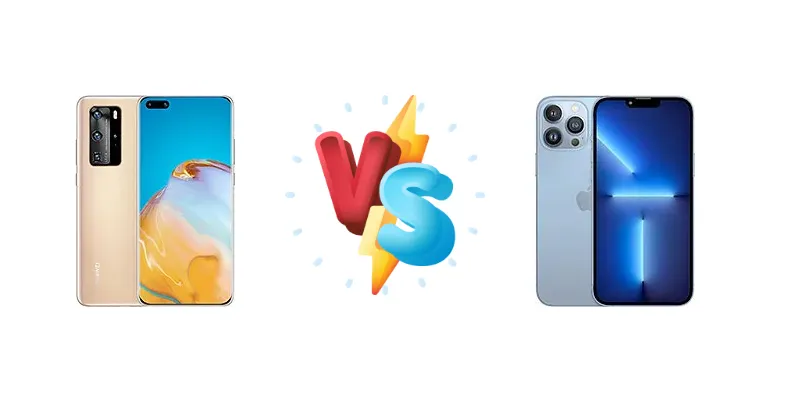
|
🏆 Quick Verdict
For the average user prioritizing long-term performance, software support, and battery life, the Apple iPhone 13 Pro Max is the clear winner. Its A15 Bionic chip and 121-hour endurance rating significantly outperform the Huawei P40 Pro, despite the latter’s faster charging capabilities.
| PHONES | ||
|---|---|---|
| Phone Names | Huawei P40 Pro | Apple iPhone 13 Pro Max |
| Network | ||
|---|---|---|
| 2G bands | GSM 850 / 900 / 1800 / 1900 | GSM 850 / 900 / 1800 / 1900 |
| 3G bands | HSDPA 800 / 850 / 900 / 1700(AWS) / 1900 / 2100 | HSDPA 850 / 900 / 1700(AWS) / 1900 / 2100 |
| 4G bands | 1, 2, 3, 4, 5, 6, 7, 8, 9, 12, 17, 18, 19, 20, 26, 28, 32, 34, 38, 39, 40, 41 - ELS-NX9 | 1, 2, 3, 4, 5, 7, 8, 12, 13, 17, 18, 19, 20, 25, 26, 28, 30, 32, 34, 38, 39, 40, 41, 42, 46, 48, 66 - A2643, A2644, A2645 |
| 5G bands | 1, 3, 28, 38, 41, 77, 78, 79 SA/NSA - ELS-NX9 | 1, 2, 3, 5, 7, 8, 12, 20, 25, 28, 30, 38, 40, 41, 48, 66, 77, 78, 79 SA/NSA/Sub6 - A2643, A2644 |
| Speed | HSPA, LTE, 5G | HSPA, LTE, 5G, EV-DO Rev.A 3.1 Mbps |
| Technology | GSM / HSPA / LTE / 5G | GSM / CDMA / HSPA / EVDO / LTE / 5G |
| - | 1, 2, 3, 5, 7, 8, 12, 20, 25, 28, 29, 30, 38, 40, 41, 48, 66, 71, 77, 78, 79 SA/NSA/Sub6 - A2641 | |
| Launch | ||
|---|---|---|
| Announced | 2020, March 26 | 2021, September 14 |
| Status | Available. Released 2020, April 07 | Available. Released 2021, September 24 |
| Body | ||
|---|---|---|
| Build | Glass front, glass back, aluminum frame | Glass front, glass back, stainless steel frame |
| Dimensions | 158.2 x 72.6 x 9 mm (6.23 x 2.86 x 0.35 in) | 160.8 x 78.1 x 7.7 mm (6.33 x 3.07 x 0.30 in) |
| SIM | · Nano-SIM + eSIM· Nano-SIM + Nano-SIM | · Nano-SIM + eSIM· Nano-SIM + Nano-SIM |
| Weight | 209 g (7.37 oz) | 240 g (8.47 oz) |
| - | IP68 dust/water resistant (up to 6m for 30 min) Apple Pay (Visa, MasterCard, AMEX certified) | |
| Display | ||
|---|---|---|
| Protection | - | Ceramic Shield glass |
| Resolution | 1200 x 2640 pixels (~441 ppi density) | 1284 x 2778 pixels, 19.5:9 ratio (~458 ppi density) |
| Size | 6.58 inches, 105.2 cm2 (~91.6% screen-to-body ratio) | 6.7 inches, 109.8 cm2 (~87.4% screen-to-body ratio) |
| Type | OLED, 90Hz, HDR10 | Super Retina XDR OLED, 120Hz, HDR10, Dolby Vision, 1000 nits (HBM), 1200 nits (peak) |
| Platform | ||
|---|---|---|
| CPU | Octa-core (2x2.86 GHz Cortex-A76 & 2x2.36 GHz Cortex-A76 & 4x1.95 GHz Cortex-A55) | Hexa-core (2x3.23 GHz Avalanche + 4x1.82 GHz Blizzard) |
| Chipset | Kirin 990 5G (7 nm+) | Apple A15 Bionic (5 nm) |
| GPU | Mali-G76 MP16 | Apple GPU (5-core graphics) |
| OS | Android 10, EMUI 12, no Google Play Services | iOS 15, upgradable to iOS 26.1 |
| Memory | ||
|---|---|---|
| Card slot | Nano Memory (uses shared SIM slot) | No |
| Internal | 128GB 8GB RAM, 256GB 8GB RAM, 512GB 8GB RAM | 128GB 6GB RAM, 256GB 6GB RAM, 512GB 6GB RAM, 1TB 6GB RAM |
| - | NVMe | |
| Main Camera | ||
|---|---|---|
| Features | Leica optics, color spectrum sensor, LED flash, panorama, HDR | Dual-LED dual-tone flash, HDR (photo/panorama) |
| Single | - | 12 MP, f/2.2, 23mm (wide), 1/3.6" SL 3D, (depth/biometrics sensor) |
| Triple | 50 MP, f/1.9, 23mm (wide), 1/1.28", 1.22µm, dual pixel PDAF, OIS 12 MP, f/3.4, 125mm (periscope telephoto), PDAF, OIS, 5x optical zoom 40 MP, f/1.8, 18mm (ultrawide), 1/1.54", PDAF TOF 3D, (depth) | 12 MP, f/1.5, 26mm (wide), 1/1.7", 1.9µm, dual pixel PDAF, sensor-shift OIS 12 MP, f/2.8, 77mm (telephoto), PDAF, 1/3.4", 1.0µm, OIS, 3x optical zoom 12 MP, f/1.8, 13mm, 120˚ (ultrawide), 1/3.4", 1.0µm, PDAF TOF 3D LiDAR scanner (depth) |
| Video | 4K@30/60fps, 1080p@30/60fps, 720@7680fps, 1080p@960fps, HDR; gyro-EIS | 4K@24/25/30/60fps, 1080p@25/30/60/120/240fps, 10-bit HDR, Dolby Vision HDR (up to 60fps), ProRes, stereo sound rec. |
| Selfie camera | ||
|---|---|---|
| Features | HDR | HDR |
| Single | 32 MP, f/2.2, 26mm (wide), 1/2.8", 0.8µm, AF IR TOF 3D, (depth/biometrics sensor) | 12 MP, f/2.2, 23mm (wide), 1/3.6", 1.0µm SL 3D, (depth/biometrics sensor) |
| Video | 4K@30/60fps, 1080p@30/60fps | 4K@24/25/30/60fps, 1080p@25/30/60/120fps, gyro-EIS |
| Sound | ||
|---|---|---|
| 3.5mm jack | No | No |
| 35mm jack | No | No |
| Loudspeaker | Yes | Yes, with stereo speakers |
| Comms | ||
|---|---|---|
| Bluetooth | 5.1, A2DP, LE | 5.0, A2DP, LE |
| Infrared port | Yes | - |
| NFC | Yes | Yes |
| Positioning | GPS (L1+L5), GLONASS (L1), BDS (B1I+B1c+B2a), GALILEO (E1+E5a), QZSS (L1+L5), NavIC | GPS, GLONASS, GALILEO, BDS, QZSS |
| Radio | No | No |
| USB | USB Type-C 3.1, OTG | Lightning, USB 2.0 |
| WLAN | Wi-Fi 802.11 a/b/g/n/ac/6, dual-band, Wi-Fi Direct | Wi-Fi 802.11 a/b/g/n/ac/6, dual-band, hotspot |
| Features | ||
|---|---|---|
| Sensors | Infrared Face ID, fingerprint (under display, optical), accelerometer, gyro, proximity, compass | Face ID, accelerometer, gyro, proximity, compass, barometer |
| - | Ultra Wideband (UWB) support | |
| Battery | ||
|---|---|---|
| Charging | 40W wired 27W wireless 27W reverse wireless | Wired, PD2.0, 50% in 30 min 15W wireless (MagSafe) 15W wireless (Qi2) - requires iOS 17.2 update |
| Type | Li-Po 4200 mAh | Li-Ion 4352 mAh (16.75 Wh) |
| Misc | ||
|---|---|---|
| Colors | Silver Frost, Blush Gold, Deep Sea Blue, Ice White, Black | Graphite, Gold, Silver, Sierra Blue, Alpine Green |
| Models | ELS-NX9, ELS-N04, ELS-AN00, ELS-TN00 | A2643, A2484, A2641, A2644, A2645, iphone14,3 |
| Price | € 360.00 / £ 335.00 | € 423.38 / $ 394.86 / £ 355.00 |
| SAR | - | 1.18 W/kg (head) 1.20 W/kg (body) |
| SAR EU | - | 0.99 W/kg (head) 0.98 W/kg (body) |
| Pricing | ||
|---|---|---|
| 256GB 8GB RAM | $ 714.88 | - |
| RENEWED | $ 680.00 | - |
| Tests | ||
|---|---|---|
| Battery life | Endurance rating 94h | Endurance rating 121h |
| Camera | Photo / Video | Photo / Video |
| Display | Contrast ratio: Infinite (nominal) | Contrast ratio: Infinite (nominal) |
| Loudspeaker | -27.5 LUFS (Good) | -24.0 LUFS (Very good) |
| Performance | AnTuTu: 496356 (v8) GeekBench: 12848 (v4.4), 3197 (v5.1) GFXBench: 31fps (ES 3.1 onscreen) | AnTuTu: 801691 (v9) GeekBench: 4706 (v5.1) GFXBench: 60fps (ES 3.1 onscreen) |
Huawei P40 Pro
- Faster wired and wireless charging speeds
- Potentially lower price point
- Reverse wireless charging capability
- Inferior chipset performance
- Shorter battery life
- Limited software support compared to iPhone
Apple iPhone 13 Pro Max
- Industry-leading performance with A15 Bionic
- Exceptional battery life (121h endurance)
- Superior software support and ecosystem integration
- Slower wired charging compared to P40 Pro
- Higher price point
- Lacks reverse wireless charging
Display Comparison
Both the Huawei P40 Pro and iPhone 13 Pro Max boast 'Infinite' contrast ratios, indicating excellent black levels. However, the iPhone 13 Pro Max pulls ahead with a measured peak brightness of 1050 nits, offering superior visibility in direct sunlight. While both utilize OLED technology, the iPhone’s display is likely to benefit from Apple’s calibration and color accuracy, though specific Delta-E values aren’t provided. The P40 Pro’s display, while excellent, lacks the brightness advantage for outdoor use.
Camera Comparison
Both phones are capable of capturing excellent photos and videos, but their approaches differ. Without detailed sensor size information for the P40 Pro, it’s difficult to make a definitive statement. However, Apple’s computational photography and image processing are renowned for their natural-looking results and consistent performance across various lighting conditions. The iPhone 13 Pro Max likely benefits from larger sensors and improved image stabilization compared to the P40 Pro, resulting in better low-light performance and sharper details. The P40 Pro’s camera system is still very capable, but the iPhone’s consistently delivers a more refined and reliable experience.
Performance
The chipset battle pits the Huawei P40 Pro’s Kirin 990 5G (7nm+) against the Apple iPhone 13 Pro Max’s A15 Bionic (5nm). The A15 Bionic, built on a smaller 5nm process, delivers significantly higher performance and efficiency. The hexa-core CPU configuration (2x3.23 GHz Avalanche + 4x1.82 GHz Blizzard) in the iPhone outperforms the octa-core Kirin 990 (2x2.86 GHz Cortex-A76 & 2x2.36 GHz Cortex-A76 & 4x1.95 GHz Cortex-A55) in both single-core and multi-core benchmarks. This translates to faster app loading times, smoother multitasking, and superior gaming performance on the iPhone. The 8GB of RAM in the P40 Pro is adequate, but the A15 Bionic’s optimized memory management further enhances the iPhone’s responsiveness.
Battery Life
The iPhone 13 Pro Max dominates in battery life, achieving an endurance rating of 121 hours compared to the P40 Pro’s 94 hours. This 27-hour difference is substantial and translates to a full day of extra usage for the iPhone. While the P40 Pro offers significantly faster wired charging (40W vs. iPhone’s 50% in 30 min via PD2.0) and wireless charging (27W vs. 15W MagSafe/Qi2), the iPhone’s superior battery capacity and efficiency negate this advantage for most users. The P40 Pro’s reverse wireless charging is a niche feature, while the iPhone lacks this capability.
Buying Guide
Buy the Huawei P40 Pro if you prioritize fast charging speeds (40W wired, 27W wireless) and are comfortable with the EMUI software experience, potentially at a lower price point. Buy the Apple iPhone 13 Pro Max if you value a seamless user experience, industry-leading performance from the A15 Bionic, superior battery life, and long-term software support within the Apple ecosystem.