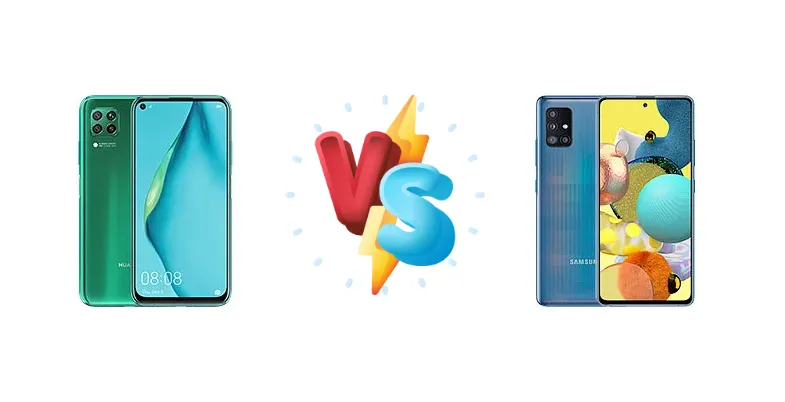
The Huawei P40 lite and Samsung Galaxy A51 5G UW represent compelling options in the increasingly crowded budget 5G smartphone market. While both aim to deliver 5G connectivity without breaking the bank, they take different approaches to achieving this, particularly in chipset choice and charging speed. This comparison dissects their key specifications to determine which device offers the best value.
🏆 Quick Verdict
For the average user prioritizing fast charging and a slightly more refined software experience, the Huawei P40 lite emerges as the winner. Its 40W charging capability and strong endurance rating outweigh the Samsung Galaxy A51 5G UW’s 5G connectivity, especially given the limited UW availability and slower 15W charging.
| Network |
|---|
| 2G bands | GSM 850 / 900 / 1800 / 1900 | GSM 850 / 900 / 1800 / 1900 |
| 3G bands | HSDPA 800 / 850 / 900 / 1700(AWS) / 2100 | HSDPA 850 / 900 / 1900 / 2100 |
| 4G bands | 1, 2, 3, 4, 5, 7, 8, 18, 19, 20, 28, 34, 38, 39, 40, 41 - JNY-L21A, JNY-L01A, JNY-L21B | 2, 4, 5, 13, 66 |
| 5G bands | - | 260, 261 mmWave |
| Speed | HSPA 42.2/5.76 Mbps, LTE (2CA) Cat13 400/75 Mbps | HSPA, LTE, 5G |
| Technology | GSM / HSPA / LTE | GSM / HSPA / LTE / 5G |
| | 1, 2, 3, 4, 5, 7, 8, 18, 19, 28, 34, 38, 39, 40, 41 - JNY-L22A, JNY-L02A, JNY-L22B | - |
| Launch |
|---|
| Announced | 2020, February 27. Released 2020, March 02 | 2020, August 14 |
| Status | Discontinued | Available. Released 2020, August 14 |
| Body |
|---|
| Build | Glass front, plastic back, plastic frame | Glass front (Gorilla Glass 3), plastic back, aluminum frame |
| Dimensions | 159.2 x 76.3 x 8.7 mm (6.27 x 3.00 x 0.34 in) | 158.8 x 73.4 x 8.6 mm (6.25 x 2.89 x 0.34 in) |
| SIM | Nano-SIM + Nano-SIM | Nano-SIM (pre-installed) |
| Weight | 183 g (6.46 oz) | 188.8 g (6.67 oz) |
| Display |
|---|
| Protection | - | Corning Gorilla Glass 3 |
| Resolution | 1080 x 2310 pixels (~398 ppi density) | 1080 x 2400 pixels, 20:9 ratio (~405 ppi density) |
| Size | 6.4 inches, 101.4 cm2 (~83.5% screen-to-body ratio) | 6.5 inches, 102.0 cm2 (~87.5% screen-to-body ratio) |
| Type | IPS LCD | Super AMOLED |
| Platform |
|---|
| CPU | Octa-core (2x2.27 GHz Cortex-A76 & 6x1.88 GHz Cortex-A55) | Octa-core (1x2.4 GHz Kryo 475 Prime & 1x2.2 GHz Kryo 475 Gold & 6x1.8 GHz Kryo 475 Silver) |
| Chipset | Kirin 810 (7 nm) | Qualcomm SM7250 Snapdragon 765G 5G (7 nm) |
| GPU | Mali-G52 MP6 | Adreno 620 |
| OS | Android 10, EMUI 10, no Google Play Services | Android 10, One UI 2 |
| Memory |
|---|
| Card slot | Nano Memory (uses shared SIM slot) | microSDXC (uses shared SIM slot) |
| Internal | 128GB 6GB RAM, 128GB 8GB RAM | 128GB 6GB RAM |
| | UFS 2.1 | UFS 2.1 |
| Main Camera |
|---|
| Features | LED flash, HDR, panorama | LED flash, panorama, HDR |
| Quad | 48 MP, f/1.8, 26mm (wide), 1/2.0", 0.8µm, PDAF
8 MP, f/2.4, (ultrawide)
2 MP (macro)
Auxiliary lens | 48 MP, f/2.0, 26mm (wide), 1/2.0", 0.8µm, PDAF
12 MP, f/2.2, 123˚ (ultrawide)
5 MP (macro)
Auxiliary lens |
| Single | - | 5 MP, AF |
| Video | 1080p@30fps | 4K@30fps, 1080p@30/120fps; gyro-EIS |
| Selfie camera |
|---|
| Features | HDR | HDR |
| Single | 16 MP, f/2.0, (wide), 1/3.06", 1.0µm | 32 MP, f/2.2, 26mm (wide), 1/2.8", 0.8µm |
| Video | 1080p@30fps | 4K@30fps, 1080p@30fps |
| Sound |
|---|
| 3.5mm jack | Yes | Yes |
| 35mm jack | Yes | Yes |
| Loudspeaker | Yes | Yes |
| Comms |
|---|
| Bluetooth | 5.0, A2DP, LE | 5.0, A2DP, LE |
| NFC | Yes (market/region dependent): JNY-L21A, JNY-L01A, JNY-L21B | Yes |
| Positioning | GPS, GLONASS, GALILEO, BDS, QZSS | GPS, GLONASS, GALILEO, BDS |
| Radio | FM radio | FM radio, RDS, recording |
| USB | USB Type-C 2.0, OTG | USB Type-C 2.0, OTG |
| WLAN | Wi-Fi 802.11 a/b/g/n/ac, dual-band, Wi-Fi Direct | Wi-Fi 802.11 a/b/g/n/ac, dual-band, Wi-Fi Direct |
| Features |
|---|
| Sensors | Fingerprint (side-mounted), accelerometer, proximity, compass | Fingerprint (under display, optical), accelerometer, gyro, proximity, compass |
| | - | ANT+ |
| Battery |
|---|
| Charging | 40W wired, 70% in 30 min | 15W wired |
| Stand-by | - | Up to 672 h |
| Talk time | - | Up to 5 h |
| Type | Li-Po 4200 mAh, non-removable | Li-Po 4500 mAh |
| Misc |
|---|
| Colors | Black, Emerald Green, Light Pink/Blue, Skyline Gray | Prism Bricks Blue |
| Models | JNY-L21A, JNY-L01A, JNY-L21B, JNY-L22A, JNY-L02A, JNY-L22B, JNY-LX1 | SM-A516V |
| Price | About 170 EUR | About 470 EUR |
| SAR | - | 0.70 W/kg (head) 1.25 W/kg (body) |
| SAR EU | - | 0.59 W/kg (head) 1.32 W/kg (body) |
| Tests |
|---|
| Battery life |
Endurance rating 121h
| - |
| Camera |
Photo / Video | - |
| Display |
Contrast ratio: 1085:1 (nominal) | - |
| Loudspeaker |
-27.0 LUFS (Good)
| - |
| Performance |
AnTuTu: 325777 (v8)
GeekBench: 7846 (v4.4), 1862 (v5.1)
GFXBench: 18fps (ES 3.1 onscreen) | - |
Huawei P40 lite
- 40W fast charging significantly reduces downtime.
- Excellent 121-hour endurance rating for all-day use.
- Kirin 810 offers strong multi-core performance.
- Software experience (EMUI) may not appeal to all users.
- Camera specifications are vague, limiting expectations.
Samsung Galaxy A51 5G UW
- 5G connectivity provides faster data speeds (where available).
- Samsung One UI offers a familiar and polished software experience.
- Potential for better image processing due to 5G modem integration.
- Slow 15W charging is a major drawback.
- Battery life is likely inferior to the P40 lite.
- UW 5G availability is limited.
Display Comparison
The Huawei P40 lite boasts a display capable of reaching 515 nits of peak brightness, coupled with a 1085:1 contrast ratio. While the A51 5G UW’s display specifications aren’t provided, Samsung typically employs vibrant AMOLED panels in this range. However, the P40 lite’s measured brightness suggests good outdoor visibility. The contrast ratio indicates a decent level of black depth, though without knowing the panel technology of the A51 5G UW, a direct comparison is difficult. Both phones likely target a 60Hz refresh rate, common in this price bracket.
Camera Comparison
Both devices are listed as having 'Photo / Video' capabilities, lacking specific details. This suggests a focus on general-purpose photography rather than specialized features. Without sensor size or aperture information, it’s difficult to assess image quality. However, the inclusion of a 5G modem in the A51 5G UW might suggest a slightly more advanced image signal processor (ISP) for faster processing of 5G-enabled features like cloud-based photo storage. The absence of detail implies neither phone will excel in low-light conditions or offer significant zoom capabilities.
Performance
The core difference lies in the chipsets. The Huawei P40 lite utilizes the Kirin 810 (7nm), an octa-core processor with a mix of Cortex-A76 and A55 cores, peaking at 2.27 GHz. The Samsung Galaxy A51 5G UW features the Qualcomm Snapdragon 765G (7nm), also an octa-core, but with a Kryo 475 configuration topping out at 2.4 GHz. While the Snapdragon 765G’s prime core has a slightly higher clock speed, the Kirin 810’s architecture is known for efficient multi-core performance. The Snapdragon 765G benefits from Qualcomm’s optimized 5G modem, but the real-world performance difference will likely be subtle for most users. Neither phone specifies RAM speed, but LPDDR4X is probable in both cases.
Battery Life
The Huawei P40 lite shines with an endurance rating of 121 hours, indicating excellent battery life. Crucially, it supports 40W wired charging, capable of reaching 70% charge in just 30 minutes. The Samsung Galaxy A51 5G UW, in contrast, is limited to 15W wired charging. This disparity in charging speed is significant; the P40 lite offers a much faster top-up, mitigating any potential concerns about battery capacity. While the A51 5G UW’s battery capacity isn’t specified, the slower charging suggests it’s unlikely to compensate for the P40 lite’s superior charging speed and endurance.
Buying Guide
Buy the Huawei P40 lite if you need exceptionally fast charging, prioritize battery life, and are comfortable with Huawei’s EMUI software. This phone is ideal for users who frequently find themselves away from a power outlet. Buy the Samsung Galaxy A51 5G UW if you absolutely require 5G connectivity on a budget and prefer the Samsung One UI experience, understanding that charging will be significantly slower and battery life is less impressive.
Frequently Asked Questions
❓ Does the Kirin 810 chipset struggle with demanding games like PUBG or Call of Duty?
The Kirin 810 is a capable mid-range chipset. While it won't deliver flagship-level gaming performance, it should handle PUBG and Call of Duty at medium settings without significant issues. Expect some frame drops during intense scenes, but the experience should be generally playable. Thermal throttling is a possibility during extended gaming sessions.
❓ Is the 5G connectivity on the Samsung Galaxy A51 5G UW actually useful, given the limited availability of mmWave 5G?
The 'UW' designation indicates support for mmWave 5G, which offers the fastest 5G speeds but has extremely limited coverage. Most 5G deployments currently utilize sub-6GHz 5G, which is slower but has a much wider range. Unless you live in a very specific area with mmWave 5G coverage, the benefit of the A51 5G UW’s UW support will be minimal.
❓ How does Huawei's EMUI software compare to Samsung's One UI in terms of usability and features?
EMUI and One UI represent distinct software philosophies. One UI is generally considered more polished and user-friendly, with a cleaner interface and a wider range of customization options. EMUI, while feature-rich, can feel cluttered and includes more pre-installed bloatware. Software updates are also typically faster and more consistent on Samsung devices.