
Huawei P40 lite vs Realme 6 Pro: A Detailed Comparison
| Phones Images | |||||
|---|---|---|---|---|---|
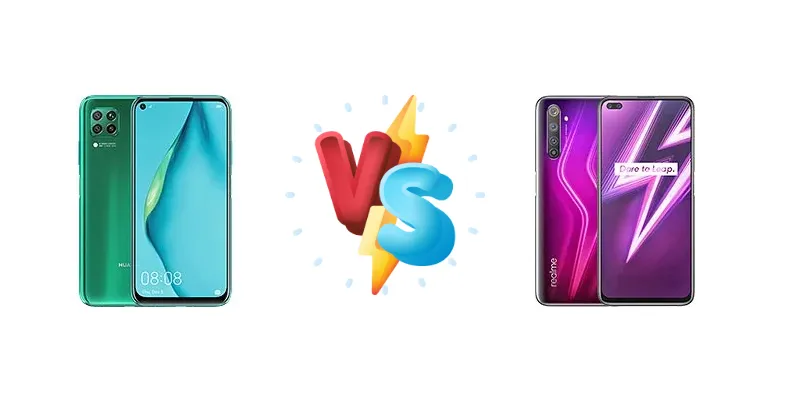
|
🏆 Quick Verdict
For the average user prioritizing sustained performance and faster charging, the Realme 6 Pro emerges as the stronger contender. Its Snapdragon 720G chipset, built on an 8nm process, offers a slight edge in efficiency and gaming, while the 30W charging significantly reduces downtime. However, the P40 lite’s slightly superior endurance rating and contrast ratio shouldn’t be dismissed.
| PHONES | ||
|---|---|---|
| Phone Names | Huawei P40 lite | Realme 6 Pro |
| Network | ||
|---|---|---|
| 2G bands | GSM 850 / 900 / 1800 / 1900 | GSM 850 / 900 / 1800 / 1900 |
| 3G bands | HSDPA 800 / 850 / 900 / 1700(AWS) / 2100 | HSDPA 850 / 900 / 1700(AWS) / 1900 / 2100 - Global |
| 4G bands | 1, 2, 3, 4, 5, 7, 8, 18, 19, 20, 28, 34, 38, 39, 40, 41 - JNY-L21A, JNY-L01A, JNY-L21B | 1, 2, 3, 4, 5, 7, 8, 20, 28, 38, 40, 41 - Global |
| Speed | HSPA 42.2/5.76 Mbps, LTE (2CA) Cat13 400/75 Mbps | HSPA 42.2/11.5 Mbps, LTE (2CA) Cat6 300/150 Mbps |
| Technology | GSM / HSPA / LTE | GSM / HSPA / LTE |
| 1, 2, 3, 4, 5, 7, 8, 18, 19, 28, 34, 38, 39, 40, 41 - JNY-L22A, JNY-L02A, JNY-L22B | 1, 3, 5, 8, 38, 40, 41 - India | |
| Launch | ||
|---|---|---|
| Announced | 2020, February 27. Released 2020, March 02 | 2020, March 05. Released 2020, March 13 |
| Status | Discontinued | Discontinued |
| Body | ||
|---|---|---|
| Build | Glass front, plastic back, plastic frame | Glass front (Gorilla Glass 5), glass back, plastic frame |
| Dimensions | 159.2 x 76.3 x 8.7 mm (6.27 x 3.00 x 0.34 in) | 163.8 x 75.8 x 8.9 mm (6.45 x 2.98 x 0.35 in) |
| SIM | Nano-SIM + Nano-SIM | Nano-SIM + Nano-SIM |
| Weight | 183 g (6.46 oz) | 202 g (7.13 oz) |
| Display | ||
|---|---|---|
| Protection | - | Corning Gorilla Glass 5 |
| Resolution | 1080 x 2310 pixels (~398 ppi density) | 1080 x 2400 pixels, 20:9 ratio (~399 ppi density) |
| Size | 6.4 inches, 101.4 cm2 (~83.5% screen-to-body ratio) | 6.6 inches, 105.2 cm2 (~84.7% screen-to-body ratio) |
| Type | IPS LCD | IPS LCD, 90Hz, 480 nits (typ) |
| Platform | ||
|---|---|---|
| CPU | Octa-core (2x2.27 GHz Cortex-A76 & 6x1.88 GHz Cortex-A55) | Octa-core (2x2.3 GHz Kryo 465 Gold & 6x1.8 GHz Kryo 465 Silver) |
| Chipset | Kirin 810 (7 nm) | Qualcomm SM7125 Snapdragon 720G (8 nm) |
| GPU | Mali-G52 MP6 | Adreno 618 |
| OS | Android 10, EMUI 10, no Google Play Services | Android 10, upgradable to Android 11, Realme UI 2.0 |
| Memory | ||
|---|---|---|
| Card slot | Nano Memory (uses shared SIM slot) | microSDXC (dedicated slot) |
| Internal | 128GB 6GB RAM, 128GB 8GB RAM | 64GB 6GB RAM, 128GB 6GB RAM, 128GB 8GB RAM |
| UFS 2.1 | UFS 2.1 | |
| Main Camera | ||
|---|---|---|
| Features | LED flash, HDR, panorama | LED flash, HDR, panorama |
| Quad | 48 MP, f/1.8, 26mm (wide), 1/2.0", 0.8µm, PDAF 8 MP, f/2.4, (ultrawide) 2 MP (macro) Auxiliary lens | 64 MP, f/1.8, 26mm (wide), 1/1.72", 0.8µm, PDAF 12 MP, f/2.5, 54mm (telephoto), 1/3.4", 1.0µm, PDAF, 2x optical zoom 8 MP, f/2.3, 13mm (ultrawide), 1/4.0", 1.12µm 2 MP (macro) |
| Video | 1080p@30fps | 4K@30fps, 1080p@30/60/120fps, gyro-EIS |
| Selfie camera | ||
|---|---|---|
| Dual | - | 16 MP, f/2.1, 26mm (wide), 1/3.06", 1.0µm 8 MP, f/2.2, 105˚ (ultrawide), 1/4.0", 1.12µm |
| Features | HDR | HDR, panorama |
| Single | 16 MP, f/2.0, (wide), 1/3.06", 1.0µm | - |
| Video | 1080p@30fps | 1080p@30fps |
| Sound | ||
|---|---|---|
| 3.5mm jack | Yes | Yes |
| 35mm jack | Yes | Yes |
| Loudspeaker | Yes | Yes |
| - | 24-bit/192kHz audio | |
| Comms | ||
|---|---|---|
| Bluetooth | 5.0, A2DP, LE | 5.1, A2DP, LE |
| NFC | Yes (market/region dependent): JNY-L21A, JNY-L01A, JNY-L21B | Yes (market/region dependent) |
| Positioning | GPS, GLONASS, GALILEO, BDS, QZSS | GPS (L1+L5), GLONASS, BDS, NavIC |
| Radio | FM radio | FM radio |
| USB | USB Type-C 2.0, OTG | USB Type-C 2.0, OTG |
| WLAN | Wi-Fi 802.11 a/b/g/n/ac, dual-band, Wi-Fi Direct | Wi-Fi 802.11 a/b/g/n/ac, dual-band, Wi-Fi Direct |
| Features | ||
|---|---|---|
| Sensors | Fingerprint (side-mounted), accelerometer, proximity, compass | Fingerprint (side-mounted), accelerometer, gyro, proximity, compass |
| Battery | ||
|---|---|---|
| Charging | 40W wired, 70% in 30 min | 30W wired, 100% in 57 min |
| Type | Li-Po 4200 mAh, non-removable | 4300 mAh |
| Misc | ||
|---|---|---|
| Colors | Black, Emerald Green, Light Pink/Blue, Skyline Gray | Lightning Blue, Lightning Orange, Lightning Red |
| Models | JNY-L21A, JNY-L01A, JNY-L21B, JNY-L22A, JNY-L02A, JNY-L22B, JNY-LX1 | RMX2061, RMX2063 |
| Price | About 170 EUR | About 540 EUR |
| SAR | - | 1.19 W/kg (head) 0.92 W/kg (body) |
| Tests | ||
|---|---|---|
| Battery life | Endurance rating 121h | Endurance rating 107h |
| Camera | Photo / Video | Photo / Video |
| Display | Contrast ratio: 1085:1 (nominal) | Contrast ratio: 1324:1 (nominal) |
| Loudspeaker | -27.0 LUFS (Good) | -28.5 LUFS (Average) |
| Performance | AnTuTu: 325777 (v8) GeekBench: 7846 (v4.4), 1862 (v5.1) GFXBench: 18fps (ES 3.1 onscreen) | AnTuTu: 268785 (v8) GeekBench: 7027 (v4.4), 1666 (v5.1) GFXBench: 19fps (ES 3.1 onscreen) |
Huawei P40 lite
- Slightly longer battery endurance
- Higher peak display brightness for outdoor visibility
- Higher contrast ratio for richer visuals
- Older chipset architecture (Kirin 810)
- Slower full charge time compared to Realme 6 Pro
Realme 6 Pro
- More efficient Snapdragon 720G chipset
- Faster 30W charging for quicker top-ups
- Potentially better image processing capabilities
- Lower peak display brightness
- Slightly shorter battery endurance rating
Display Comparison
The Realme 6 Pro boasts a higher contrast ratio of 1324:1 compared to the Huawei P40 lite’s 1085:1, suggesting deeper blacks and a more vibrant image. However, the P40 lite counters with a measured peak brightness of 515 nits, exceeding the Realme 6 Pro’s 421 nits. This means the P40 lite will be more visible under direct sunlight. Both displays utilize similar LCD technology, lacking the advanced features like variable refresh rates found in higher-end devices. The difference in contrast will be most noticeable in dark scenes, while the P40 lite’s brightness provides a practical advantage outdoors.
Camera Comparison
Both phones feature a multi-camera setup, but detailed sensor information is limited. Without specifics on sensor size and aperture, a direct comparison is difficult. However, focusing on the overall system, the Realme 6 Pro’s Snapdragon 720G ISP likely offers more advanced image processing capabilities, potentially leading to better dynamic range and low-light performance. The inclusion of features like Night Mode and AI scene detection are likely more refined on the Realme 6 Pro. The presence of a dedicated 2MP macro camera on both devices is largely a marketing tactic, offering limited practical benefit due to the small sensor size.
Performance
The Realme 6 Pro’s Qualcomm Snapdragon 720G (8nm) and the Huawei P40 lite’s Kirin 810 (7nm) represent different approaches to mid-range performance. The Snapdragon 720G benefits from Qualcomm’s optimized CPU architecture (2x2.3 GHz Kryo 465 Gold & 6x1.8 GHz Kryo 465 Silver) and a more efficient 8nm manufacturing process. While the Kirin 810 (2x2.27 GHz Cortex-A76 & 6x1.88 GHz Cortex-A55) is still capable, the Snapdragon 720G generally delivers better sustained performance and improved thermal management, crucial for extended gaming sessions. The 8nm process of the Snapdragon 720G contributes to better power efficiency, potentially offsetting the P40 lite’s slightly larger battery.
Battery Life
The Huawei P40 lite claims an endurance rating of 121 hours, while the Realme 6 Pro achieves 107 hours. This suggests the P40 lite offers slightly better overall battery life. However, the Realme 6 Pro compensates with significantly faster charging – 30W wired, achieving 100% in 57 minutes, compared to the P40 lite’s 40W wired, reaching 70% in 30 minutes. While the P40 lite charges quickly initially, the Realme 6 Pro’s ability to fully charge in under an hour provides greater convenience for users who need to top up their battery quickly.
Buying Guide
Buy the Huawei P40 lite if you prioritize maximizing battery life and appreciate a slightly higher contrast display for media consumption. It’s ideal for users who primarily use their phone for everyday tasks and aren’t heavily reliant on demanding games. Buy the Realme 6 Pro if you value quicker charging, a more modern chipset architecture, and a smoother experience with graphically intensive applications. This phone is geared towards users who enjoy mobile gaming and want a device that can keep up with their fast-paced lifestyle.