
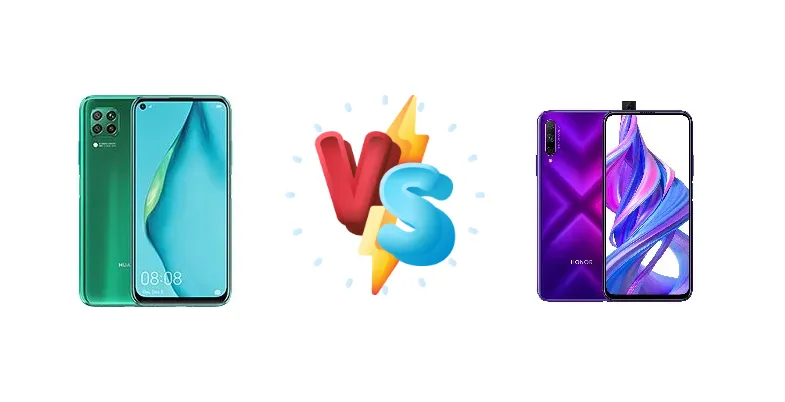
Huawei P40 lite vs Honor 9X Pro: A Detailed Comparison for Budget-Minded Users
| Phones Images | |||||
|---|---|---|---|---|---|
|
🏆 Quick Verdict
For the average user prioritizing longevity, the Huawei P40 lite is the better choice. Its significantly superior 121-hour endurance rating outweighs the Honor 9X Pro’s slightly better contrast ratio. While both phones offer similar performance, the P40 lite’s faster 40W charging is a substantial advantage.
| PHONES | ||
|---|---|---|
| Phone Names | Huawei P40 lite | Honor 9X Pro |
| Network | ||
|---|---|---|
| 2G bands | GSM 850 / 900 / 1800 / 1900 | GSM 850 / 900 / 1800 / 1900 |
| 3G bands | HSDPA 800 / 850 / 900 / 1700(AWS) / 2100 | HSDPA 850 / 900 / 2100 |
| 4G bands | 1, 2, 3, 4, 5, 7, 8, 18, 19, 20, 28, 34, 38, 39, 40, 41 - JNY-L21A, JNY-L01A, JNY-L21B | 1, 3, 7, 8, 20, 38, 40, 41 - International |
| Speed | HSPA 42.2/5.76 Mbps, LTE (2CA) Cat13 400/75 Mbps | HSPA 42.2/5.76 Mbps, LTE (2CA) Cat12 600/50 Mbps |
| Technology | GSM / HSPA / LTE | GSM / CDMA / HSPA / EVDO / LTE |
| 1, 2, 3, 4, 5, 7, 8, 18, 19, 28, 34, 38, 39, 40, 41 - JNY-L22A, JNY-L02A, JNY-L22B | 1, 3, 5, 8, 38, 39, 40, 41 - China | |
| Launch | ||
|---|---|---|
| Announced | 2020, February 27. Released 2020, March 02 | 2019, July 23. Released 2019, August 09 |
| Status | Discontinued | Discontinued |
| Body | ||
|---|---|---|
| Build | Glass front, plastic back, plastic frame | Glass front, glass back, aluminum frame |
| Dimensions | 159.2 x 76.3 x 8.7 mm (6.27 x 3.00 x 0.34 in) | 163.5 x 77.3 x 8.8 mm (6.44 x 3.04 x 0.35 in) |
| SIM | Nano-SIM + Nano-SIM | Nano-SIM + Nano-SIM |
| Weight | 183 g (6.46 oz) | 202 g (7.13 oz) |
| Display | ||
|---|---|---|
| Resolution | 1080 x 2310 pixels (~398 ppi density) | 1080 x 2340 pixels, 19.5:9 ratio (~391 ppi density) |
| Size | 6.4 inches, 101.4 cm2 (~83.5% screen-to-body ratio) | 6.59 inches, 106.6 cm2 (~84.3% screen-to-body ratio) |
| Type | IPS LCD | IPS LCD |
| Platform | ||
|---|---|---|
| CPU | Octa-core (2x2.27 GHz Cortex-A76 & 6x1.88 GHz Cortex-A55) | Octa-core (2x2.27 GHz Cortex-A76 & 6x1.88 GHz Cortex-A55) |
| Chipset | Kirin 810 (7 nm) | Kirin 810 (7 nm) |
| GPU | Mali-G52 MP6 | Mali-G52 MP6 |
| OS | Android 10, EMUI 10, no Google Play Services | Android 9.0 (Pie), upgradable to Android 10, EMUI 9.1, no Google Play Services |
| Memory | ||
|---|---|---|
| Card slot | Nano Memory (uses shared SIM slot) | microSDXC (uses shared SIM slot) |
| Internal | 128GB 6GB RAM, 128GB 8GB RAM | 128GB 8GB RAM, 256GB 6GB RAM, 256GB 8GB RAM |
| UFS 2.1 | - | |
| Main Camera | ||
|---|---|---|
| Features | LED flash, HDR, panorama | LED flash, HDR, panorama |
| Quad | 48 MP, f/1.8, 26mm (wide), 1/2.0", 0.8µm, PDAF 8 MP, f/2.4, (ultrawide) 2 MP (macro) Auxiliary lens | - |
| Triple | - | 48 MP, f/1.8, (wide), 1/2.0", 0.8µm, PDAF 8 MP, f/2.4, 120˚ (ultrawide) Auxiliary lens |
| Video | 1080p@30fps | 1080p@30fps, gyro-EIS |
| Selfie camera | ||
|---|---|---|
| Features | HDR | - |
| Single | 16 MP, f/2.0, (wide), 1/3.06", 1.0µm | Motorized pop-up 16 MP, f/2.2, 26mm (wide), 1/3.06", 1.0µm |
| Video | 1080p@30fps | 1080p@60fps |
| Sound | ||
|---|---|---|
| 3.5mm jack | Yes | Yes |
| 35mm jack | Yes | Yes |
| Loudspeaker | Yes | Yes |
| Comms | ||
|---|---|---|
| Bluetooth | 5.0, A2DP, LE | 4.2, A2DP, LE (International)5.0, A2DP, LE (China) |
| NFC | Yes (market/region dependent): JNY-L21A, JNY-L01A, JNY-L21B | No |
| Positioning | GPS, GLONASS, GALILEO, BDS, QZSS | GPS, GLONASS, BDS |
| Radio | FM radio | FM radio |
| USB | USB Type-C 2.0, OTG | USB Type-C 2.0 |
| WLAN | Wi-Fi 802.11 a/b/g/n/ac, dual-band, Wi-Fi Direct | Wi-Fi 802.11 a/b/g/n/ac, dual-band, Wi-Fi Direct |
| Features | ||
|---|---|---|
| Sensors | Fingerprint (side-mounted), accelerometer, proximity, compass | Fingerprint (side-mounted), accelerometer, gyro, proximity, compass |
| Battery | ||
|---|---|---|
| Charging | 40W wired, 70% in 30 min | 10W wired |
| Type | Li-Po 4200 mAh, non-removable | Li-Po 4000 mAh, non-removable |
| Misc | ||
|---|---|---|
| Colors | Black, Emerald Green, Light Pink/Blue, Skyline Gray | Midnight Black, Phantom Purple |
| Models | JNY-L21A, JNY-L01A, JNY-L21B, JNY-L22A, JNY-L02A, JNY-L22B, JNY-LX1 | HLK-AL10, HLK-TL10, HLK-L41, HLK-L42 |
| Price | About 170 EUR | About 230 EUR |
| Tests | ||
|---|---|---|
| Battery life | Endurance rating 121h | Endurance rating 104h |
| Camera | Photo / Video | Photo / Video |
| Display | Contrast ratio: 1085:1 (nominal) | Contrast ratio: 1319:1 (nominal) |
| Loudspeaker | -27.0 LUFS (Good) | -31.1 LUFS (Below average) |
| Performance | AnTuTu: 325777 (v8) GeekBench: 7846 (v4.4), 1862 (v5.1) GFXBench: 18fps (ES 3.1 onscreen) | AnTuTu: 312668 (v8) GeekBench: 7836 (v4.4), 1911 (v5.1) GFXBench: 18fps (ES 3.1 onscreen) |
Huawei P40 lite
- Superior battery endurance (121h)
- Significantly faster 40W charging
- Longer usage between charges
- Slightly lower display contrast ratio
- Potentially higher price point
Honor 9X Pro
- Higher display contrast ratio (1319:1)
- Potentially lower price
- Similar performance to P40 lite
- Inferior battery endurance (104h)
- Slow 10W charging
- Requires more frequent charging
Display Comparison
Both the P40 lite and 9X Pro feature displays capable of 515-517 nits of peak brightness, ensuring adequate visibility in most outdoor conditions. However, the Honor 9X Pro boasts a higher contrast ratio of 1319:1 compared to the P40 lite’s 1085:1. This translates to slightly deeper blacks and more visually striking images, though the difference is subtle. Neither device specifies panel technology, suggesting LCDs are used, and neither boasts high refresh rates, focusing instead on efficiency. The practical impact is a marginally more visually appealing experience on the 9X Pro, but at the cost of battery life.
Camera Comparison
Both phones are listed with 'Photo / Video' capabilities, lacking specific details about sensor size, aperture, or optical image stabilization (OIS). Given the market positioning, it’s reasonable to assume both utilize multi-camera setups with a primary sensor, an ultrawide, and potentially a depth sensor. The lack of detail makes a direct comparison impossible, but the emphasis on 'Photo / Video' suggests a focus on general-purpose photography rather than specialized features. Ignoring the likely inclusion of low-resolution macro lenses, the image quality will likely be similar, relying heavily on Huawei’s image processing algorithms.
Performance
Both devices are powered by the Kirin 810 (7nm) chipset, featuring an octa-core CPU configuration with 2x2.27 GHz Cortex-A76 and 6x1.88 GHz Cortex-A55 cores. This means performance in everyday tasks and moderate gaming will be virtually identical. The absence of information regarding RAM speed (LPDDR4X is likely) and thermal management solutions suggests neither phone is designed for sustained, intensive workloads. The shared chipset ensures a similar user experience regarding app launch times and multitasking capabilities.
Battery Life
The most significant difference lies in battery performance. The Huawei P40 lite achieves an endurance rating of 121 hours, significantly outperforming the Honor 9X Pro’s 104 hours. This translates to a full day of heavier usage on the P40 lite versus potentially needing a top-up during the day with the 9X Pro. Furthermore, the P40 lite supports 40W wired charging, capable of reaching 70% charge in just 30 minutes, while the 9X Pro is limited to a slower 10W charging speed. This disparity in charging speed is a major convenience factor for P40 lite users.
Buying Guide
Buy the Huawei P40 lite if you need all-day battery life and fast charging capabilities, making it ideal for users who are frequently on the go. Buy the Honor 9X Pro if you prioritize a marginally more vibrant display and are willing to sacrifice battery endurance and charging speed for a potentially lower price point. The 9X Pro is best suited for users who primarily use their phone at home or in the office with consistent access to power.