
Huawei P40 lite vs Google Pixel 4a 5G: A Detailed Comparison
| Phones Images | |||||
|---|---|---|---|---|---|
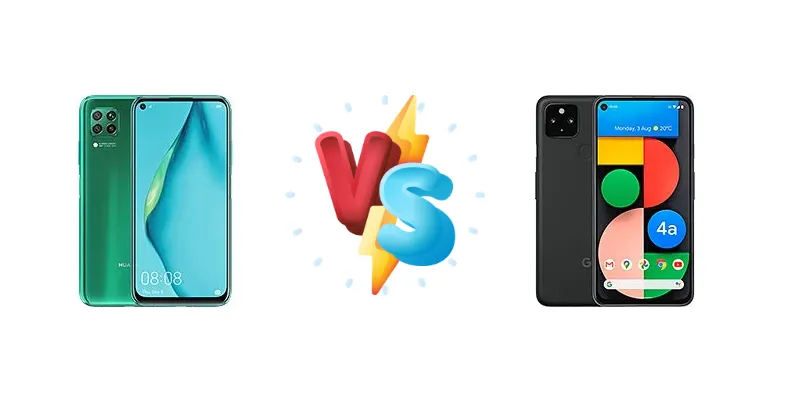
|
🏆 Quick Verdict
For most users, the Google Pixel 4a 5G emerges as the stronger choice. While the Huawei P40 lite boasts faster 40W charging and impressive battery endurance, the Pixel 4a 5G’s Snapdragon 765G chipset and superior camera processing provide a smoother, more refined user experience.
| PHONES | ||
|---|---|---|
| Phone Names | Huawei P40 lite | Google Pixel 4a 5G |
| Network | ||
|---|---|---|
| 2G bands | GSM 850 / 900 / 1800 / 1900 | GSM 850 / 900 / 1800 / 1900 |
| 3G bands | HSDPA 800 / 850 / 900 / 1700(AWS) / 2100 | HSDPA 850 / 900 / 1700(AWS) / 1900 / 2100 |
| 4G bands | 1, 2, 3, 4, 5, 7, 8, 18, 19, 20, 28, 34, 38, 39, 40, 41 - JNY-L21A, JNY-L01A, JNY-L21B | 1, 2, 3, 4, 5, 7, 8, 12, 13, 14, 17, 18, 19, 20, 25, 26, 28, 29, 30, 32, 38, 39, 40, 41, 42, 46, 48, 66, 71 |
| 5G bands | - | 1, 2, 3, 5, 7, 8, 12, 28, 41, 66, 71, 77, 78 Sub6, mmWave (market dependant) |
| Speed | HSPA 42.2/5.76 Mbps, LTE (2CA) Cat13 400/75 Mbps | HSPA, LTE, 5G |
| Technology | GSM / HSPA / LTE | GSM / HSPA / LTE / 5G |
| 1, 2, 3, 4, 5, 7, 8, 18, 19, 28, 34, 38, 39, 40, 41 - JNY-L22A, JNY-L02A, JNY-L22B | - | |
| Launch | ||
|---|---|---|
| Announced | 2020, February 27. Released 2020, March 02 | 2020, September 30 |
| Status | Discontinued | Available. Released 2020, November 05 |
| Body | ||
|---|---|---|
| Build | Glass front, plastic back, plastic frame | Glass front (Gorilla Glass 3), plastic back, plastic frame |
| Dimensions | 159.2 x 76.3 x 8.7 mm (6.27 x 3.00 x 0.34 in) | 153.9 x 74 x 8.2 mm (Sub-6) or 8.5 mm (Sub-6 and mmWave) |
| SIM | Nano-SIM + Nano-SIM | Nano-SIM + eSIM |
| Weight | 183 g (6.46 oz) | 168 g (5G Sub-6); 171 g ( 5G Sub-6 and mmWave) (5.93 oz) |
| Display | ||
|---|---|---|
| Protection | - | Corning Gorilla Glass 3 |
| Resolution | 1080 x 2310 pixels (~398 ppi density) | 1080 x 2340 pixels, 19.5:9 ratio (~413 ppi density) |
| Size | 6.4 inches, 101.4 cm2 (~83.5% screen-to-body ratio) | 6.2 inches, 95.7 cm2 (~84.1% screen-to-body ratio) |
| Type | IPS LCD | OLED, HDR |
| - | Always-on display | |
| Platform | ||
|---|---|---|
| CPU | Octa-core (2x2.27 GHz Cortex-A76 & 6x1.88 GHz Cortex-A55) | Octa-core (1x2.4 GHz Kryo 475 Prime & 1x2.2 GHz Kryo 475 Gold & 6x1.8 GHz Kryo 475 Silver) |
| Chipset | Kirin 810 (7 nm) | Qualcomm SM7250 Snapdragon 765G 5G (7 nm) |
| GPU | Mali-G52 MP6 | Adreno 620 |
| OS | Android 10, EMUI 10, no Google Play Services | Android 11, upgradable to Android 14 |
| Memory | ||
|---|---|---|
| Card slot | Nano Memory (uses shared SIM slot) | No |
| Internal | 128GB 6GB RAM, 128GB 8GB RAM | 128GB 6GB RAM |
| UFS 2.1 | UFS 2.1 | |
| Main Camera | ||
|---|---|---|
| Dual | - | 12.2 MP, f/1.7, 27mm (wide), 1/2.55", 1.4µm, dual pixel PDAF, OIS 16 MP, f/2.2, 107˚ (ultrawide), 1.0µm |
| Features | LED flash, HDR, panorama | LED flash, Pixel Shift, Auto-HDR, panorama |
| Quad | 48 MP, f/1.8, 26mm (wide), 1/2.0", 0.8µm, PDAF 8 MP, f/2.4, (ultrawide) 2 MP (macro) Auxiliary lens | - |
| Video | 1080p@30fps | 4K@30/60fps, 1080p@30/60/120/240fps; gyro-EIS |
| Selfie camera | ||
|---|---|---|
| Features | HDR | HDR |
| Single | 16 MP, f/2.0, (wide), 1/3.06", 1.0µm | 8 MP, f/2.0, 24mm (wide), 1/4.0", 1.12µm |
| Video | 1080p@30fps | 1080p@30fps |
| Sound | ||
|---|---|---|
| 3.5mm jack | Yes | Yes |
| 35mm jack | Yes | Yes |
| Loudspeaker | Yes | Yes, with stereo speakers |
| Comms | ||
|---|---|---|
| Bluetooth | 5.0, A2DP, LE | 5.0, A2DP, LE, aptX HD |
| NFC | Yes (market/region dependent): JNY-L21A, JNY-L01A, JNY-L21B | Yes |
| Positioning | GPS, GLONASS, GALILEO, BDS, QZSS | GPS, GLONASS, GALILEO, QZSS, BDS |
| Radio | FM radio | No |
| USB | USB Type-C 2.0, OTG | USB Type-C 3.1 |
| WLAN | Wi-Fi 802.11 a/b/g/n/ac, dual-band, Wi-Fi Direct | Wi-Fi 802.11 a/b/g/n/ac, dual-band, Wi-Fi Direct |
| Features | ||
|---|---|---|
| Sensors | Fingerprint (side-mounted), accelerometer, proximity, compass | Fingerprint (rear-mounted), accelerometer, gyro, proximity, compass, barometer |
| Battery | ||
|---|---|---|
| Charging | 40W wired, 70% in 30 min | 18W wired, PD2.0 |
| Type | Li-Po 4200 mAh, non-removable | Li-Po 3885 mAh |
| Misc | ||
|---|---|---|
| Colors | Black, Emerald Green, Light Pink/Blue, Skyline Gray | Just Black, Clearly White |
| Models | JNY-L21A, JNY-L01A, JNY-L21B, JNY-L22A, JNY-L02A, JNY-L22B, JNY-LX1 | GD1YQ, G025I, G025E, G025H, G6QU3 |
| Price | About 170 EUR | About 140 EUR |
| Tests | ||
|---|---|---|
| Battery life | Endurance rating 121h | - |
| Camera | Photo / Video | - |
| Display | Contrast ratio: 1085:1 (nominal) | - |
| Loudspeaker | -27.0 LUFS (Good) | - |
| Performance | AnTuTu: 325777 (v8) GeekBench: 7846 (v4.4), 1862 (v5.1) GFXBench: 18fps (ES 3.1 onscreen) | - |
Huawei P40 lite
- Exceptional 121-hour battery endurance
- Ultra-fast 40W wired charging
- Competitive price point
- Kirin 810 chipset is less powerful than Snapdragon 765G
- Display likely lacks the vibrancy of OLED
Google Pixel 4a 5G
- Superior performance with Snapdragon 765G
- Excellent camera quality thanks to Google’s software
- Clean Android experience with guaranteed updates
- Slower 18W charging
- Potentially shorter battery life compared to P40 lite
Display Comparison
The Huawei P40 lite features a display capable of 515 nits of peak brightness and a 1085:1 contrast ratio. While respectable, this is likely an LCD panel, lacking the vibrant colors and deeper blacks of OLED displays. The Pixel 4a 5G, while specs are not provided, typically features an OLED panel in this price range, offering superior contrast and viewing angles. The P40 lite’s brightness is adequate for indoor use, but may struggle in direct sunlight. The contrast ratio suggests a standard LCD experience, lacking the dynamic range of more advanced display technologies.
Camera Comparison
Both phones offer photo and video capabilities, but the Pixel 4a 5G is expected to excel due to Google’s renowned computational photography. While sensor sizes and apertures aren’t specified for the P40 lite, the Pixel 4a 5G benefits from Google’s image processing algorithms, which compensate for potentially smaller sensors. The P40 lite likely relies more on hardware for image quality, while the Pixel prioritizes software optimization. The absence of detailed camera specs for the P40 lite makes a direct comparison difficult, but the Pixel’s software advantage is significant.
Performance
The core of the P40 lite is the Kirin 810 (7nm), an octa-core processor with a dual-cluster configuration: 2x2.27 GHz Cortex-A76 and 6x1.88 GHz Cortex-A55. This is paired against the Qualcomm Snapdragon 765G (7nm) in the Pixel 4a 5G, featuring a tri-cluster setup: 1x2.4 GHz Kryo 475 Prime, 1x2.2 GHz Kryo 475 Gold, and 6x1.8 GHz Kryo 475 Silver. While both are 7nm chips, the Snapdragon 765G generally exhibits better sustained performance and GPU capabilities, making it more suitable for gaming and demanding applications. The Kryo 475 Prime core in the Pixel offers a performance advantage over the Cortex-A76 in the P40 lite.
Battery Life
The Huawei P40 lite boasts an impressive endurance rating of 121 hours, indicating excellent battery life. This is further enhanced by its 40W wired charging, capable of reaching 70% charge in just 30 minutes. The Pixel 4a 5G, with 18W wired charging and PD2.0 support, charges significantly slower. However, the Pixel’s more efficient Snapdragon 765G chipset may partially offset the slower charging speed. The P40 lite is the clear winner for users who prioritize rapid charging and extended battery life.
Buying Guide
Buy the Huawei P40 lite if you prioritize all-day battery life and extremely fast charging speeds, and are comfortable with the Huawei ecosystem. Buy the Google Pixel 4a 5G if you value a clean Android experience, excellent camera performance, and a more modern chipset with 5G connectivity, even if it means sacrificing some charging speed and overall endurance.