
Huawei P40 4G vs Xiaomi 13 Ultra: A Clash of Titans
| Phones Images | |||||
|---|---|---|---|---|---|
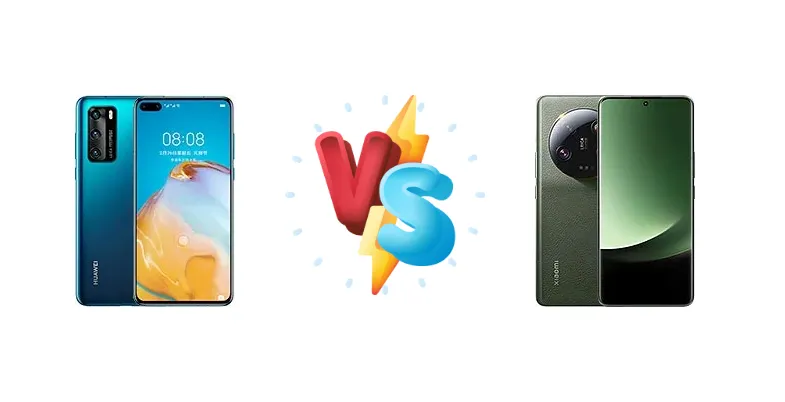
|
🏆 Quick Verdict
The Xiaomi 13 Ultra decisively wins this comparison. Its Snapdragon 8 Gen 2 chipset, vastly superior charging speeds, and exceptional camera system, coupled with a brighter display, make it a clear upgrade over the aging P40 4G. The P40 still holds value, but the 13 Ultra offers a significantly more modern experience.
| PHONES | ||
|---|---|---|
| Phone Names | Huawei P40 4G | Xiaomi 13 Ultra |
| Network | ||
|---|---|---|
| 2G bands | GSM 850 / 900 / 1800 / 1900 | GSM 850 / 900 / 1800 / 1900 |
| 3G bands | HSDPA 850 / 900 / 1700(AWS) / 1900 / 2100 | HSDPA 800 / 850 / 900 / 1700(AWS) / 1900 / 2100 |
| 4G bands | LTE | 1, 2, 3, 4, 5, 7, 8, 18, 19, 20, 26, 28, 38, 40, 41, 66 - International |
| 5G bands | - | 1, 3, 5, 7, 8, 20, 28, 38, 40, 41, 77, 78, 79 SA/NSA - International |
| Speed | HSPA, LTE | HSPA, LTE, 5G |
| Technology | GSM / HSPA / LTE | GSM / CDMA / HSPA / EVDO / LTE / 5G |
| - | CDMA2000 1xEV-DO | |
| Launch | ||
|---|---|---|
| Announced | 2021, February 26 | 2023, April 18 |
| Status | Available. Released 2021, February 26 | Available. Released 2023, April 21 |
| Body | ||
|---|---|---|
| Build | Glass front, glass back, aluminum frame | Glass front (Gorilla Glass Victus), eco leather back, aluminum frame |
| Dimensions | 148.9 x 71.1 x 8.5 mm (5.86 x 2.80 x 0.33 in) | 163.2 x 74.6 x 9.1 mm (6.43 x 2.94 x 0.36 in) |
| SIM | · Nano-SIM + eSIM· Nano-SIM + Nano-SIM | Nano-SIM + Nano-SIM |
| Weight | 175 g (6.17 oz) | 227 g (8.01 oz) |
| IP53, dust and splash resistant | IP68 dust/water resistant (up to 1.5m for 30 min) | |
| Display | ||
|---|---|---|
| Protection | - | Corning Gorilla Glass Victus |
| Resolution | 1080 x 2340 pixels, 19.5:9 ratio (~422 ppi density) | 1440 x 3200 pixels, 20:9 ratio (~522 ppi density) |
| Size | 6.1 inches, 91.3 cm2 (~86.3% screen-to-body ratio) | 6.73 inches, 108.9 cm2 (~89.5% screen-to-body ratio) |
| Type | OLED | LTPO AMOLED, 68B colors, 120Hz, Dolby Vision, HDR10+, 1300 nits (HBM), 2600 nits (peak) |
| Platform | ||
|---|---|---|
| CPU | Octa-core (2x2.86 GHz Cortex-A76 & 2x2.09 GHz Cortex-A76 & 4x1.86 GHz Cortex-A55) | Octa-core (1x3.2 GHz Cortex-X3 & 2x2.8 GHz Cortex-A715 & 2x2.8 GHz Cortex-A710 & 3x2.0 GHz Cortex-A510) |
| Chipset | Kirin 990 (7 nm+) | Qualcomm SM8550-AB Snapdragon 8 Gen 2 (4 nm) |
| GPU | Mali-G76 MP16 | Adreno 740 |
| OS | Android 10, EMUI, no Google Play Services | Android 13, upgradable to Android 14, HyperOS |
| Memory | ||
|---|---|---|
| Card slot | Nano Memory (uses shared SIM slot) | No |
| Internal | 128GB 4GB RAM, 128GB 8GB RAM | 256GB 12GB RAM, 512GB 12GB RAM, 512GB 16GB RAM, 1TB 16GB RAM |
| UFS 3.0 | UFS 4.0 | |
| Main Camera | ||
|---|---|---|
| Features | Leica optics, color spectrum sensor, LED flash, panorama, HDR | Laser AF, color spectrum sensor, Leica lenses, Dual-LED flash, HDR, panorama, 67mm filter ring holder (optional) |
| Quad | - | 50 MP, f/1.9 or f/4.0, 23mm (wide), 1.0"-type, 1.6µm, dual pixel PDAF, OIS 50 MP, f/1.8, 75mm (telephoto), 1/2.51", 0.7µm, dual pixel PDAF, OIS, 3.2x optical zoom 50 MP, f/3.0, 120mm (periscope telephoto), 1/2.51", 0.7µm, dual pixel PDAF, OIS, 5x optical zoom 50 MP, f/1.8, 12mm, 122˚ (ultrawide), 1/2.51", 0.7µm, dual pixel PDAF TOF 3D, (depth) |
| Single | 32 MP, f/2.0, 26mm (wide), 1/2.8", 0.8µm IR TOF 3D, (biometrics sensor only) | - |
| Triple | 50 MP, f/1.9, 23mm (wide), 1/1.28", 1.22µm, multi-directional PDAF, OIS 8 MP, f/2.4, 80mm (telephoto), PDAF, OIS, 3x optical zoom 16 MP, f/2.2, 17mm (ultrawide), AF | - |
| Video | 4K@30/60fps, 1080p@30/60fps, 720p@960fps; gyro-EIS | 8K@24fps, 4K@24/30/60fps, 1080p@30/60/120/240/480/960/1920fps, gyro-EIS, Dolby Vision HDR 10-bit rec. (4K@60fps, 1080p) |
| Selfie camera | ||
|---|---|---|
| Features | HDR | HDR, panorama |
| Single | 32 MP, f/2.0, 26mm (wide), 1/2.8", 0.8µm IR TOF 3D, (biometrics sensor only) | 32 MP, f/2.0, 22mm (wide), 1/3.14", 0.7µm |
| Video | 4K@30/60fps, 1080p@30/60fps | 1080p@30/60fps, gyro-EIS |
| Sound | ||
|---|---|---|
| 3.5mm jack | No | No |
| 35mm jack | No | No |
| Loudspeaker | Yes | Yes, with stereo speakers |
| - | 24-bit/192kHz audio | |
| Comms | ||
|---|---|---|
| Bluetooth | 5.1, A2DP, LE | 5.3, A2DP, LE, aptX HD, aptX Adaptive |
| Infrared port | - | Yes |
| NFC | Yes | Yes |
| Positioning | GPS (L1+L5), GLONASS (L1), BDS (B1I+B1c+B2a), GALILEO (E1+E5a), QZSS (L1+L5), NavIC | GPS (L1+L5), GLONASS (L1), BDS (B1I+B1c+B2a), GALILEO (E1+E5a), QZSS (L1+L5), NavIC (L5) |
| Radio | No | No |
| USB | USB Type-C 3.1, OTG | USB Type-C 3.2, DisplayPort, OTG |
| WLAN | Wi-Fi 802.11 a/b/g/n/ac/6, dual-band, Wi-Fi Direct | Wi-Fi 802.11 a/b/g/n/ac/6e/7, tri-band, Wi-Fi Direct |
| Features | ||
|---|---|---|
| Sensors | Infrared Face ID, fingerprint (under display, optical), accelerometer, gyro, proximity, compass | Fingerprint (under display, optical), accelerometer, proximity, gyro, compass, barometer |
| - | Virtual proximity sensing | |
| Battery | ||
|---|---|---|
| Charging | 22.5W wired | 90W wired, PD3.0, QC4, 100% in 35 min 50W wireless, 100% in 49 min 10W reverse wireless |
| Type | Li-Po 3800 mAh | Li-Po 5000 mAh |
| Misc | ||
|---|---|---|
| Colors | Frost Silver, Dark Blue | Black, Olive Green, White, Orange, Yellow, Blue |
| Models | ANA-AL00 | 2304FPN6DC, 2304FPN6DG |
| Price | About 500 EUR | € 797.98 / $ 389.69 |
| SAR EU | - | 0.99 W/kg (head) 1.00 W/kg (body) |
Huawei P40 4G
- Good camera for its price
- Sleek design
- Decent performance for everyday tasks
- Compact size
- Outdated chipset
- Slow charging
- Limited software updates
- Lower display brightness
Xiaomi 13 Ultra
- Exceptional camera system
- Powerful Snapdragon 8 Gen 2 chipset
- Fast charging (wired & wireless)
- Bright and vibrant display
- Long battery life
- Large and heavy design
- Premium price
- MIUI software can be polarizing
Display Comparison
The Xiaomi 13 Ultra boasts a significantly brighter display (1207 nits vs. P40's ~800 nits), offering better outdoor visibility. Both have OLED panels with vibrant colors, but the 13 Ultra's higher refresh rate (likely 120Hz, though not explicitly stated) provides smoother scrolling and animations. The P40's display is still good, but noticeably less impressive.
Camera Comparison
The Xiaomi 13 Ultra's camera system is a major highlight, featuring a versatile array of lenses and advanced image processing. It excels in both photo and video quality, offering superior detail, dynamic range, and low-light performance. The P40 4G has a capable camera, but it can't compete with the 13 Ultra's capabilities.
Performance
The Snapdragon 8 Gen 2 in the Xiaomi 13 Ultra is a generational leap over the Kirin 990 in the P40 4G. Expect dramatically faster app loading, smoother multitasking, and superior gaming performance from the 13 Ultra. The Kirin 990 is still capable for everyday tasks, but struggles with demanding applications.
Battery Life
The Xiaomi 13 Ultra offers significantly better battery life and charging speeds. Its 90W wired charging can fully charge the phone in just 35 minutes, while the P40 4G's 22.5W charging is considerably slower. The 13 Ultra's endurance rating is also much higher.
Buying Guide
Who should buy the Huawei P40 4G? Users seeking a budget-friendly option with a decent camera and don't require the latest features. Who should buy the Xiaomi 13 Ultra? Photography enthusiasts, power users, and anyone wanting a top-tier Android experience with cutting-edge technology and fast charging.