
Huawei P40 4G vs Samsung Galaxy S23: A Clash of Titans
| Phones Images | |||||
|---|---|---|---|---|---|
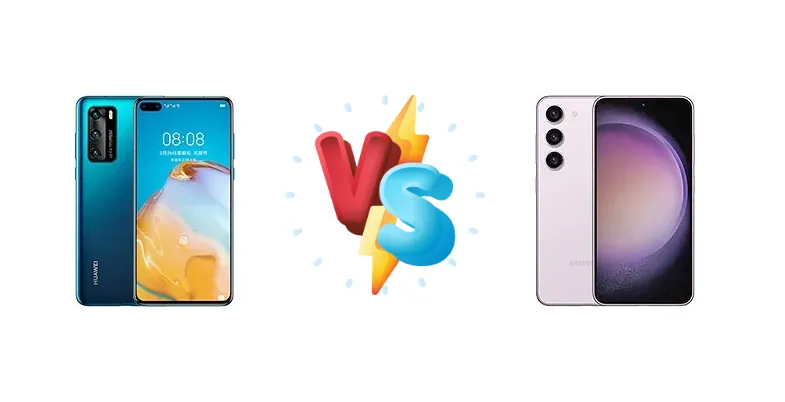
|
🏆 Quick Verdict
The Samsung Galaxy S23 is the clear winner, offering a significantly faster processor, brighter display, faster charging, and more modern features. While the P40 4G has a respectable camera, the S23's overall package and future-proofing make it the superior choice for most users.
| PHONES | ||
|---|---|---|
| Phone Names | Huawei P40 4G | Samsung Galaxy S23 |
| Network | ||
|---|---|---|
| 2G bands | GSM 850 / 900 / 1800 / 1900 | GSM 850 / 900 / 1800 / 1900 |
| 3G bands | HSDPA 850 / 900 / 1700(AWS) / 1900 / 2100 | HSDPA 850 / 900 / 1700(AWS) / 1900 / 2100 |
| 4G bands | LTE | 1, 2, 3, 4, 5, 7, 8, 12, 13, 17, 18, 19, 20, 25, 26, 28, 32, 38, 39, 40, 41, 66 - International |
| 5G bands | - | 1, 2, 3, 5, 7, 8, 12, 20, 25, 28, 38, 40, 41, 66, 75, 77, 78 SA/NSA/Sub6 - International |
| Speed | HSPA, LTE | HSPA, LTE (up to 7CA), 5G |
| Technology | GSM / HSPA / LTE | GSM / CDMA / HSPA / EVDO / LTE / 5G |
| - | 1, 7, 25, 28, 41, 66, 71, 78, 258, 260, 261 SA/NSA/Sub6/mmWave - USA | |
| Launch | ||
|---|---|---|
| Announced | 2021, February 26 | 2023, February 01 |
| Status | Available. Released 2021, February 26 | Available. Released 2023, February 17 |
| Body | ||
|---|---|---|
| Build | Glass front, glass back, aluminum frame | Glass front (Gorilla Glass Victus 2), glass back (Gorilla Glass Victus 2), aluminum frame |
| Dimensions | 148.9 x 71.1 x 8.5 mm (5.86 x 2.80 x 0.33 in) | 146.3 x 70.9 x 7.6 mm (5.76 x 2.79 x 0.30 in) |
| SIM | · Nano-SIM + eSIM· Nano-SIM + Nano-SIM | · Nano-SIM + eSIM· Nano-SIM + Nano-SIM + eSIM (max 2 at a time) |
| Weight | 175 g (6.17 oz) | 168 g (5.93 oz) |
| IP53, dust and splash resistant | IP68 dust/water resistant (up to 1.5m for 30 min) Armor aluminum frame with tougher drop and scratch resistance (advertised) | |
| Display | ||
|---|---|---|
| Protection | - | Corning Gorilla Glass Victus 2 |
| Resolution | 1080 x 2340 pixels, 19.5:9 ratio (~422 ppi density) | 1080 x 2340 pixels, 19.5:9 ratio (~425 ppi density) |
| Size | 6.1 inches, 91.3 cm2 (~86.3% screen-to-body ratio) | 6.1 inches, 90.1 cm2 (~86.8% screen-to-body ratio) |
| Type | OLED | Dynamic AMOLED 2X, 120Hz, HDR10+, 1200 nits (HBM), 1750 nits (peak) |
| - | Always-on display | |
| Platform | ||
|---|---|---|
| CPU | Octa-core (2x2.86 GHz Cortex-A76 & 2x2.09 GHz Cortex-A76 & 4x1.86 GHz Cortex-A55) | Octa-core (1x3.36 GHz Cortex-X3 & 2x2.8 GHz Cortex-A715 & 2x2.8 GHz Cortex-A710 & 3x2.0 GHz Cortex-A510) |
| Chipset | Kirin 990 (7 nm+) | Qualcomm SM8550-AC Snapdragon 8 Gen 2 (4 nm) |
| GPU | Mali-G76 MP16 | Adreno 740 |
| OS | Android 10, EMUI, no Google Play Services | Android 13, up to 4 major Android upgrades, One UI 8 |
| Memory | ||
|---|---|---|
| Card slot | Nano Memory (uses shared SIM slot) | No |
| Internal | 128GB 4GB RAM, 128GB 8GB RAM | 128GB 8GB RAM, 256GB 8GB RAM, 512GB 8GB RAM |
| UFS 3.0 | UFS 3.1 - 128GB only UFS 4.0 | |
| Main Camera | ||
|---|---|---|
| Features | Leica optics, color spectrum sensor, LED flash, panorama, HDR | LED flash, auto-HDR, panorama |
| Single | 32 MP, f/2.0, 26mm (wide), 1/2.8", 0.8µm IR TOF 3D, (biometrics sensor only) | 12 MP, f/2.2, 26mm (wide), Dual Pixel PDAF |
| Triple | 50 MP, f/1.9, 23mm (wide), 1/1.28", 1.22µm, multi-directional PDAF, OIS 8 MP, f/2.4, 80mm (telephoto), PDAF, OIS, 3x optical zoom 16 MP, f/2.2, 17mm (ultrawide), AF | 50 MP, f/1.8, 24mm (wide), 1/1.56", 1.0µm, dual pixel PDAF, OIS 10 MP, f/2.4, 70mm (telephoto), 1/3.94", 1.0µm, PDAF, OIS, 3x optical zoom 12 MP, f/2.2, 13mm, 120˚ (ultrawide), 1/2.55" 1.4µm, Super Steady video |
| Video | 4K@30/60fps, 1080p@30/60fps, 720p@960fps; gyro-EIS | 8K@24/30fps, 4K@30/60fps, 1080p@30/60/120/240fps, HDR10+, stereo sound rec., gyro-EIS |
| Selfie camera | ||
|---|---|---|
| Features | HDR | HDR, HDR10+ |
| Single | 32 MP, f/2.0, 26mm (wide), 1/2.8", 0.8µm IR TOF 3D, (biometrics sensor only) | 12 MP, f/2.2, 26mm (wide), 1/3.2", 1.12µm, dual pixel PDAF |
| Video | 4K@30/60fps, 1080p@30/60fps | 4K@30/60fps, 1080p@30fps |
| Sound | ||
|---|---|---|
| 3.5mm jack | No | No |
| 35mm jack | No | No |
| Loudspeaker | Yes | Yes, with stereo speakers |
| - | 32-bit/384kHz audio Tuned by AKG | |
| Comms | ||
|---|---|---|
| Bluetooth | 5.1, A2DP, LE | 5.3, A2DP, LE |
| NFC | Yes | Yes |
| Positioning | GPS (L1+L5), GLONASS (L1), BDS (B1I+B1c+B2a), GALILEO (E1+E5a), QZSS (L1+L5), NavIC | GPS, GLONASS, BDS, GALILEO |
| Radio | No | No |
| USB | USB Type-C 3.1, OTG | USB Type-C 3.2, OTG |
| WLAN | Wi-Fi 802.11 a/b/g/n/ac/6, dual-band, Wi-Fi Direct | Wi-Fi 802.11 a/b/g/n/ac/6e, tri-band, Wi-Fi Direct |
| Features | ||
|---|---|---|
| Sensors | Infrared Face ID, fingerprint (under display, optical), accelerometer, gyro, proximity, compass | Fingerprint (under display, ultrasonic), accelerometer, gyro, proximity, compass, barometer |
| - | Samsung DeX, Samsung Wireless DeX (desktop experience support) Bixby natural language commands and dictation Samsung Pay (Visa, MasterCard certified) | |
| Battery | ||
|---|---|---|
| Charging | 22.5W wired | 25W wired, PD3.0, 50% in 30 min 15W wireless (Qi) 4.5W reverse wireless |
| Type | Li-Po 3800 mAh | Li-Ion 3900 mAh |
| Misc | ||
|---|---|---|
| Colors | Frost Silver, Dark Blue | Phantom Black, Cream, Green, Lavender, Graphite, Lime |
| Models | ANA-AL00 | SM-S911B, SM-S911B/DS, SM-S911U, SM-S911U1, SM-S911W, SM-S911N, SM-S9110, SM-S911E, SM-S911E/DS |
| Price | About 500 EUR | $ 237.95 / C$ 336.75 / £ 255.00 / € 322.41 / ₹ 49,990 |
| SAR | - | 0.95 W/kg (head) 0.88 W/kg (body) |
| SAR EU | - | 0.96 W/kg (head) 1.30 W/kg (body) |
| Tests | ||
|---|---|---|
| Battery life | - | Endurance rating 101h |
| Camera | - | Photo / Video |
| Display | - | Contrast ratio: Infinite (nominal) |
| Loudspeaker | - | -27.0 LUFS (Good) |
| Performance | - | AnTuTu: 1231075 (v9) GeekBench: 4950 (v5.1) GFXBench: 110fps (ES 3.1 onscreen) |
Huawei P40 4G
- Excellent camera zoom
- Premium design and build quality
- Good OLED display
- Competitive price (now)
- Outdated chipset
- No 5G connectivity
- Slower charging
- Limited software updates
Samsung Galaxy S23
- Blazing-fast performance
- Bright and vibrant display
- Excellent camera system (especially video)
- Long battery life
- Fast charging (wired & wireless)
- 5G connectivity
- Regular software updates
- Higher price
- Design is evolutionary, not revolutionary
Display Comparison
The Samsung Galaxy S23 boasts a significantly brighter display (1198 nits peak) with an infinite contrast ratio, offering a more immersive and vibrant viewing experience. The P40 4G has a decent OLED display, but it lacks the S23's brightness and color accuracy. The S23's display is a clear winner.
Camera Comparison
Both phones offer excellent camera systems. The P40 4G is known for its impressive zoom capabilities and detailed images in good lighting. The Galaxy S23 excels in video recording and low-light photography, thanks to its advanced image processing and larger sensor. While subjective, the S23's versatility and overall image quality are generally considered superior.
Performance
The Snapdragon 8 Gen 2 in the Galaxy S23 provides a massive performance advantage over the Kirin 990 in the P40 4G. The S23 handles demanding games and multitasking with ease, while the P40 4G can show signs of lag under heavy load. The S23's newer architecture and fabrication process (4nm vs 7nm+) contribute to its superior efficiency and power.
Battery Life
The Galaxy S23 demonstrates exceptional battery life, achieving an endurance rating of 101 hours. It also supports faster charging (25W wired, 15W wireless) and reverse wireless charging. The P40 4G's battery life is respectable, but it falls short of the S23's longevity and charging speeds.
Buying Guide
The Huawei P40 4G is a good option for budget-conscious users who prioritize camera quality and a premium design, and don't mind the lack of 5G. The Samsung Galaxy S23 is ideal for those seeking top-tier performance, a vibrant display, excellent camera capabilities, and the latest Android features.