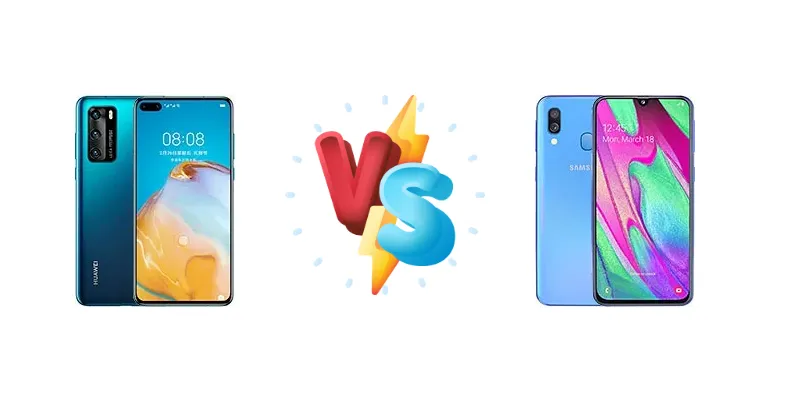
Choosing a new smartphone can be overwhelming. The Huawei P40 4G and Samsung Galaxy A40 offer compelling features at different price points. This comprehensive comparison will break down their strengths and weaknesses to help you make an informed decision.
🏆 Quick Verdict
The Huawei P40 4G boasts a significantly more powerful chipset and a superior camera system. However, the Galaxy A40 offers exceptional battery life and a potentially more accessible price. For performance and photography, the P40 4G wins, but budget-conscious users might prefer the A40.
| Network |
|---|
| 2G bands | GSM 850 / 900 / 1800 / 1900 | GSM 850 / 900 / 1800 / 1900 |
| 3G bands | HSDPA 850 / 900 / 1700(AWS) / 1900 / 2100 | HSDPA 850 / 900 / 1900 / 2100 |
| 4G bands | LTE | 1, 3, 5, 7, 8, 20, 38, 40, 41 |
| Speed | HSPA, LTE | HSPA 42.2/5.76 Mbps, LTE (2CA) Cat12 600/150 Mbps |
| Technology | GSM / HSPA / LTE | GSM / HSPA / LTE |
| Launch |
|---|
| Announced | 2021, February 26 | 2019, March 19. Released 2019, April |
| Status | Available. Released 2021, February 26 | Discontinued |
| Body |
|---|
| Build | Glass front, glass back, aluminum frame | Glass front (Gorilla Glass 3), plastic back, plastic frame |
| Dimensions | 148.9 x 71.1 x 8.5 mm (5.86 x 2.80 x 0.33 in) | 144.4 x 69.2 x 7.9 mm (5.69 x 2.72 x 0.31 in) |
| SIM | · Nano-SIM + eSIM· Nano-SIM + Nano-SIM | · Nano-SIM· Nano-SIM + Nano-SIM |
| Weight | 175 g (6.17 oz) | 140 g (4.94 oz) |
| | IP53, dust and splash resistant | - |
| Display |
|---|
| Protection | - | Corning Gorilla Glass 3 |
| Resolution | 1080 x 2340 pixels, 19.5:9 ratio (~422 ppi density) | 1080 x 2340 pixels, 19.5:9 ratio (~437 ppi density) |
| Size | 6.1 inches, 91.3 cm2 (~86.3% screen-to-body ratio) | 5.9 inches, 85.5 cm2 (~85.5% screen-to-body ratio) |
| Type | OLED | Super AMOLED |
| Platform |
|---|
| CPU | Octa-core (2x2.86 GHz Cortex-A76 & 2x2.09 GHz Cortex-A76 & 4x1.86 GHz Cortex-A55) | Octa-core (2x1.77 GHz Cortex-A73 & 6x1.59 GHz Cortex-A53) |
| Chipset | Kirin 990 (7 nm+) | Exynos 7904 (14 nm) |
| GPU | Mali-G76 MP16 | Mali-G71 MP2 |
| OS | Android 10, EMUI, no Google Play Services | Android 9.0 (Pie), upgradable to Android 11 |
| Memory |
|---|
| Card slot | Nano Memory (uses shared SIM slot) | microSDXC (dedicated slot) |
| Internal | 128GB 4GB RAM, 128GB 8GB RAM | 64GB 4GB RAM, 128GB 4GB RAM |
| | UFS 3.0 | eMMC 5.1 |
| Main Camera |
|---|
| Dual | - | 16 MP, f/1.7, 26mm (wide), PDAF
5 MP, f/2.2, 13mm (ultrawide) |
| Features | Leica optics, color spectrum sensor, LED flash, panorama, HDR | LED flash, panorama, HDR |
| Single | 32 MP, f/2.0, 26mm (wide), 1/2.8", 0.8µm
IR TOF 3D, (biometrics sensor only) | - |
| Triple | 50 MP, f/1.9, 23mm (wide), 1/1.28", 1.22µm, multi-directional PDAF, OIS
8 MP, f/2.4, 80mm (telephoto), PDAF, OIS, 3x optical zoom
16 MP, f/2.2, 17mm (ultrawide), AF | - |
| Video | 4K@30/60fps, 1080p@30/60fps, 720p@960fps; gyro-EIS | 1080p@30fps |
| Selfie camera |
|---|
| Features | HDR | - |
| Single | 32 MP, f/2.0, 26mm (wide), 1/2.8", 0.8µm
IR TOF 3D, (biometrics sensor only) | 25 MP, f/2.0, 25mm (wide), 1/2.8", 0.9µm |
| Video | 4K@30/60fps, 1080p@30/60fps | 1080p@30fps |
| Sound |
|---|
| 3.5mm jack | No | Yes |
| 35mm jack | No | Yes |
| Loudspeaker | Yes | Yes |
| Comms |
|---|
| Bluetooth | 5.1, A2DP, LE | 5.0, A2DP, LE |
| NFC | Yes | Yes |
| Positioning | GPS (L1+L5), GLONASS (L1), BDS (B1I+B1c+B2a), GALILEO (E1+E5a), QZSS (L1+L5), NavIC | GPS, GLONASS, GALILEO, BDS |
| Radio | No | FM radio |
| USB | USB Type-C 3.1, OTG | USB Type-C 2.0 |
| WLAN | Wi-Fi 802.11 a/b/g/n/ac/6, dual-band, Wi-Fi Direct | Wi-Fi 802.11 a/b/g/n/ac, dual-band, Wi-Fi Direct |
| Features |
|---|
| Sensors | Infrared Face ID, fingerprint (under display, optical), accelerometer, gyro, proximity, compass | Fingerprint (rear-mounted), accelerometer, gyro, proximity, compass |
| | - | ANT+ |
| Battery |
|---|
| Charging | 22.5W wired | 15W wired |
| Type | Li-Po 3800 mAh | Li-Po 3100 mAh, non-removable |
| Misc |
|---|
| Colors | Frost Silver, Dark Blue | Black, White, Blue, Coral |
| Models | ANA-AL00 | SM-A405F, SM-A405FN, SM-A405FM, SM-A405S |
| Price | About 500 EUR | About 260 EUR |
| SAR EU | - | 0.49 W/kg (head) 1.34 W/kg (body) |
| Tests |
|---|
| Audio quality | - |
Noise -91.0dB / Crosstalk -85.9dB |
| Battery life | - | Endurance rating 73h |
| Camera | - |
Photo / Video |
| Display | - |
Contrast ratio: infinite |
| Loudspeaker | - |
Voice 66dB / Noise 68dB / Ring 73dB |
| Performance | - |
AnTuTu: 106388 (v7)
GeekBench: 4112 (v4.4)
GFXBench: 4.6fps (ES 3.1 onscreen) |
Huawei P40 4G
- Superior Performance
- Excellent Camera System
- Premium Build Quality
- Faster Charging (22.5W)
- Potentially Higher Price
- Limited Google Services (due to US sanctions)
- Battery life not as exceptional as A40
Samsung Galaxy A40
- Exceptional Battery Life (73h endurance)
- Vibrant Display with High Contrast
- More Affordable
- Good Value for Money
- Less Powerful Chipset
- Camera Not as Impressive
- Slower Charging (15W)
Display Comparison
The Samsung Galaxy A40's display shines with its impressive contrast ratio (infinite) and measured 548 nits brightness, offering vivid colors and good visibility even in sunlight. The P40 4G likely has a good OLED display, but specific brightness figures are harder to find. Overall, the A40 has a slight edge in display metrics.
Camera Comparison
The Huawei P40 4G is renowned for its exceptional camera capabilities, featuring a Leica-engineered triple-lens system. While the Galaxy A40 has a capable camera, it simply can't compete with the P40 4G's image quality, zoom capabilities, and overall versatility. The P40 4G excels in low-light conditions.
Performance
Here, the Huawei P40 4G takes a commanding lead. Its Kirin 990 chipset, built on a 7nm+ process, is significantly more powerful than the Galaxy A40's Exynos 7904 (14nm). Expect smoother multitasking, faster app loading, and better gaming performance on the P40 4G.
Battery Life
The Samsung Galaxy A40 shines in this category. Its endurance rating of 73 hours is remarkable, suggesting exceptional battery life. The Huawei P40 4G's battery life is respectable, but not as impressive as the A40's. The A40's 15W charging is slower than the P40 4G's 22.5W.
Buying Guide
The Huawei P40 4G is ideal for users prioritizing performance, camera quality, and a premium feel. The Samsung Galaxy A40 is a great choice for those seeking long battery life, a vibrant display, and a more budget-friendly option.
Frequently Asked Questions
❓ Is the Huawei P40 4G worth buying in 2024?
It depends. If you prioritize performance and camera quality and don't mind the lack of Google services, it's still a capable phone. However, consider newer alternatives if Google services are essential.
❓ Does the Samsung Galaxy A40 still receive software updates?
Software support for the Galaxy A40 has largely ended. It's unlikely to receive major Android updates, but may still get security patches for a limited time.