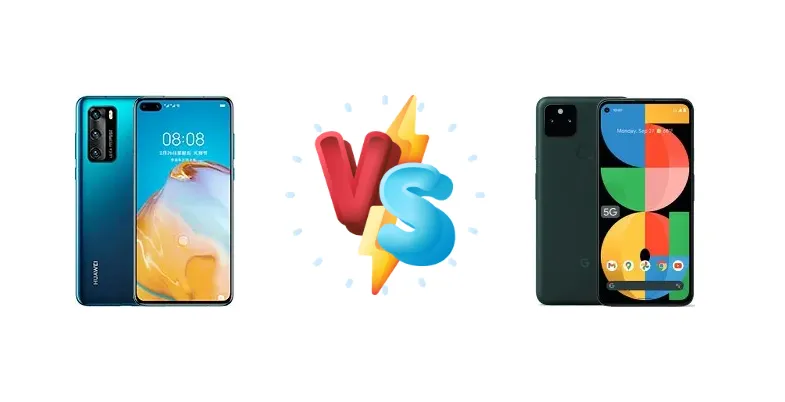
Choosing a new smartphone can be overwhelming. The Huawei P40 4G and Google Pixel 5a 5G offer compelling features, but cater to different needs. This comprehensive comparison will break down their strengths and weaknesses to help you make an informed decision.
🏆 Quick Verdict
The Pixel 5a 5G offers a cleaner Android experience, 5G connectivity, and excellent camera performance. The P40 4G boasts a more powerful chipset and potentially better image processing in certain scenarios, but lacks 5G and has a less optimized software ecosystem. The Pixel wins for most users.
| Network |
|---|
| 2G bands | GSM 850 / 900 / 1800 / 1900 | GSM 850 / 900 / 1800 / 1900 |
| 3G bands | HSDPA 850 / 900 / 1700(AWS) / 1900 / 2100 | HSDPA 850 / 900 / 1700(AWS) / 1900 / 2100 |
| 4G bands | LTE | 1, 2, 3, 4, 5, 7, 8, 12, 13, 14, 17, 18, 19, 20, 25, 26, 28, 29, 30, 32, 38, 39, 40, 41, 42, 46, 48, 66, 71 |
| 5G bands | - | 1, 2, 5, 12, 25, 28, 41, 66, 71, 77, 78 SA/NSA/Sub6 |
| Speed | HSPA, LTE | HSPA, LTE, 5G |
| Technology | GSM / HSPA / LTE | GSM / HSPA / EVDO / LTE / 5G |
| | - | CDMA2000 1xEV-DO |
| Launch |
|---|
| Announced | 2021, February 26 | 2021, August 17 |
| Status | Available. Released 2021, February 26 | Available. Released 2021, August 26 |
| Body |
|---|
| Build | Glass front, glass back, aluminum frame | Glass front (Gorilla Glass 3), aluminum frame, aluminum back |
| Dimensions | 148.9 x 71.1 x 8.5 mm (5.86 x 2.80 x 0.33 in) | 156.2 x 73.2 x 8.8 mm (6.15 x 2.88 x 0.35 in) |
| SIM | · Nano-SIM + eSIM· Nano-SIM + Nano-SIM | Nano-SIM + eSIM |
| Weight | 175 g (6.17 oz) | 183 g (6.46 oz) |
| | IP53, dust and splash resistant | IP67 dust/water resistant (up to 1m for 30 min) |
| Display |
|---|
| Protection | - | Corning Gorilla Glass 3 |
| Resolution | 1080 x 2340 pixels, 19.5:9 ratio (~422 ppi density) | 1080 x 2400 pixels, 20:9 ratio (~415 ppi density) |
| Size | 6.1 inches, 91.3 cm2 (~86.3% screen-to-body ratio) | 6.34 inches, 97.0 cm2 (~84.9% screen-to-body ratio) |
| Type | OLED | OLED, HDR |
| | - | Always-on display |
| Platform |
|---|
| CPU | Octa-core (2x2.86 GHz Cortex-A76 & 2x2.09 GHz Cortex-A76 & 4x1.86 GHz Cortex-A55) | Octa-core (1x2.4 GHz Kryo 475 Prime & 1x2.2 GHz Kryo 475 Gold & 6x1.8 GHz Kryo 475 Silver) |
| Chipset | Kirin 990 (7 nm+) | Qualcomm SM7250 Snapdragon 765G 5G (7 nm) |
| GPU | Mali-G76 MP16 | Adreno 620 |
| OS | Android 10, EMUI, no Google Play Services | Android 11, upgradable to Android 14 |
| Memory |
|---|
| Card slot | Nano Memory (uses shared SIM slot) | No |
| Internal | 128GB 4GB RAM, 128GB 8GB RAM | 128GB 6GB RAM |
| | UFS 3.0 | - |
| Main Camera |
|---|
| Dual | - | 12.2 MP, f/1.7, 27mm, (wide), 1/2.55", 1.4µm, dual pixel PDAF, OIS
16 MP, f/2.2, 119˚ (ultrawide), 1.0µm |
| Features | Leica optics, color spectrum sensor, LED flash, panorama, HDR | LED flash, Pixel Shift, Auto-HDR, panorama |
| Single | 32 MP, f/2.0, 26mm (wide), 1/2.8", 0.8µm
IR TOF 3D, (biometrics sensor only) | 8 MP, f/2.0, 24mm (wide), 1.12µm |
| Triple | 50 MP, f/1.9, 23mm (wide), 1/1.28", 1.22µm, multi-directional PDAF, OIS
8 MP, f/2.4, 80mm (telephoto), PDAF, OIS, 3x optical zoom
16 MP, f/2.2, 17mm (ultrawide), AF | - |
| Video | 4K@30/60fps, 1080p@30/60fps, 720p@960fps; gyro-EIS | 4K@30/60fps, 1080p@30/60/120/240fps; gyro-EIS |
| Selfie camera |
|---|
| Features | HDR | HDR |
| Single | 32 MP, f/2.0, 26mm (wide), 1/2.8", 0.8µm
IR TOF 3D, (biometrics sensor only) | 8 MP, f/2.0, 24mm (wide), 1.12µm |
| Video | 4K@30/60fps, 1080p@30/60fps | 1080p@30fps |
| Sound |
|---|
| 3.5mm jack | No | Yes |
| 35mm jack | No | Yes |
| Loudspeaker | Yes | Yes, with stereo speakers |
| Comms |
|---|
| Bluetooth | 5.1, A2DP, LE | 5.0, A2DP, LE, aptX HD |
| NFC | Yes | Yes |
| Positioning | GPS (L1+L5), GLONASS (L1), BDS (B1I+B1c+B2a), GALILEO (E1+E5a), QZSS (L1+L5), NavIC | GPS, GLONASS, GALILEO, QZSS, BDS |
| Radio | No | No |
| USB | USB Type-C 3.1, OTG | USB Type-C 3.1 |
| WLAN | Wi-Fi 802.11 a/b/g/n/ac/6, dual-band, Wi-Fi Direct | Wi-Fi 802.11 a/b/g/n/ac, dual-band, Wi-Fi Direct |
| Features |
|---|
| Sensors | Infrared Face ID, fingerprint (under display, optical), accelerometer, gyro, proximity, compass | Fingerprint (rear-mounted), accelerometer, gyro, proximity, compass, barometer |
| Battery |
|---|
| Charging | 22.5W wired | 18W wired, PD2.0 |
| Type | Li-Po 3800 mAh | Li-Po 4680 mAh |
| Misc |
|---|
| Colors | Frost Silver, Dark Blue | Mostly Black |
| Models | ANA-AL00 | G1F8F, G4S1M |
| Price | About 500 EUR | $ 189.00 / C$ 249.99 |
| Tests |
|---|
| Battery life | - |
Endurance rating 122h
|
| Display | - |
Contrast ratio: Infinite (nominal) |
| Performance | - |
AnTuTu: 291303 (v8)
GeekBench: 1337 (v5.1)
GFXBench: 19fps (ES 3.1 onscreen) |
Huawei P40 4G
- Powerful Kirin 990 chipset
- Excellent build quality and design
- Versatile camera system with strong zoom
- Good battery life
- No 5G connectivity
- Huawei's ecosystem limitations
- Slower charging speed
- Software updates may be limited
Google Pixel 5a 5G
- Clean and optimized Android experience
- Excellent camera with Google's computational photography
- 5G connectivity
- Good battery life
- Regular software updates
- Less powerful chipset than P40 4G
- Slower charging speed
- Design is more utilitarian
Display Comparison
The Pixel 5a 5G's display shines with a measured 861 nits of peak brightness, offering excellent visibility even in direct sunlight. Its infinite contrast ratio (nominal) suggests deep blacks. The P40 4G's display is good, but lacks the Pixel's brightness advantage. Color accuracy is generally good on both, but the Pixel's outdoor performance is superior.
Camera Comparison
Both phones offer excellent camera systems. The Pixel 5a 5G leverages Google's computational photography prowess, delivering consistently impressive images with accurate colors and excellent dynamic range. The P40 4G's camera system is versatile, with a strong zoom capability, but its color science can be less consistent. The Pixel generally wins for ease of use and consistent quality.
Performance
The Huawei P40 4G's Kirin 990 chipset is undeniably more powerful on paper than the Snapdragon 765G in the Pixel 5a 5G. This translates to smoother performance in demanding games and applications. However, Google's software optimization often allows the Pixel 5a 5G to feel surprisingly responsive in everyday use. The P40 4G's advantage is noticeable, but not always game-changing.
Battery Life
Both phones boast impressive endurance ratings of 122h. Real-world usage will vary, but both should easily last a full day, and potentially longer with moderate use. The Pixel 5a 5G supports PD2.0 fast charging, while the P40 4G is limited to 22.5W wired charging.
Buying Guide
The Huawei P40 4G is ideal for users prioritizing raw processing power and a premium design, who don't need 5G and are comfortable with Huawei's ecosystem. The Google Pixel 5a 5G is perfect for those seeking a reliable, clean Android experience, excellent camera quality, and 5G connectivity at a mid-range price.
Frequently Asked Questions
❓ Does the Huawei P40 4G have Google Play Services?
No, the Huawei P40 4G does not have Google Play Services pre-installed. Users need to use Huawei's AppGallery or sideload apps.
❓ Is the Pixel 5a 5G worth buying if I don't need 5G?
Yes, even without 5G, the Pixel 5a 5G offers a fantastic camera, clean Android experience, and regular updates, making it a compelling choice.