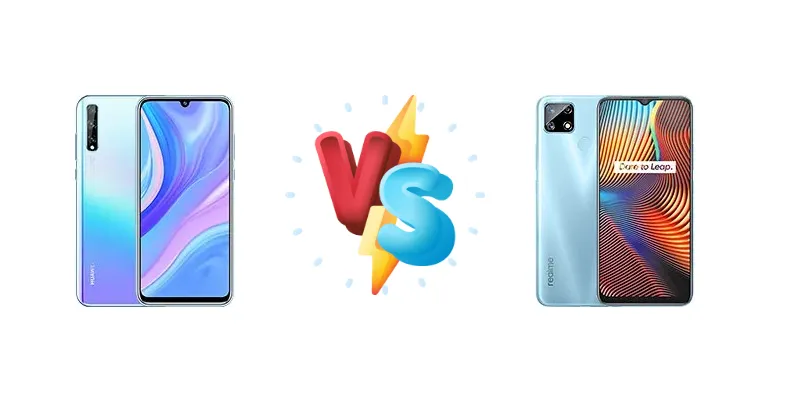
The Huawei P Smart S and Realme 7i represent compelling options in the crowded budget smartphone market. Both aim to deliver essential features at an accessible price point, but they diverge significantly in their core hardware. This comparison dissects the key differences – particularly the chipset and charging capabilities – to determine which device offers the best value for your money.
🏆 Quick Verdict
For most users, the Realme 7i (Global) emerges as the stronger choice. While the Huawei P Smart S offers a familiar EMUI experience, the Realme 7i’s Helio G85 chipset provides a noticeable performance edge, and its 18W fast charging significantly reduces downtime compared to the P Smart S’s 10W charging.
| Network |
|---|
| 2G bands | GSM 900 / 1800 / 1900 | GSM 850 / 900 / 1800 / 1900 |
| 3G bands | HSDPA 850 / 900 / 1700(AWS) / 1900 / 2100 | HSDPA 850 / 900 / 1700(AWS) / 1900 / 2100 |
| 4G bands | 1, 2, 3, 4, 5, 7, 8, 26, 20, 28, 38, 40, 41 | 1, 2, 3, 4, 5, 7, 8, 20, 28, 38, 40, 41 |
| Speed | HSPA, LTE | HSPA, LTE |
| Technology | GSM / HSPA / LTE | GSM / HSPA / LTE |
| Launch |
|---|
| Announced | 2020, June 09. Released 2020, June 09 | 2020, December 22. Released 2020, December 23 |
| Status | Discontinued | Discontinued |
| Body |
|---|
| Dimensions | 157.4 x 73.2 x 7.8 mm (6.20 x 2.88 x 0.31 in) | 164.5 x 75.9 x 9.8 mm (6.48 x 2.99 x 0.39 in) |
| SIM | Nano-SIM + Nano-SIM | Nano-SIM + Nano-SIM |
| Weight | 163 g (5.75 oz) | 208 g (7.34 oz) |
| Display |
|---|
| Resolution | 1080 x 2400 pixels, 20:9 ratio (~418 ppi density) | 720 x 1600 pixels, 20:9 ratio (~270 ppi density) |
| Size | 6.3 inches, 95.8 cm2 (~83.2% screen-to-body ratio) | 6.5 inches, 102.0 cm2 (~81.7% screen-to-body ratio) |
| Type | OLED | IPS LCD, 450 nits (typ), 560 nits (peak) |
| Platform |
|---|
| CPU | Octa-core (4x2.2 GHz Cortex-A73 & 4x1.7 GHz Cortex-A53) | Octa-core (2x2.0 GHz Cortex-A75 & 6x1.8 GHz Cortex-A55) |
| Chipset | Kirin 710F (12 nm) | Mediatek MT6769Z Helio G85 (12 nm) |
| GPU | Mali-G51 MP4 | Mali-G52 MC2 |
| OS | Android 10, EMUI 10.1, no Google Play Services | Android 10, Realme UI |
| Memory |
|---|
| Card slot | Nano Memory (uses shared SIM slot) | microSDXC (dedicated slot) |
| Internal | 128GB 4GB RAM | 64GB 4GB RAM |
| | - | eMMC 5.1 |
| Main Camera |
|---|
| Features | LED flash, HDR, panorama | LED flash, HDR, panorama |
| Triple | 48 MP, f/1.8, 27mm (wide), 1/2.0", 0.8µm, PDAF
8 MP, f/2.4, 120˚ (ultrawide)
Auxiliary lens | 48 MP, f/1.8, 26mm (wide), 1/2.0", 0.8µm, PDAF
8 MP, f/2.3, 16mm, 119˚ (ultrawide), 1/4.0", 1.12µm
2 MP (macro) |
| Video | 1080p@30fps | 1080p@30/60fps |
| Selfie camera |
|---|
| Features | HDR | HDR, panorama |
| Single | 16 MP, f/2.0 | 8 MP, f/2.0, 26mm (wide), 1/4.0", 1.12µm |
| Video | 1080p@30fps | 1080p@30fps |
| Sound |
|---|
| 3.5mm jack | Yes | Yes |
| 35mm jack | Yes | Yes |
| Loudspeaker | Yes | Yes |
| Comms |
|---|
| Bluetooth | 5.0, A2DP, LE | 5.0, A2DP, LE, aptX HD |
| NFC | Yes | No |
| Positioning | GPS, GLONASS, BDS | GPS, GLONASS, BDS |
| Radio | FM radio | FM radio |
| USB | USB Type-C 2.0, OTG | USB Type-C 2.0, OTG |
| WLAN | Wi-Fi 802.11 a/b/g/n/ac, dual-band, Wi-Fi Direct | Wi-Fi 802.11 a/b/g/n/ac, dual-band, Wi-Fi Direct |
| Features |
|---|
| Sensors | Fingerprint (under display, optical), accelerometer, proximity, compass | Fingerprint (rear-mounted), accelerometer, proximity, compass |
| Battery |
|---|
| Charging | 10W wired | 18W wired
5W reverse wired |
| Type | Li-Po 4000 mAh | 6000 mAh |
| Misc |
|---|
| Colors | Breathing Crystal, Midnight Black | Glory Silver, Victory Blue |
| Price | About 260 EUR | About 190 EUR |
Huawei P Smart S
- Familiar EMUI software experience
- Potentially more refined software optimization
- Clean aesthetic design
- Slower 10W charging
- Less powerful Kirin 710F chipset
- Limited gaming performance
Realme 7i (Global)
- Faster 18W charging with reverse charging
- More powerful MediaTek Helio G85 chipset
- Better performance for gaming and multitasking
- Realme UI may not appeal to all users
- Potential for more bloatware
- Software update support may be less consistent
Display Comparison
Neither device boasts a standout display. Both utilize 12nm chipsets, suggesting similar power constraints impacting display capabilities. While specific display specs (resolution, panel type) are missing, the focus here is on performance. The absence of high refresh rates on either device indicates a prioritization of battery life over visual fluidity. Bezels are likely comparable given the price bracket, and color accuracy will likely be standard for this segment.
Camera Comparison
Without detailed camera specs beyond the presence of sensors, a direct comparison is limited. However, the Realme 7i’s brand positioning suggests a greater emphasis on camera features. The P Smart S likely relies heavily on software processing to enhance image quality. Given the price point, both phones will struggle in low-light conditions, and the usefulness of any 2MP macro sensors on either device is questionable. Expect similar video recording capabilities, likely capped at 1080p/30fps.
Performance
The core difference lies in the chipsets. The Realme 7i’s MediaTek Helio G85 (12nm) features a more modern CPU architecture with 2x2.0 GHz Cortex-A75 cores and 6x1.8 GHz Cortex-A55 cores, compared to the Huawei P Smart S’s Kirin 710F (12nm) with 4x2.2 GHz Cortex-A73 and 4x1.7 GHz Cortex-A53 cores. The Cortex-A75 cores in the Helio G85 offer a performance advantage in single-core tasks and are more efficient. While both are 12nm, the Helio G85’s architecture translates to better responsiveness in app loading and multitasking. The Realme 7i is likely to handle graphically intensive games with slightly higher frame rates and fewer stutters.
Battery Life
The Realme 7i’s 18W wired charging is a significant advantage over the Huawei P Smart S’s 10W charging. This translates to a substantially faster 0-100% charge time, reducing downtime. While battery capacity isn’t specified, the faster charging speed of the Realme 7i mitigates any potential disadvantage from a slightly smaller battery. The Realme 7i also includes 5W reverse wired charging, a feature absent on the P Smart S, allowing it to top up accessories like earbuds.
Buying Guide
Buy the Huawei P Smart S if you prioritize a streamlined, familiar software experience with EMUI and are less concerned with demanding gaming or rapid charging. Buy the Realme 7i (Global) if you prioritize performance for everyday tasks and light gaming, and value the convenience of faster charging, making it ideal for users constantly on the go.
Frequently Asked Questions
❓ Does the Kirin 710F in the Huawei P Smart S struggle with demanding apps like TikTok or Instagram?
The Kirin 710F is capable of running social media apps, but you may experience occasional lag or stuttering when multitasking or using resource-intensive features within those apps. The Helio G85 in the Realme 7i offers a smoother experience for these types of applications.
❓ How long does it realistically take to fully charge the Realme 7i with the 18W charger?
With the included 18W charger, the Realme 7i can typically charge from 0% to 100% in approximately 1 hour and 45 minutes to 2 hours, depending on usage during charging. This is significantly faster than the Huawei P Smart S, which will likely take over 3 hours with its 10W charger.
❓ Is the Realme 7i a good option for playing PUBG Mobile or other popular battle royale games?
The Realme 7i’s Helio G85 chipset is capable of running PUBG Mobile at medium settings with reasonable frame rates. While it won’t deliver a flagship gaming experience, it provides a playable experience for casual gamers. The Huawei P Smart S will likely require lower settings and may experience more frequent frame drops.
❓ Does the Huawei P Smart S still have access to Google Mobile Services (GMS)?
The Huawei P Smart S, depending on the specific release date and region, may or may not have access to Google Mobile Services (GMS). If it lacks GMS, you'll rely on Huawei's AppGallery and potentially workarounds to install popular apps like Google Maps and YouTube.