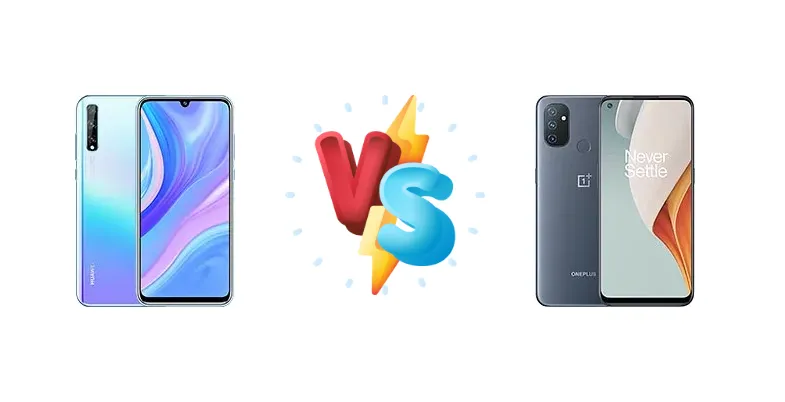
The sub-$150 smartphone market is fiercely competitive. Both the Huawei P Smart S and the OnePlus Nord N100 aim to deliver a functional Android experience without breaking the bank. However, they take different approaches to achieving this, primarily in their chipset choices and charging capabilities. This comparison dissects those differences to determine which phone offers the best value.
🏆 Quick Verdict
For most users, the OnePlus Nord N100 represents the better value. While the Kirin 710F in the P Smart S is a capable chip, the Snapdragon 460’s more modern architecture and, crucially, the Nord N100’s 18W fast charging provide a more responsive and convenient user experience. The $125 price point further solidifies its position.
| Network |
|---|
| 2G bands | GSM 900 / 1800 / 1900 | GSM 850 / 900 / 1800 / 1900 |
| 3G bands | HSDPA 850 / 900 / 1700(AWS) / 1900 / 2100 | HSDPA 850 / 900 / 1700(AWS) / 1900 / 2100 |
| 4G bands | 1, 2, 3, 4, 5, 7, 8, 26, 20, 28, 38, 40, 41 | 1, 2, 3, 4, 5, 7, 8, 12, 17, 20, 28, 38, 40, 41 - International |
| Speed | HSPA, LTE | HSPA 42.2/5.76 Mbps, LTE Cat13 400/50 Mbps |
| Technology | GSM / HSPA / LTE | GSM / CDMA / HSPA / LTE |
| | - | 1, 2, 3, 4, 5, 7, 8, 12, 13, 17, 20, 25, 26, 28, 38, 41, 66, 71 - USA |
| Launch |
|---|
| Announced | 2020, June 09. Released 2020, June 09 | 2020, October 26 |
| Status | Discontinued | Available. Released 2020, November 11 |
| Body |
|---|
| Build | - | Glass front (Gorilla Glass 3), plastic frame |
| Dimensions | 157.4 x 73.2 x 7.8 mm (6.20 x 2.88 x 0.31 in) | 164.9 x 75.1 x 8.5 mm (6.49 x 2.96 x 0.33 in) |
| SIM | Nano-SIM + Nano-SIM | Nano-SIM + Nano-SIM |
| Weight | 163 g (5.75 oz) | 188 g (6.63 oz) |
| Display |
|---|
| Protection | - | Corning Gorilla Glass 3 |
| Resolution | 1080 x 2400 pixels, 20:9 ratio (~418 ppi density) | 720 x 1600 pixels, 20:9 ratio (~269 ppi density) |
| Size | 6.3 inches, 95.8 cm2 (~83.2% screen-to-body ratio) | 6.52 inches, 102.6 cm2 (~82.9% screen-to-body ratio) |
| Type | OLED | IPS LCD, 90Hz |
| Platform |
|---|
| CPU | Octa-core (4x2.2 GHz Cortex-A73 & 4x1.7 GHz Cortex-A53) | Octa-core (4x1.8 GHz Kryo 240 & 4x1.6 GHz Kryo 240) |
| Chipset | Kirin 710F (12 nm) | Qualcomm SM4250 Snapdragon 460 (11 nm) |
| GPU | Mali-G51 MP4 | Adreno 610 |
| OS | Android 10, EMUI 10.1, no Google Play Services | Android 10, OxygenOS 10.5.9 |
| Memory |
|---|
| Card slot | Nano Memory (uses shared SIM slot) | microSDXC |
| Internal | 128GB 4GB RAM | 64GB 4GB RAM |
| | - | UFS 2.1 |
| Main Camera |
|---|
| Features | LED flash, HDR, panorama | LED flash, HDR, panorama |
| Triple | 48 MP, f/1.8, 27mm (wide), 1/2.0", 0.8µm, PDAF
8 MP, f/2.4, 120˚ (ultrawide)
Auxiliary lens | 13 MP, f/2.2, (wide), PDAF
2 MP (macro)
Auxiliary lens |
| Video | 1080p@30fps | 1080p@30fps, gyro-EIS |
| Selfie camera |
|---|
| Features | HDR | HDR |
| Single | 16 MP, f/2.0 | 8 MP, f/2.0 |
| Video | 1080p@30fps | 1080p@30fps |
| Sound |
|---|
| 3.5mm jack | Yes | Yes |
| 35mm jack | Yes | Yes |
| Loudspeaker | Yes | Yes, with stereo speakers |
| Comms |
|---|
| Bluetooth | 5.0, A2DP, LE | 5.0, A2DP, LE |
| NFC | Yes | - |
| Positioning | GPS, GLONASS, BDS | GPS, GLONASS, GALILEO, BDS |
| Radio | FM radio | FM radio |
| USB | USB Type-C 2.0, OTG | USB Type-C 2.0, OTG |
| WLAN | Wi-Fi 802.11 a/b/g/n/ac, dual-band, Wi-Fi Direct | Wi-Fi 802.11 a/b/g/n/ac, dual-band, Wi-Fi Direct |
| Features |
|---|
| Sensors | Fingerprint (under display, optical), accelerometer, proximity, compass | Fingerprint (rear-mounted), accelerometer, gyro, proximity, compass |
| Battery |
|---|
| Charging | 10W wired | 18W wired |
| Type | Li-Po 4000 mAh | Li-Po 5000 mAh |
| Misc |
|---|
| Colors | Breathing Crystal, Midnight Black | Midnight Frost |
| Models | - | BE2013, BE2015, BE2011, BE2012 |
| Price | About 260 EUR | About 80 EUR |
| Pricing |
|---|
| 64GB 4GB RAM | - | $ 125.00 |
| RENEWED | - | $ 129.00 |
Huawei P Smart S
- Potentially more refined software experience (Huawei EMUI)
- Slightly higher CPU clock speeds on performance cores
- May offer a more aesthetically pleasing design (subjective)
- Lacks Google Mobile Services (GMS)
- Significantly slower 10W charging
- Older chipset architecture (Kirin 710F)
OnePlus Nord N100
- Faster 18W charging
- Modern Snapdragon 460 chipset
- Full Google Mobile Services (GMS) support
- Competitive $125 price point
- OxygenOS can be resource intensive
- May not have the same software polish as Huawei's EMUI
Display Comparison
Neither device boasts a standout display. Details on panel type and resolution are missing, but both likely utilize LCD technology common in this price bracket. The focus here isn't on visual fidelity. However, the lack of high refresh rate options on either device is standard for the segment. Bezels are expected to be noticeable on both, impacting the overall screen-to-body ratio.
Camera Comparison
Camera performance is likely to be similar, with both phones relying on budget sensors. Without specific sensor details, it’s difficult to make a definitive judgment. However, the emphasis on 2MP macro lenses on both devices suggests these are largely marketing features. Image quality will depend heavily on software processing, and both Huawei and OnePlus have their own distinct styles. Expect decent results in good lighting conditions, but struggles in low light.
Performance
The core difference lies in the chipsets. Huawei’s Kirin 710F, built on a 12nm process, features a traditional big.LITTLE architecture with Cortex-A73 and A53 cores. The OnePlus Nord N100 utilizes the Qualcomm Snapdragon 460 (11nm). While clock speeds (2.2GHz vs 1.8GHz) might suggest the Kirin has an edge, the Snapdragon 460’s newer Kryo 240 cores and smaller manufacturing process generally translate to better efficiency and sustained performance. The Snapdragon 460’s Adreno 610 GPU is also likely to outperform the Kirin 710F’s Mali-G51 MP4, offering a smoother experience in less demanding games. The 4GB of RAM on both devices will limit multitasking capabilities, but the Snapdragon’s architecture should handle it more gracefully.
Battery Life
Battery capacity is not specified for the P Smart S, but typical for this segment is around 4000mAh. The Nord N100’s battery capacity is also not specified, but the real differentiator is charging speed. The P Smart S is limited to 10W wired charging, meaning a full charge will take a significant amount of time. The Nord N100’s 18W charging support, while not blazing fast, offers a considerably quicker top-up, making it more convenient for users who need to recharge frequently. This difference in charging speed is a significant advantage for the Nord N100.
Buying Guide
Buy the Huawei P Smart S if you prioritize a slightly more mature software experience (though lacking Google Mobile Services) and are comfortable with slower charging speeds. It’s a reasonable choice for basic tasks and media consumption. Buy the OnePlus Nord N100 if you value faster charging, a more modern chipset architecture, and a cleaner Android experience with full Google Mobile Services support. It’s the better option for users who want a phone that can keep up with a slightly more demanding workload.
Frequently Asked Questions
❓ Does the Huawei P Smart S's lack of Google Mobile Services significantly impact usability?
Yes, the absence of GMS means you won't have direct access to the Google Play Store or popular Google apps like Gmail, YouTube, and Maps. While Huawei's AppGallery offers alternatives, the selection is limited, and sideloading apps can be cumbersome for less tech-savvy users.
❓ How does the Snapdragon 460 in the Nord N100 handle popular games like PUBG Mobile?
The Snapdragon 460 can run PUBG Mobile, but you'll likely need to stick to lower graphics settings (Balanced or Low) to maintain a stable frame rate. Don't expect a flagship-level gaming experience, but it's perfectly playable for casual gaming sessions.
❓ Is the 18W charging on the Nord N100 a significant improvement over the P Smart S's 10W charging?
Absolutely. 18W charging will reduce charging times considerably. While a precise 0-100% time isn't available, expect the Nord N100 to charge significantly faster, potentially cutting charging time by 30-50% compared to the P Smart S.