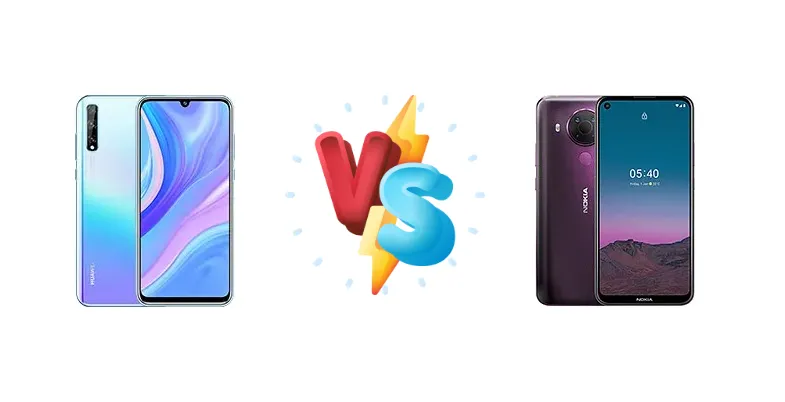
The Huawei P Smart S and Nokia 5.4 represent compelling options in the sub-$200 smartphone market. However, they approach this segment with different philosophies. The P Smart S, hampered by the lack of Google Mobile Services, relies on Huawei’s ecosystem, while the Nokia 5.4 offers a clean Android experience powered by Qualcomm. This comparison dives deep into the core differences to determine which phone delivers the best value.
🏆 Quick Verdict
For most users, the Nokia 5.4 is the better choice. While both phones offer 10W charging and similar price points, the Snapdragon 662’s 11nm process provides superior efficiency and sustained performance compared to the Kirin 710F’s 12nm node. This translates to a smoother user experience and better long-term reliability.
| Network |
|---|
| 2G bands | GSM 900 / 1800 / 1900 | GSM 850 / 900 / 1800 / 1900 |
| 3G bands | HSDPA 850 / 900 / 1700(AWS) / 1900 / 2100 | HSDPA 850 / 900 / 1900 / 2100 - International |
| 4G bands | 1, 2, 3, 4, 5, 7, 8, 26, 20, 28, 38, 40, 41 | 1, 3, 5, 7, 8, 20, 28, 38, 40, 41 - International |
| Speed | HSPA, LTE | HSPA 42.2/5.76 Mbps, LTE Cat4 150/50 Mbps |
| Technology | GSM / HSPA / LTE | GSM / HSPA / LTE |
| | - | 1, 2, 3, 4, 5, 7, 8, 12, 13, 17, 28, 66 - NA, LATAM |
| Launch |
|---|
| Announced | 2020, June 09. Released 2020, June 09 | 2020, December 15. Released 2020, December 25 |
| Status | Discontinued | Discontinued |
| Body |
|---|
| Dimensions | 157.4 x 73.2 x 7.8 mm (6.20 x 2.88 x 0.31 in) | 161 x 76 x 8.7 mm (6.34 x 2.99 x 0.34 in) |
| SIM | Nano-SIM + Nano-SIM | · Nano-SIM· Nano-SIM + Nano-SIM |
| Weight | 163 g (5.75 oz) | 181 g (6.38 oz) |
| Display |
|---|
| Resolution | 1080 x 2400 pixels, 20:9 ratio (~418 ppi density) | 720 x 1560 pixels, 19.5:9 ratio (~269 ppi density) |
| Size | 6.3 inches, 95.8 cm2 (~83.2% screen-to-body ratio) | 6.39 inches, 100.2 cm2 (~81.9% screen-to-body ratio) |
| Type | OLED | IPS LCD, 400 nits (typ) |
| Platform |
|---|
| CPU | Octa-core (4x2.2 GHz Cortex-A73 & 4x1.7 GHz Cortex-A53) | Octa-core (4x2.0 GHz Kryo 260 Gold & 4x1.8 GHz Kryo 260 Silver) |
| Chipset | Kirin 710F (12 nm) | Qualcomm SM6115 Snapdragon 662 (11 nm) |
| GPU | Mali-G51 MP4 | Adreno 610 |
| OS | Android 10, EMUI 10.1, no Google Play Services | Android 10, upgradable to Android 12 |
| Memory |
|---|
| Card slot | Nano Memory (uses shared SIM slot) | microSDXC (dedicated slot) |
| Internal | 128GB 4GB RAM | 64GB 4GB RAM, 64GB 6GB RAM, 128GB 4GB RAM |
| Main Camera |
|---|
| Features | LED flash, HDR, panorama | LED flash, HDR, panorama |
| Quad | - | 48 MP, f/1.8, (wide), PDAF
5 MP, 13mm (ultrawide)
2 MP (macro)
Auxiliary lens |
| Triple | 48 MP, f/1.8, 27mm (wide), 1/2.0", 0.8µm, PDAF
8 MP, f/2.4, 120˚ (ultrawide)
Auxiliary lens | - |
| Video | 1080p@30fps | 1080p@30fps |
| Selfie camera |
|---|
| Features | HDR | - |
| Single | 16 MP, f/2.0 | 16 MP, f/2.0, (wide) |
| Video | 1080p@30fps | 1080p@30fps |
| Sound |
|---|
| 3.5mm jack | Yes | Yes |
| 35mm jack | Yes | Yes |
| Loudspeaker | Yes | Yes |
| Comms |
|---|
| Bluetooth | 5.0, A2DP, LE | 4.2, A2DP, aptX Adaptive |
| NFC | Yes | Yes (market/region dependent) |
| Positioning | GPS, GLONASS, BDS | GPS, GLONASS, GALILEO, BDS |
| Radio | FM radio | FM radio |
| USB | USB Type-C 2.0, OTG | USB Type-C 2.0, OTG |
| WLAN | Wi-Fi 802.11 a/b/g/n/ac, dual-band, Wi-Fi Direct | Wi-Fi 802.11 b/g/n |
| Features |
|---|
| Sensors | Fingerprint (under display, optical), accelerometer, proximity, compass | Fingerprint (rear-mounted), accelerometer, gyro, proximity |
| Battery |
|---|
| Charging | 10W wired | 10W wired |
| Type | Li-Po 4000 mAh | Li-Po 4000 mAh |
| Misc |
|---|
| Colors | Breathing Crystal, Midnight Black | Polar Night, Dusk |
| Models | - | TA-1333, TA-1340, TA-1337, TA-1328, TA-1325 |
| Price | About 260 EUR | About 90 EUR |
| SAR | - | 0.68 W/kg (head) 1.02 W/kg (body) |
| SAR EU | - | 0.99 W/kg (head) 0.96 W/kg (body) |
Huawei P Smart S
- Potentially more stylish design
- Huawei ecosystem integration (for existing users)
- Capable ISP for image processing
- Lack of Google Mobile Services
- Less efficient Kirin 710F chipset
- Limited software updates
Nokia 5.4
- Clean Android experience
- More efficient Snapdragon 662 chipset
- Guaranteed Android updates
- Potentially less premium build quality
- Less aggressive image processing
- 10W charging is slow
Display Comparison
Neither Huawei nor Nokia provide detailed display specifications beyond resolution. However, the display is likely a standard IPS LCD on both devices. The absence of high refresh rates or advanced features like LTPO suggests a focus on cost savings. The real-world difference in display quality will likely be minimal, with color accuracy and viewing angles being the key differentiators, but without testing, it's impossible to declare a clear winner.
Camera Comparison
Both phones likely feature a multi-camera setup, but detailed sensor information is limited. The Nokia 5.4’s camera system, while potentially offering more software features through its clean Android implementation, doesn’t inherently have a hardware advantage. The Kirin 710F’s ISP is capable, but Huawei’s image processing tends to favor oversaturation, while Nokia aims for a more natural look. Without detailed sensor size and aperture data, it’s difficult to definitively declare a camera winner, but the Nokia 5.4’s software optimization could provide a more consistent experience.
Performance
The core difference lies in the chipsets. The Nokia 5.4’s Qualcomm Snapdragon 662 (11nm) benefits from a more modern fabrication process than the Huawei P Smart S’s Kirin 710F (12nm). This 1nm difference is significant; the Snapdragon 662 will exhibit better thermal efficiency, reducing throttling during sustained tasks like gaming. While both CPUs feature octa-core configurations, the Snapdragon’s Kryo 260 Gold cores clocked at 2.0 GHz offer a slight edge over the Kirin’s Cortex-A73 cores at 2.2 GHz, due to architectural improvements. The Snapdragon 662 is known for its stable performance in mid-range tasks, making it ideal for everyday use and light gaming.
Battery Life
Both devices are equipped with 10W wired charging, a significant limitation in today’s market. Battery capacity isn’t specified, but both likely fall in the 4000-5000 mAh range. The Snapdragon 662’s superior power efficiency will translate to longer battery life on the Nokia 5.4, even with a similar capacity battery. The 11nm process allows the Nokia 5.4 to sip power during less demanding tasks, extending standby time and overall usage.
Buying Guide
Buy the Huawei P Smart S if you are deeply embedded in the Huawei ecosystem and can navigate life without Google Play Services. Its design is also arguably more premium. Buy the Nokia 5.4 if you prioritize a clean Android experience, better performance-per-watt, and access to the full Google suite of apps and services. It’s the more versatile and future-proof option for the average user.
Frequently Asked Questions
❓ Does the Kirin 710F struggle with multitasking compared to the Snapdragon 662?
Yes, the Kirin 710F, due to its less efficient architecture and larger process node, will exhibit more noticeable slowdowns when multitasking with numerous apps open. The Snapdragon 662’s superior thermal management and optimized cores allow it to handle multiple tasks concurrently with greater ease.
❓ How significant is the lack of Google Mobile Services on the Huawei P Smart S?
The absence of Google Mobile Services (GMS) is a major drawback for most users. It means no access to the Google Play Store, requiring users to sideload apps or rely on Huawei’s AppGallery, which has a limited selection. Core Google apps like Gmail, YouTube, and Maps are also unavailable without workarounds.
❓ Will the Nokia 5.4 receive major Android version updates?
Nokia has a strong commitment to software updates. The Nokia 5.4 is guaranteed to receive at least two major Android version updates and three years of security patches, ensuring it remains secure and up-to-date for a longer period.
❓ Is the 10W charging on either phone a dealbreaker?
Yes, 10W charging is significantly slower than the fast charging options available on many competing devices. Expect a full charge to take over 2.5 hours. This is a major inconvenience for users accustomed to quicker charging speeds.