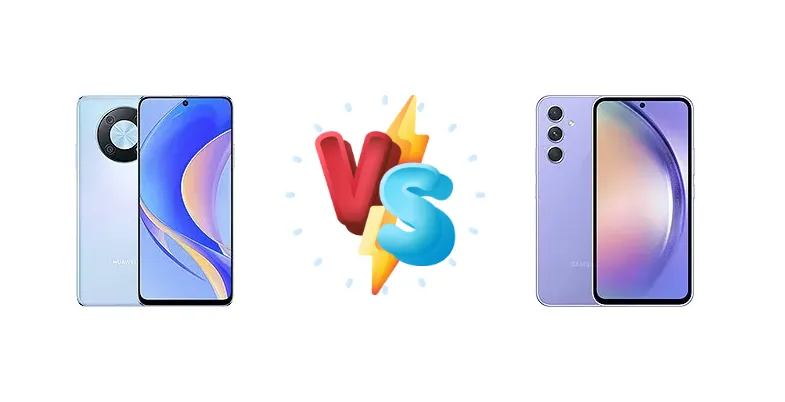
The mid-range smartphone market is fiercely competitive, and two contenders vying for your attention are the Huawei nova Y90 and the Samsung Galaxy A54. Both offer compelling features, but cater to slightly different needs. Let's dive into a detailed comparison to help you decide which one deserves your money.
🏆 Quick Verdict
The Samsung Galaxy A54 emerges as the overall winner thanks to its superior display, more powerful chipset, and longer software support. While the nova Y90 boasts faster charging, the A54's consistent performance and camera quality make it the more well-rounded choice for most users.
| Network |
|---|
| 2G bands | GSM 850 / 900 / 1800 / 1900 | GSM 850 / 900 / 1800 / 1900 |
| 3G bands | HSDPA 850 / 900 / 1900 / 2100 | HSDPA 850 / 900 / 1700(AWS) / 1900 / 2100 |
| 4G bands | 1, 3, 5, 7, 8, 20, 28, 38, 40, 41 | 1, 2, 3, 4, 5, 7, 8, 12, 17, 20, 26, 28, 32, 38, 40, 41, 66 - International |
| 5G bands | - | 1, 3, 7, 8, 20, 28, 38, 40, 41, 77, 78 SA/NSA/Sub6 - International |
| Speed | HSPA, LTE | HSPA, LTE, 5G |
| Technology | GSM / HSPA / LTE | GSM / HSPA / LTE / 5G |
| | - | 25, 41, 66, 71 SA/NSA/Sub6/mmWave - USA |
| Launch |
|---|
| Announced | 2022, June 23 | 2023, March 15 |
| Status | Available. Released 2022, July 27 | Available. Released 2023, March 24 |
| Body |
|---|
| Build | - | Glass front (Gorilla Glass 5), glass back (Gorilla Glass 5), plastic frame |
| Dimensions | 163.3 x 74.7 x 8.4 mm (6.43 x 2.94 x 0.33 in) | 158.2 x 76.7 x 8.2 mm (6.23 x 3.02 x 0.32 in) |
| SIM | · Nano-SIM· Nano-SIM + Nano-SIM | · Nano-SIM + eSIM· Nano-SIM + Nano-SIM |
| Weight | 195 g (6.88 oz) | 202 g (7.13 oz) |
| | - | IP67 dust/water resistant (up to 1m for 30 min) |
| Display |
|---|
| Protection | - | Corning Gorilla Glass 5 |
| Resolution | 1080 x 2388 pixels (~391 ppi density) | 1080 x 2340 pixels, 19.5:9 ratio (~403 ppi density) |
| Size | 6.7 inches, 108.7 cm2 (~89.1% screen-to-body ratio) | 6.4 inches, 100.5 cm2 (~82.9% screen-to-body ratio) |
| Type | IPS LCD, 90Hz | Super AMOLED, 120Hz, HDR10+, 1000 nits (HBM) |
| Platform |
|---|
| CPU | Octa-core (4x2.4 GHz Kryo 265 Gold & 4x1.9 GHz Kryo 265 Silver) | Octa-core (4x2.4 GHz Cortex-A78 & 4x2.0 GHz Cortex-A55) |
| Chipset | Qualcomm SM6225 Snapdragon 680 4G (6 nm) | Exynos 1380 (5 nm) |
| GPU | Adreno 610 | Mali-G68 MP5 |
| OS | EMUI 12 | Android 13, up to 4 major Android upgrades, One UI 7 |
| Memory |
|---|
| Card slot | No | microSDXC (uses shared SIM slot) |
| Internal | 128GB 4GB RAM, 128GB 6GB RAM, 128GB 8GB RAM | 128GB 4GB RAM, 128GB 6GB RAM, 128GB 8GB RAM, 256GB 6GB RAM, 256GB 8GB RAM |
| Main Camera |
|---|
| Features | LED flash, panorama, HDR | LED flash, panorama, HDR |
| Single | 8 MP, f/2.0 | 32 MP, f/2.2, 26mm (wide), 1/2.8", 0.8µm |
| Triple | 50 MP, f/1.8, (wide), PDAF
2 MP (macro)
Auxiliary lens | 50 MP, f/1.8, 23mm (wide), 1/1.56", 1.0µm, PDAF, OIS
12 MP, f/2.2, 13mm, 123˚ (ultrawide), 1/3.X", 1.12µm
5 MP (macro) |
| Video | 1080p@30fps | 4K@30fps, 1080p@30/60fps, 720p@480fps, gyro-EIS |
| Selfie camera |
|---|
| Single | 8 MP, f/2.0 | 32 MP, f/2.2, 26mm (wide), 1/2.8", 0.8µm |
| Video | 1080p@30fps | 4K@30fps, 1080p@30/60fps |
| Sound |
|---|
| 3.5mm jack | Yes | No |
| 35mm jack | Yes | No |
| Loudspeaker | Yes | Yes, with stereo speakers |
| Comms |
|---|
| Bluetooth | 5.0, A2DP, LE | 5.3, A2DP, LE |
| NFC | Yes (market/region dependent) | Yes (market/region dependent) |
| Positioning | GPS, GLONASS, BDS, GALILEO, QZSS | GPS, GLONASS, GALILEO, BDS |
| Radio | No | No |
| USB | USB Type-C 2.0, OTG | USB Type-C 2.0, OTG |
| WLAN | Wi-Fi 802.11 a/b/g/n/ac, dual-band, Wi-Fi Direct | Wi-Fi 802.11 a/b/g/n/ac/6, dual-band, Wi-Fi Direct |
| Features |
|---|
| Sensors | Fingerprint (side-mounted), accelerometer, compass | Fingerprint (under display, optical), accelerometer, gyro, compass, barometer (USA only) |
| | Virtual proximity sensing | Virtual proximity sensing |
| Battery |
|---|
| Charging | 40W wired, 50% in 30 min | 25W wired |
| Type | Li-Po 5000 mAh | 5000 mAh |
| Misc |
|---|
| Colors | Crystal Blue, Pearl White, Emerald Green, Midnight Black | Lime, Graphite, Violet, White |
| Models | CTR-LX2, CTR-LX1, CTR-LX3 | SM-A546V, SM-A546U, SM-A546U1, SM-A546B, SM-A546B/DS, SM-A546E, SM-A546E/DS, SM-A5460, SM-A546M, SM-A546M/DS, SM-A546W |
| Price | About 160 EUR | € 210.00 / $ 119.11 / £ 169.95 / ₹ 28,999 |
| SAR | - | 0.81 W/kg (head) 0.67 W/kg (body) |
| SAR EU | - | 0.69 W/kg (head) 1.34 W/kg (body) |
| Tests |
|---|
| Battery life | - |
Endurance rating 119h
|
| Camera | - |
Photo / Video |
| Display | - |
Contrast ratio: Infinite (nominal) |
| Loudspeaker | - |
-26.6 LUFS (Good)
|
| Performance | - |
AnTuTu: 506678 (v9)
GeekBench: 2703 (v5.1), 2797 (v6)
GFXBench: 25fps (ES 3.1 onscreen) |
Huawei nova Y90
- Fast 40W Charging
- Large Display
- Competitive Price
- Less Powerful Chipset
- Lower Camera Quality
- Limited Software Support
Samsung Galaxy A54
- Excellent Display (980 nits, AMOLED)
- Powerful Exynos 1380 Chipset
- Superior Camera System
- Long Battery Life (119h Endurance)
- Extended Software Updates
- Slower 25W Charging
- Higher Price
Display Comparison
The Samsung Galaxy A54 takes a clear lead in the display department. Its 980 nits peak brightness ensures excellent visibility even in direct sunlight, while the infinite contrast ratio delivers stunning visuals. The nova Y90's display is decent, but lacks the A54's vibrancy and outdoor usability. The A54's Super AMOLED technology also provides richer colors and deeper blacks.
Camera Comparison
While both phones offer capable cameras, the Samsung Galaxy A54 generally produces better image quality. Its camera system is more versatile, offering improved dynamic range, detail, and low-light performance. The A54's video recording capabilities are also superior. The nova Y90's camera is adequate for casual photography, but doesn't match the A54's overall quality.
Performance
The Samsung Galaxy A54's Exynos 1380 (5nm) chipset offers significantly better performance than the Huawei nova Y90's Snapdragon 680 (6nm). The A54 handles demanding tasks and games with ease, while the nova Y90 might show some lag during intensive use. The A54's Cortex-A78 cores provide a noticeable boost in processing power.
Battery Life
The Samsung Galaxy A54 shines in battery life, boasting an impressive endurance rating of 119 hours. Its active use score of 11:15h further solidifies its position as a battery champion. The nova Y90's battery life is respectable, but falls short of the A54's longevity. However, the nova Y90 compensates with its 40W fast charging, allowing for quicker top-ups.
Buying Guide
The Huawei nova Y90 is a good option for budget-conscious users who prioritize fast charging and a large display. The Samsung Galaxy A54 is ideal for those seeking a reliable all-around performer with a great camera, vibrant display, and extended software updates.
Frequently Asked Questions
❓ Which phone has better gaming performance?
The Samsung Galaxy A54's Exynos 1380 chipset provides significantly better gaming performance than the Huawei nova Y90's Snapdragon 680.
❓ How long does it take to fully charge each phone?
The Huawei nova Y90 charges faster with its 40W charging, while the Samsung Galaxy A54 takes longer with its 25W charging.
❓ Which phone will receive longer software support?
Samsung is known for providing longer software update support than Huawei, making the Galaxy A54 a better choice for users who want their phone to stay up-to-date for longer.