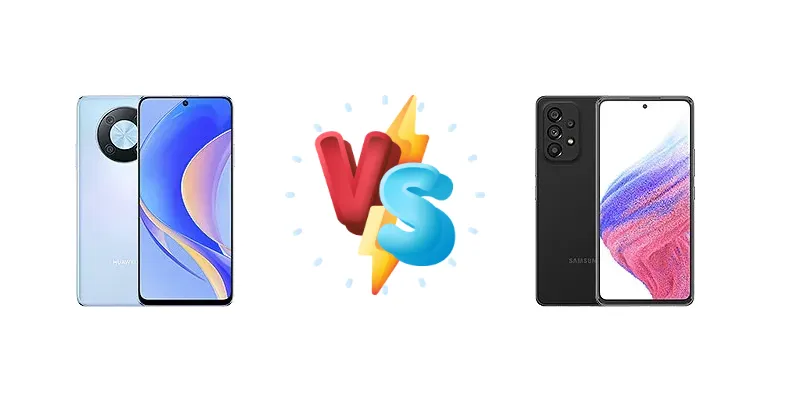
The mid-range smartphone market is fiercely competitive, and the Huawei nova Y90 and Samsung Galaxy A53 5G represent compelling options for budget-conscious buyers. While both aim to deliver a well-rounded experience, they take different approaches to achieving it. The Y90 prioritizes fast charging and a streamlined experience, while the A53 5G focuses on 5G connectivity and a brighter display. This comparison dives deep into the specifics to determine which device offers the best value.
🏆 Quick Verdict
For the average user prioritizing a brighter, more vibrant display and 5G connectivity, the Samsung Galaxy A53 5G is the better choice. However, the Huawei nova Y90 offers a compelling alternative with its significantly faster 40W charging and respectable performance for everyday tasks, making it ideal for users who value convenience and aren't reliant on 5G.
| Network |
|---|
| 2G bands | GSM 850 / 900 / 1800 / 1900 | GSM 850 / 900 / 1800 / 1900 |
| 3G bands | HSDPA 850 / 900 / 1900 / 2100 | HSDPA 850 / 900 / 1700(AWS) / 1900 / 2100 |
| 4G bands | 1, 3, 5, 7, 8, 20, 28, 38, 40, 41 | 1, 2, 3, 4, 5, 7, 12, 14, 20, 29, 30, 38, 39, 40, 41, 46, 48, 66 - SM-A536U |
| 5G bands | - | 2, 5, 41, 66, 77, 78 SA/NSA/Sub6/mmWave - SM-A536U |
| Speed | HSPA, LTE | HSPA, LTE, 5G |
| Technology | GSM / HSPA / LTE | GSM / HSPA / LTE / 5G |
| | - | 2, 5, 48, 66, 77, 78, 260, 261 SA/NSA/Sub6/mmWave - SM-A536V |
| Launch |
|---|
| Announced | 2022, June 23 | 2022, March 17 |
| Status | Available. Released 2022, July 27 | Available. Released 2022, March 24 |
| Body |
|---|
| Build | - | Glass front (Gorilla Glass 5), plastic frame, plastic back |
| Dimensions | 163.3 x 74.7 x 8.4 mm (6.43 x 2.94 x 0.33 in) | 159.6 x 74.8 x 8.1 mm (6.28 x 2.94 x 0.32 in) |
| SIM | · Nano-SIM· Nano-SIM + Nano-SIM | · Nano-SIM· Nano-SIM + Nano-SIM |
| Weight | 195 g (6.88 oz) | 189 g (6.67 oz) |
| | - | IP67 dust/water resistant (up to 1m for 30 min) |
| Display |
|---|
| Protection | - | Corning Gorilla Glass 5 |
| Resolution | 1080 x 2388 pixels (~391 ppi density) | 1080 x 2400 pixels, 20:9 ratio (~405 ppi density) |
| Size | 6.7 inches, 108.7 cm2 (~89.1% screen-to-body ratio) | 6.5 inches, 102.0 cm2 (~85.4% screen-to-body ratio) |
| Type | IPS LCD, 90Hz | Super AMOLED, 120Hz, 800 nits (HBM) |
| Platform |
|---|
| CPU | Octa-core (4x2.4 GHz Kryo 265 Gold & 4x1.9 GHz Kryo 265 Silver) | Octa-core (2x2.4 GHz Cortex-A78 & 6x2.0 GHz Cortex-A55) |
| Chipset | Qualcomm SM6225 Snapdragon 680 4G (6 nm) | Exynos 1280 (5 nm) |
| GPU | Adreno 610 | Mali-G68 |
| OS | EMUI 12 | Android 12, up to 4 major Android upgrades, One UI 8 |
| Memory |
|---|
| Card slot | No | microSDXC (uses shared SIM slot) |
| Internal | 128GB 4GB RAM, 128GB 6GB RAM, 128GB 8GB RAM | 128GB 4GB RAM, 128GB 6GB RAM, 128GB 8GB RAM, 256GB 6GB RAM, 256GB 8GB RAM |
| Main Camera |
|---|
| Features | LED flash, panorama, HDR | LED flash, panorama, HDR |
| Quad | - | 64 MP, f/1.8, 26mm (wide), 1/1.7X", 0.8µm, PDAF, OIS
12 MP, f/2.2, 123˚ (ultrawide), 1.12µm
5 MP (macro)
Auxiliary lens |
| Single | 8 MP, f/2.0 | 32 MP, f/2.2, 26mm (wide), 1/2.8", 0.8µm |
| Triple | 50 MP, f/1.8, (wide), PDAF
2 MP (macro)
Auxiliary lens | - |
| Video | 1080p@30fps | 4K@30fps, 1080p@30/60fps; gyro-EIS |
| Selfie camera |
|---|
| Features | - | HDR |
| Single | 8 MP, f/2.0 | 32 MP, f/2.2, 26mm (wide), 1/2.8", 0.8µm |
| Video | 1080p@30fps | 4K@30fps, 1080p@30fps |
| Sound |
|---|
| 3.5mm jack | Yes | No |
| 35mm jack | Yes | No |
| Loudspeaker | Yes | Yes, with stereo speakers |
| Comms |
|---|
| Bluetooth | 5.0, A2DP, LE | 5.1, A2DP, LE |
| NFC | Yes (market/region dependent) | Yes (market/region dependent) |
| Positioning | GPS, GLONASS, BDS, GALILEO, QZSS | GPS, GLONASS, GALILEO, BDS |
| Radio | No | No |
| USB | USB Type-C 2.0, OTG | USB Type-C 2.0, OTG |
| WLAN | Wi-Fi 802.11 a/b/g/n/ac, dual-band, Wi-Fi Direct | Wi-Fi 802.11 a/b/g/n/ac, dual-band, Wi-Fi Direct |
| Features |
|---|
| Sensors | Fingerprint (side-mounted), accelerometer, compass | Fingerprint (under display, optical), accelerometer, gyro, compass, barometer (market/region dependent) |
| | Virtual proximity sensing | Virtual proximity sensing |
| Battery |
|---|
| Charging | 40W wired, 50% in 30 min | 25W wired |
| Type | Li-Po 5000 mAh | Li-Po 5000 mAh |
| Misc |
|---|
| Colors | Crystal Blue, Pearl White, Emerald Green, Midnight Black | Black, White, Blue, Peach |
| Models | CTR-LX2, CTR-LX1, CTR-LX3 | SM-A536B, SM-A536B/DS, SM-A536U, SM-A536U1, SM-A5360, SM-A536E, SM-A536E/DS, SM-A536V, SM-A536W, SM-A536N, SM-S536DL |
| Price | About 160 EUR | $ 151.42 / £ 185.00 / € 169.14 |
| SAR | - | 0.75 W/kg (head) 1.58 W/kg (body) |
| SAR EU | - | 0.89 W/kg (head) 1.60 W/kg (body) |
| Tests |
|---|
| Battery life | - |
Endurance rating 113h
|
| Camera | - |
Photo / Video |
| Display | - |
Contrast ratio: Infinite (nominal) |
| Loudspeaker | - |
-26.5 LUFS (Good)
|
| Performance | - |
AnTuTu: 329802 (v8), 379313 (v9)
GeekBench: 1891 (v5.1)
GFXBench: 19fps (ES 3.1 onscreen) |
Huawei nova Y90
- 40W SuperCharge for incredibly fast charging
- Respectable performance for everyday tasks
- Sleek and modern design
- Limited to 4G connectivity
- Potentially lower camera performance in low light
Samsung Galaxy A53 5G
- Brighter and more vibrant display
- 5G connectivity for faster data speeds
- Samsung’s established software ecosystem
- Slower 25W charging
- Exynos 1280 can exhibit thermal throttling under sustained load
Display Comparison
The Samsung Galaxy A53 5G boasts a notably brighter display, reaching a measured peak of 830 nits, compared to an unstated value for the nova Y90. This brightness advantage translates to better visibility outdoors under direct sunlight. While both displays are likely to utilize AMOLED technology (based on brand standards), the A53’s ‘Infinite’ contrast ratio suggests a deeper black level and more vibrant colors. The lack of refresh rate information for the Y90 suggests it may be limited to 60Hz, while the A53 5G is commonly reported to have a 120Hz panel, offering smoother scrolling and animations.
Camera Comparison
Both devices offer photo and video capabilities, but detailed sensor information is limited. The A53 5G likely features a more sophisticated camera system, leveraging Samsung’s image processing expertise. While both may include a standard suite of lenses, the A53 5G’s larger sensor size (typically found in Samsung’s A-series) would capture more light, resulting in better low-light performance. The inclusion of Optical Image Stabilization (OIS) on the A53 5G, a common feature in this price range, would further enhance image clarity and stability, especially in video recording. The Y90’s camera performance will likely be adequate for casual use, but may struggle in challenging lighting conditions.
Performance
The core difference lies in the chipsets: the Samsung Galaxy A53 5G utilizes the Exynos 1280 (5nm), while the Huawei nova Y90 is powered by the Qualcomm Snapdragon 680 (6nm). The 5nm process of the Exynos 1280 generally leads to better power efficiency and thermal performance compared to the 6nm Snapdragon 680. However, the Exynos 1280’s CPU configuration (2x2.4 GHz Cortex-A78 & 6x2.0 GHz Cortex-A55) is architecturally more complex than the Snapdragon 680’s (4x2.4 GHz Kryo 265 Gold & 4x1.9 GHz Kryo 265 Silver), potentially offering better multi-core performance. The A53 5G’s 5G modem is a significant advantage for users in areas with 5G coverage, while the Y90 is limited to 4G.
Battery Life
Both phones share an endurance rating of 113 hours, suggesting comparable battery life under similar usage scenarios. However, the charging speeds differ significantly. The Huawei nova Y90’s 40W wired charging can replenish 50% of the battery in just 30 minutes, a substantial advantage over the Samsung Galaxy A53 5G’s 25W charging. This faster charging capability is a major convenience factor for users who frequently need to top up their battery quickly. While the A53 5G’s battery may last slightly longer on a single charge due to the more efficient Exynos chip, the Y90’s faster charging mitigates this difference.
Buying Guide
Buy the Huawei nova Y90 if you need exceptionally fast charging – its 40W capability significantly outperforms the A53 5G’s 25W. It’s also a good fit for users who primarily use 4G networks and prioritize a smooth, responsive experience for social media, browsing, and light gaming. Buy the Samsung Galaxy A53 5G if you prefer a brighter, more color-accurate display for media consumption, require 5G connectivity for faster data speeds, and value Samsung’s established software ecosystem and longer-term software support.
Frequently Asked Questions
❓ Does the Exynos 1280 in the Galaxy A53 5G tend to overheat during prolonged gaming sessions?
The Exynos 1280 is known to exhibit some thermal throttling under sustained heavy load, such as extended gaming. While it won't shut down, you may experience a slight drop in frame rates after 30-45 minutes of intensive gameplay. The Snapdragon 680 in the nova Y90, while less powerful, generally runs cooler.
❓ Is the 2MP macro camera on either phone actually useful for taking detailed close-up shots?
Generally, 2MP macro cameras on phones in this price range offer limited detail and image quality. They are often included for marketing purposes but rarely deliver truly impressive macro photography. You're better off using the main camera and cropping in for close-up shots.
❓ Can the Huawei nova Y90 support high frame rates (90fps or higher) in popular games like PUBG Mobile?
The Snapdragon 680 is capable of running PUBG Mobile, but achieving consistently high frame rates (above 60fps) at high graphics settings is unlikely. Expect to play at medium settings for a smoother experience. The A53 5G, with its more powerful chipset, has a better chance of sustaining higher frame rates.
❓ How does the lack of Google Mobile Services (GMS) on the Huawei nova Y90 affect app availability?
The Huawei nova Y90 runs on EMUI, Huawei’s operating system, which does not include Google Mobile Services (GMS). This means you won’t have direct access to the Google Play Store. Instead, you’ll need to use Huawei’s AppGallery and potentially sideload apps. While AppGallery has a growing selection, some popular apps may be missing or require alternative installation methods.