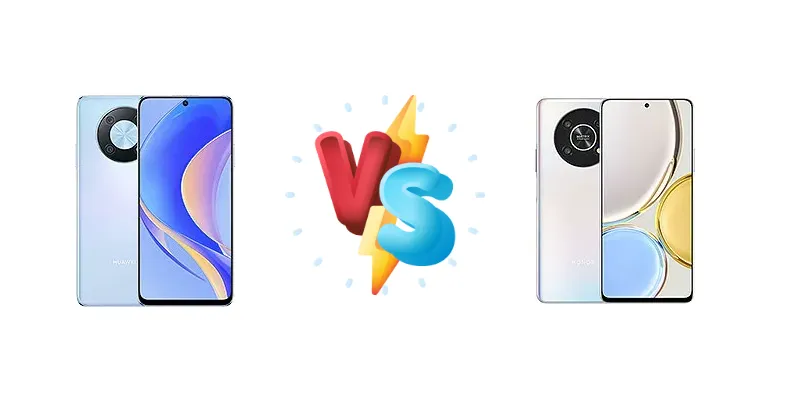
Both the Huawei nova Y90 and the Honor X9 5G target the budget-conscious consumer seeking a blend of features and 5G connectivity. However, they diverge in their core approaches: the nova Y90 prioritizes a streamlined experience with a focus on efficient charging, while the X9 5G aims for a performance boost with a more powerful chipset and faster charging capabilities. This comparison will dissect these differences to help you determine which device best suits your needs.
🏆 Quick Verdict
For the average user prioritizing consistent performance and future-proofing, the Honor X9 5G emerges as the stronger contender. Its Snapdragon 695 5G chipset offers a noticeable performance uplift over the nova Y90’s Snapdragon 680, and the 66W charging significantly reduces downtime, making it ideal for power users.
| Network |
|---|
| 2G bands | GSM 850 / 900 / 1800 / 1900 | GSM 850 / 900 / 1800 / 1900 |
| 3G bands | HSDPA 850 / 900 / 1900 / 2100 | HSDPA 850 / 900 / 1700(AWS) / 1900 / 2100 |
| 4G bands | 1, 3, 5, 7, 8, 20, 28, 38, 40, 41 | LTE |
| 5G bands | - | SA/NSA |
| Speed | HSPA, LTE | HSPA, LTE, 5G |
| Technology | GSM / HSPA / LTE | GSM / HSPA / LTE / 5G |
| | - | Virtual proximity sensing |
| Launch |
|---|
| Announced | 2022, June 23 | 2022, March 29 |
| Status | Available. Released 2022, July 27 | Available. Released 2022, March 29 |
| Body |
|---|
| Build | - | Glass front, plastic frame, plastic back |
| Dimensions | 163.3 x 74.7 x 8.4 mm (6.43 x 2.94 x 0.33 in) | 166.1 x 75.8 x 8.1 mm (6.54 x 2.98 x 0.32 in) |
| SIM | · Nano-SIM· Nano-SIM + Nano-SIM | Nano-SIM + Nano-SIM |
| Weight | 195 g (6.88 oz) | 189 g (6.67 oz) |
| Display |
|---|
| Resolution | 1080 x 2388 pixels (~391 ppi density) | 1080 x 2388 pixels (~385 ppi density) |
| Size | 6.7 inches, 108.7 cm2 (~89.1% screen-to-body ratio) | 6.81 inches, 112.3 cm2 (~89.2% screen-to-body ratio) |
| Type | IPS LCD, 90Hz | IPS LCD, 120Hz |
| Platform |
|---|
| CPU | Octa-core (4x2.4 GHz Kryo 265 Gold & 4x1.9 GHz Kryo 265 Silver) | Octa-core (2x2.2 GHz Kryo 660 Gold & 6x1.8 GHz Kryo 660 Silver) |
| Chipset | Qualcomm SM6225 Snapdragon 680 4G (6 nm) | Qualcomm SM6375 Snapdragon 695 5G (6 nm) |
| GPU | Adreno 610 | Adreno 619 |
| OS | EMUI 12 | Android 11, Magic UI 4.2 |
| Memory |
|---|
| Card slot | No | No |
| Internal | 128GB 4GB RAM, 128GB 6GB RAM, 128GB 8GB RAM | 128GB 8GB RAM, 256GB 8GB RAM |
| Main Camera |
|---|
| Features | LED flash, panorama, HDR | LED flash, panorama, HDR |
| Single | 8 MP, f/2.0 | 16 MP, f/2.5 |
| Triple | 50 MP, f/1.8, (wide), PDAF
2 MP (macro)
Auxiliary lens | 48 MP, f/1.8, 26mm (wide), PDAF
2 MP (macro)
Auxiliary lens |
| Video | 1080p@30fps | 1080p@30fps |
| Selfie camera |
|---|
| Single | 8 MP, f/2.0 | 16 MP, f/2.5 |
| Video | 1080p@30fps | 1080p@30fps |
| Sound |
|---|
| 3.5mm jack | Yes | No |
| 35mm jack | Yes | No |
| Loudspeaker | Yes | Yes |
| Comms |
|---|
| Bluetooth | 5.0, A2DP, LE | 5.1, A2DP, LE |
| NFC | Yes (market/region dependent) | Yes |
| Positioning | GPS, GLONASS, BDS, GALILEO, QZSS | GPS, GLONASS, GALILEO, BDS |
| Radio | No | No |
| USB | USB Type-C 2.0, OTG | USB Type-C 2.0, OTG |
| WLAN | Wi-Fi 802.11 a/b/g/n/ac, dual-band, Wi-Fi Direct | Wi-Fi 802.11 a/b/g/n/ac, dual-band, Wi-Fi Direct |
| Features |
|---|
| Sensors | Fingerprint (side-mounted), accelerometer, compass | Fingerprint (side-mounted), accelerometer, gyro, compass |
| | Virtual proximity sensing | - |
| Battery |
|---|
| Charging | 40W wired, 50% in 30 min | 66W wired, 81% in 30 min |
| Type | Li-Po 5000 mAh | Li-Po 4800 mAh |
| Misc |
|---|
| Colors | Crystal Blue, Pearl White, Emerald Green, Midnight Black | Titanium Silver, Ocean Blue, Midnight Black |
| Models | CTR-LX2, CTR-LX1, CTR-LX3 | ANY-NX1 |
| Price | About 160 EUR | About 240 EUR |
Huawei nova Y90
- Efficient Snapdragon 680 chipset for everyday tasks
- Reliable 40W fast charging
- Potentially more affordable price point
- Lacks 5G connectivity
- Less powerful CPU and GPU compared to the X9 5G
- Slower charging speed than the competition
Honor X9 5G
- 5G connectivity for faster data speeds
- More powerful Snapdragon 695 5G chipset
- Ultra-fast 66W charging for minimal downtime
- May be slightly more expensive than the nova Y90
- Potentially higher power consumption due to 5G and faster processor
- Performance may still be limited for demanding games at high settings
Display Comparison
While both devices likely feature LCD panels (data not provided), the core difference lies in the processing power driving them. The chipset impacts UI responsiveness and video decoding. Without specific display specs like resolution or refresh rate, it’s difficult to declare a clear winner. However, the Snapdragon 695 in the Honor X9 5G’s ability to handle more demanding graphical tasks suggests a smoother visual experience, particularly during scrolling and video playback.
Camera Comparison
Without detailed camera specifications beyond the chipsets, a direct comparison is limited. However, the Snapdragon 695’s ISP (Image Signal Processor) is generally more advanced than the 680’s, potentially leading to better image processing, particularly in low-light conditions. Both phones likely feature a multi-camera setup, but the Honor X9 5G’s chipset offers the potential for more sophisticated computational photography features. The absence of information regarding sensor sizes and optical image stabilization (OIS) makes a definitive judgment impossible.
Performance
The Honor X9 5G’s Qualcomm Snapdragon 695 5G (6nm) represents a clear step up from the Huawei nova Y90’s Snapdragon 680 4G (6nm). The 695 features a more modern CPU configuration – 2x2.2 GHz Kryo 660 Gold cores versus the 4x2.4 GHz Kryo 265 Gold in the 680 – and crucially, integrated 5G modem support. This translates to faster download and upload speeds where 5G networks are available. The 695’s Adreno 619 GPU also provides a more capable graphics experience, benefiting gaming and graphically intensive applications. The Snapdragon 680 is still competent for everyday tasks, but will show its limitations in demanding scenarios.
Battery Life
Both devices utilize a 6nm process, contributing to power efficiency. However, the Honor X9 5G’s 66W wired charging is a significant advantage. Achieving 81% charge in 30 minutes drastically reduces downtime compared to the nova Y90’s 40W charging, which reaches 50% in the same timeframe. While battery capacity isn’t specified, the faster charging speed of the X9 5G effectively mitigates any potential capacity disadvantage, making it the more convenient option for users who frequently need to top up their battery.
Buying Guide
Buy the Huawei nova Y90 if you prioritize a reliable, everyday smartphone experience with a focus on efficient power management and a predictable user interface. It’s a solid choice for users who primarily browse, use social media, and make calls. Buy the Honor X9 5G if you value faster performance for gaming and multitasking, and if minimizing charging time is a key concern. This phone is better suited for users who actively stream video, play mobile games, or rely heavily on their smartphone throughout the day.
Frequently Asked Questions
❓ Will the Honor X9 5G overheat during extended gaming sessions?
The Snapdragon 695 5G is a relatively efficient chipset. While it will generate heat during prolonged gaming, the 6nm process and likely thermal management solutions within the X9 5G should prevent significant throttling. However, demanding games at maximum settings may still lead to some performance reduction over time.
❓ Is the lack of 5G on the Huawei nova Y90 a dealbreaker in 2024?
That depends on your location and data needs. If you live in an area with limited 5G coverage or primarily use Wi-Fi, the absence of 5G on the nova Y90 is unlikely to be a major issue. However, if you frequently travel or rely on mobile data in areas with strong 5G signals, the X9 5G’s 5G connectivity will provide a noticeable speed advantage.
❓ How does the charging speed difference translate to real-world usage?
The Honor X9 5G’s 66W charging allows for a substantial top-up in a short amount of time. Going from 0% to over 80% in 30 minutes is a game-changer for users who frequently find themselves with low battery. The Huawei nova Y90’s 40W charging, while still fast, requires a longer charging duration to achieve a similar level of charge.