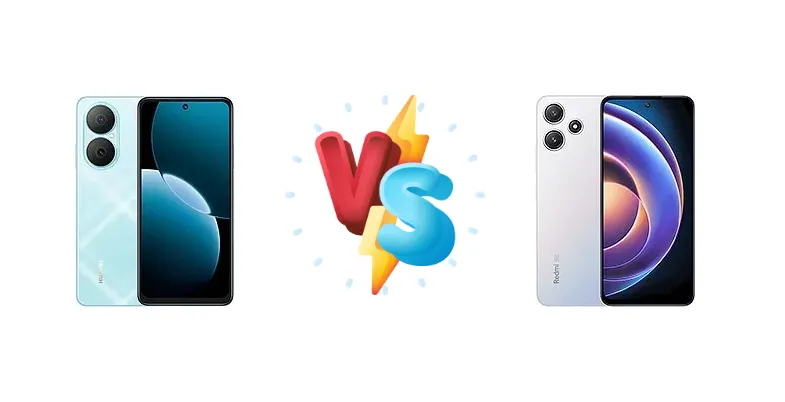
The sub-$200 smartphone market is fiercely competitive. The Huawei Nova Y73, leveraging Huawei’s established brand, faces off against the Xiaomi Redmi Note 12R, a newcomer boasting a modern Qualcomm chipset. This comparison dissects their key differences, focusing on performance, charging, and overall value to help you make the right choice.
🏆 Quick Verdict
For most users, the Xiaomi Redmi Note 12R emerges as the superior choice. Its Snapdragon 4 Gen 2 chipset, built on a 4nm process, delivers noticeably better performance and efficiency compared to the older Kirin 710A in the Nova Y73. While the Nova Y73 offers faster 40W charging, the Redmi Note 12R’s modern architecture provides a more future-proof experience.
| Network |
|---|
| 2G bands | GSM 850 / 900 / 1800 / 1900 | GSM 850 / 900 / 1800 / 1900 |
| 3G bands | HSDPA 850 / 900 / 1700(AWS) / 1900 / 2100 | HSDPA 850 / 900 / 2100 |
| 4G bands | 1, 2, 3, 4, 5, 7, 8, 13, 18, 19, 20, 26, 28, 34, 38, 39, 40, 41, 66 | 1, 3, 5, 8, 34, 38, 39, 40, 41 |
| 5G bands | - | 1, 5, 8, 28, 41, 78 SA/NSA |
| Speed | HSPA, LTE | HSPA, LTE, 5G |
| Technology | GSM / HSPA / LTE | GSM / CDMA / HSPA / EVDO / LTE / 5G |
| Launch |
|---|
| Announced | 2025, May 28 | 2023, June 28 |
| Status | Available. Released 2025, June 03 | Available. Released 2023, June 28 |
| Body |
|---|
| Build | - | Glass front, plastic frame, glass back |
| Dimensions | 166.1 x 76.6 x 8.3 mm (6.54 x 3.02 x 0.33 in) | 168.6 x 76.3 x 8.2 mm (6.64 x 3.00 x 0.32 in) |
| SIM | Nano-SIM + Nano-SIM | Nano-SIM + Nano-SIM |
| Weight | 203 g (7.16 oz) | 199 g (7.02 oz) |
| Display |
|---|
| Resolution | 720 x 1604 pixels, 20:9 ratio (~264 ppi density) | 1080 x 2460 pixels (~396 ppi density) |
| Size | 6.67 inches, 107.2 cm2 (~84.3% screen-to-body ratio) | 6.79 inches, 109.5 cm2 (~85.1% screen-to-body ratio) |
| Type | IPS LCD, 90Hz, 1000 nits (peak) | IPS LCD, 90Hz, 550 nits |
| Platform |
|---|
| CPU | Octa-core (4x2.0 GHz Cortex-A73 & 4x1.7 GHz Cortex-A53) | Octa-core (2x2.2 GHz Cortex-A78 & 6x1.95 GHz Cortex-A55) |
| Chipset | Kirin 710A (14 nm) | Qualcomm SM4450 Snapdragon 4 Gen 2 (4 nm) |
| GPU | Mali-G51 MP4 | Adreno 613 |
| OS | Android 12, EMUI 12 | Android 13, MIUI 14 |
| Memory |
|---|
| Card slot | No | microSDXC (uses shared SIM slot) |
| Internal | 128GB 8GB RAM, 256GB 8GB RAM | 128GB 4GB RAM, 128GB 6GB RAM, 128GB 8GB RAM, 256GB 8GB RAM |
| Main Camera |
|---|
| Dual | - | 50 MP, f/1.8, (wide), PDAF
2 MP (macro) |
| Features | LED flash, HDR, panorama | LED flash, HDR |
| Single | 50 MP, f/1.8, (wide), PDAF | - |
| Video | 1080p@30fps | 1080p@30fps |
| Selfie camera |
|---|
| Features | - | HDR |
| Single | 8 MP, f/2.0, (wide) | 5 MP, f/2.2, (wide), 1/5.0", 1.12µm |
| Video | 1080p@30fps | 1080p@30fps |
| Sound |
|---|
| 35mm jack | No | Yes |
| Loudspeaker | Yes | Yes |
| Comms |
|---|
| Bluetooth | 5.1, A2DP, LE | 5.3, A2DP, LE |
| Infrared port | Yes | Yes |
| NFC | Yes | Yes (market/region dependent) |
| Positioning | GPS, GLONASS, GALILEO, BDS, QZSS | GPS, GLONASS, GALILEO, BDS |
| Radio | No | No |
| USB | USB Type-C 2.0, OTG | USB Type-C |
| WLAN | Wi-Fi 802.11 b/g/n | Wi-Fi 802.11 a/b/g/n/ac, dual-band |
| Features |
|---|
| Sensors | Fingerprint (side-mounted), accelerometer, proximity, compass | Fingerprint (side-mounted), accelerometer, compass |
| Battery |
|---|
| Charging | 40W wired
5W reverse wired | 18W wired, PD |
| Type | Si/C Li-Ion 6620 mAh | Li-Po 5000 mAh |
| Misc |
|---|
| Colors | Blue, Black | Black, Blue, Silver |
| Models | MGA-LX3 | 23076RA4BC |
| Price | About 180 EUR | About 150 EUR |
Huawei Nova Y73
- Faster 40W wired charging
- Potential Huawei ecosystem integration benefits
- Established brand recognition
- Older, less efficient Kirin 710A chipset
- Likely inferior GPU performance
- Potentially less optimized software
Xiaomi Redmi Note 12R
- More efficient Snapdragon 4 Gen 2 (4nm)
- Modern CPU architecture (Cortex-A78)
- Better long-term performance and efficiency
- Slower 18W charging
- Less brand recognition in some markets
- Xiaomi’s MIUI software can be polarizing
Display Comparison
Neither device boasts a standout display. Details regarding panel type (IPS vs AMOLED) and resolution are missing, but both likely target the standard 1080p+ resolution found in this price bracket. The key difference lies in processing power impacting UI smoothness. The Redmi Note 12R’s more powerful chipset will contribute to a more fluid scrolling experience. Bezels are expected to be comparable, and color accuracy will likely be typical for budget devices – adequate but not color-critical.
Camera Comparison
Without detailed camera specs, a direct comparison is challenging. However, the Redmi Note 12R’s newer image signal processor (ISP) within the Snapdragon 4 Gen 2 chipset will likely provide superior image processing capabilities. The Nova Y73 may rely on older algorithms, potentially resulting in less dynamic range and detail in challenging lighting conditions. The presence of OIS (Optical Image Stabilization) is unknown for both, but its absence would be more impactful on the older Kirin 710A’s image stabilization capabilities. We can expect both phones to include a standard macro camera, which are generally of limited utility.
Performance
The performance gap is the most significant differentiator. The Xiaomi Redmi Note 12R’s Qualcomm Snapdragon 4 Gen 2 (4nm) is a substantial upgrade over the Huawei Nova Y73’s Kirin 710A (14nm). The 4nm fabrication process translates to significantly improved power efficiency and reduced thermal throttling. While both are octa-core CPUs, the Redmi Note 12R utilizes newer Cortex-A78 cores (2x2.2 GHz) alongside A55 cores, offering a performance advantage over the Nova Y73’s older Cortex-A73 (4x2.0 GHz) and A53 cores. This means faster app loading times, smoother multitasking, and a better gaming experience on the Redmi Note 12R. The Redmi Note 12R is also likely to benefit from more modern GPU architecture.
Battery Life
The Huawei Nova Y73’s 40W wired charging is a clear advantage over the Redmi Note 12R’s 18W charging. This translates to significantly faster 0-100% charging times. However, the Redmi Note 12R’s more efficient 4nm chipset will likely result in better battery life overall, offsetting the slower charging speed. The actual battery capacity is unknown for both, but the Snapdragon 4 Gen 2’s efficiency means the Redmi Note 12R will extract more usage from a given mAh capacity.
Buying Guide
Buy the Huawei Nova Y73 if you prioritize faster wired charging and are deeply embedded within the Huawei ecosystem, potentially benefiting from seamless integration with other Huawei devices. Buy the Xiaomi Redmi Note 12R if you value modern processor architecture, improved power efficiency, and a more responsive user experience, especially for multitasking and light gaming. The Redmi Note 12R is the better all-rounder for the average smartphone user.
Frequently Asked Questions
❓ Will the Kirin 710A in the Nova Y73 struggle with demanding games like PUBG Mobile?
Yes, the Kirin 710A is likely to struggle with demanding games like PUBG Mobile, especially at higher settings. You’ll likely need to lower graphics settings and frame rates to achieve a playable experience. The Snapdragon 4 Gen 2 in the Redmi Note 12R will provide a smoother gaming experience, even if it’s not a dedicated gaming chipset.
❓ Does the Redmi Note 12R support Power Delivery (PD) charging, and can I use a higher wattage charger with it?
Yes, the Redmi Note 12R supports Power Delivery (PD) charging. While it ships with an 18W charger, you can safely use a higher wattage PD charger (e.g., 20W, 30W) to potentially reduce charging times, although the phone will only draw up to its maximum supported wattage.
❓ Is the 40W charging on the Nova Y73 significantly faster in real-world use than the 18W on the Redmi Note 12R?
Yes, the 40W charging on the Nova Y73 will be noticeably faster. Expect a 0-100% charge in approximately 60-75 minutes, compared to potentially 90-120 minutes on the Redmi Note 12R. However, the Redmi Note 12R’s superior efficiency means you may not notice a significant difference in overall daily usage due to longer battery life.