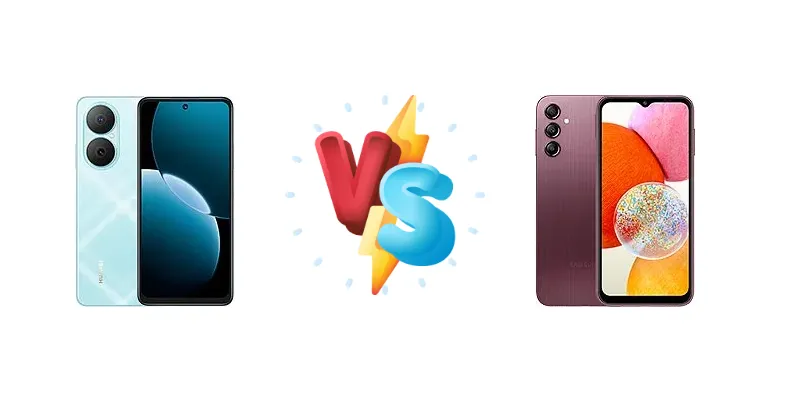
The Huawei Nova Y73 and Samsung Galaxy A14 represent compelling options in the crowded budget smartphone market. While both aim to deliver essential features at an accessible price point, they diverge significantly in their core hardware, particularly in chipset choice and charging capabilities. This comparison dissects these differences to determine which device offers the best value for your money.
🏆 Quick Verdict
For users prioritizing fast charging and a potentially smoother experience with everyday tasks, the Huawei Nova Y73 emerges as the winner. Its 40W charging significantly outperforms the Galaxy A14’s 15W, and the Kirin 710A, despite being older, offers a comparable CPU performance. However, Samsung’s broader software support and potential for a more refined user experience are worth considering.
| Network |
|---|
| 2G bands | GSM 850 / 900 / 1800 / 1900 | GSM 850 / 900 / 1800 / 1900 |
| 3G bands | HSDPA 850 / 900 / 1700(AWS) / 1900 / 2100 | HSDPA 850 / 900 / 2100 |
| 4G bands | 1, 2, 3, 4, 5, 7, 8, 13, 18, 19, 20, 26, 28, 34, 38, 39, 40, 41, 66 | 1, 3, 5, 7, 8, 20, 28, 38, 40, 41 |
| Speed | HSPA, LTE | HSPA, LTE |
| Technology | GSM / HSPA / LTE | GSM / HSPA / LTE |
| Launch |
|---|
| Announced | 2025, May 28 | 2023, February 28 |
| Status | Available. Released 2025, June 03 | Available. Released 2023, March 27 |
| Body |
|---|
| Build | - | Glass front, plastic back, plastic frame |
| Dimensions | 166.1 x 76.6 x 8.3 mm (6.54 x 3.02 x 0.33 in) | 167.7 x 78 x 9.1 mm (6.60 x 3.07 x 0.36 in) |
| SIM | Nano-SIM + Nano-SIM | · Nano-SIM· Nano-SIM + Nano-SIM |
| Weight | 203 g (7.16 oz) | 201 g (7.09 oz) |
| Display |
|---|
| Resolution | 720 x 1604 pixels, 20:9 ratio (~264 ppi density) | 1080 x 2408 pixels, 20:9 ratio (~400 ppi density) |
| Size | 6.67 inches, 107.2 cm2 (~84.3% screen-to-body ratio) | 6.6 inches, 104.9 cm2 (~80.2% screen-to-body ratio) |
| Type | IPS LCD, 90Hz, 1000 nits (peak) | PLS LCD |
| Platform |
|---|
| CPU | Octa-core (4x2.0 GHz Cortex-A73 & 4x1.7 GHz Cortex-A53) | Octa-core (2x2.0 GHz Cortex-A75 & 6x1.8 GHz Cortex-A55) - Version AOcta-core (4x2.0 GHz Cortex-A55 & 4x2.0 GHz Cortex-A55) - Version B |
| Chipset | Kirin 710A (14 nm) | Mediatek MT6769 Helio G80 (12 nm) - Version AExynos 850 (8 nm) - Version B |
| GPU | Mali-G51 MP4 | Mali-G52 MC2 |
| OS | Android 12, EMUI 12 | Android 13, upgradable to Android 15, One UI 7 |
| Memory |
|---|
| Card slot | No | microSDXC (dedicated slot) |
| Internal | 128GB 8GB RAM, 256GB 8GB RAM | 64GB 4GB RAM, 128GB 4GB RAM, 128GB 6GB RAM |
| Main Camera |
|---|
| Features | LED flash, HDR, panorama | LED flash, panorama, HDR |
| Single | 50 MP, f/1.8, (wide), PDAF | 13 MP, f/2.0, (wide) |
| Triple | - | 50 MP, f/1.8, 26mm (wide), 1/2.75", 0.64µm, PDAF
5 MP, f/2.2, 17mm (ultrawide), 1/5.0", 1.12µm
2 MP (macro) |
| Video | 1080p@30fps | 1080p@30fps |
| Selfie camera |
|---|
| Single | 8 MP, f/2.0, (wide) | 13 MP, f/2.0, 26mm (wide), 1/3.1", 1.12µm |
| Video | 1080p@30fps | 1080p@30fps |
| Sound |
|---|
| 3.5mm jack | - | Yes |
| 35mm jack | No | Yes |
| Loudspeaker | Yes | Yes |
| Comms |
|---|
| Bluetooth | 5.1, A2DP, LE | 5.1 or 5.3, A2DP, LE |
| Infrared port | Yes | - |
| NFC | Yes | Yes (market/region dependent) |
| Positioning | GPS, GLONASS, GALILEO, BDS, QZSS | GPS, GALILEO, GLONASS, BDS, QZSS |
| Radio | No | Unspecified |
| USB | USB Type-C 2.0, OTG | USB Type-C 2.0 |
| WLAN | Wi-Fi 802.11 b/g/n | Wi-Fi 802.11 a/b/g/n/ac, dual-band, Wi-Fi Direct |
| Features |
|---|
| Sensors | Fingerprint (side-mounted), accelerometer, proximity, compass | Fingerprint (side-mounted), accelerometer, proximity, compass |
| Battery |
|---|
| Charging | 40W wired
5W reverse wired | 15W wired |
| Type | Si/C Li-Ion 6620 mAh | Li-Po 5000 mAh |
| Misc |
|---|
| Colors | Blue, Black | Black, Dark Red, Silver, Green |
| Models | MGA-LX3 | SM-A145F, SM-A145F/DSN, SM-A145M, SM-A145M/DS, SM-A145P, SM-A145R |
| Price | About 180 EUR | € 85.76 / $ 147.60 / £ 79.95 |
| SAR EU | - | 0.46 W/kg (head) 1.37 W/kg (body) |
Huawei Nova Y73
- 40W fast charging for quick top-ups
- Kirin 710A offers solid performance for everyday tasks
- Potentially smoother experience with the Cortex-A73 cores
- Huawei’s software ecosystem and app availability concerns
- Limited long-term software support compared to Samsung
Samsung Galaxy A14
- Samsung’s established brand and software support
- Potential for a more refined user experience with One UI
- Exynos 850 variant offers improved power efficiency (potentially)
- Significantly slower 15W charging
- Helio G80/Exynos 850 performance may be slightly lower than Kirin 710A in some scenarios
- Lower CPU core performance in Exynos 850 variant
Display Comparison
Neither Huawei nor Samsung provide display specifications beyond basic resolution. However, given the price bracket, both likely utilize LCD panels. The key difference lies in the processing power available to drive the display; the Kirin 710A and Helio G80/Exynos 850 will impact rendering smoothness. The A14’s potential Exynos 850 variant, built on an 8nm process, *could* offer slightly better efficiency and potentially improved color accuracy compared to the Nova Y73’s 14nm Kirin 710A, but this is speculative without detailed panel analysis.
Camera Comparison
Camera performance is difficult to assess without detailed sensor information. Both phones likely feature a primary camera accompanied by auxiliary lenses (often 2MP macro/depth sensors of limited utility). The larger the primary sensor, the better the low-light performance. Without sensor size data, we can only speculate. Image processing algorithms will also play a crucial role; Samsung generally prioritizes vibrant, saturated images, while Huawei often aims for more natural tones. The absence of Optical Image Stabilization (OIS) on either device suggests reliance on software stabilization, which can introduce artifacts in low-light videos.
Performance
The performance landscape is complex. The Huawei Nova Y73’s Kirin 710A features a Cortex-A73 based CPU, which, while older, provides a strong foundation for everyday tasks. The Samsung Galaxy A14 presents a split: the Helio G80 version utilizes a Cortex-A75 based CPU, offering similar performance to the Kirin 710A in burst workloads. The Exynos 850 variant, built on a more efficient 8nm process, features only Cortex-A55 cores, suggesting a focus on efficiency over raw power. The 12nm process of the Helio G80 and 14nm of the Kirin 710A will result in higher power consumption under sustained load compared to the 8nm Exynos 850. Gamers should note that the GPU performance is not specified, but the Kirin 710A’s Mali-G51 MP4 is likely comparable to the Helio G80’s Mali-G52 MC2.
Battery Life
The Huawei Nova Y73’s 40W wired charging is a significant advantage over the Samsung Galaxy A14’s 15W charging. This translates to substantially faster top-up times – potentially going from 0-100% in under an hour compared to over two hours for the A14. While battery capacity isn’t specified, the faster charging mitigates the impact of a potentially smaller battery on the Nova Y73. The Exynos 850 variant of the A14 *may* offer slightly better battery life due to its more efficient 8nm process, but the difference will likely be marginal.
Buying Guide
Buy the Huawei Nova Y73 if you need rapid charging, and prioritize a phone that can quickly top up between uses. It’s ideal for users who frequently find themselves with low battery and need a fast solution. Buy the Samsung Galaxy A14 if you value a well-established brand with a longer software support lifecycle, and prefer a potentially more polished software experience, even if it means sacrificing charging speed and potentially some raw performance.
Frequently Asked Questions
❓ Does the Exynos 850 chip in the Galaxy A14 overheat during prolonged gaming sessions?
The Exynos 850 is generally known for its efficiency, meaning it's less prone to overheating than more powerful chips. However, sustained gaming on the Galaxy A14 will likely lead to some thermal throttling, reducing performance slightly after extended play. The 8nm process helps mitigate this, but it's not a gaming-focused chipset.
❓ Is the 2MP macro camera on either phone actually useful for taking detailed close-up photos?
Generally, 2MP macro cameras on budget phones are of limited utility. The low resolution results in images lacking detail and sharpness. They are often included for marketing purposes but rarely deliver truly impressive macro photography. Expect soft, noisy images.
❓ How long does it realistically take to fully charge the Huawei Nova Y73 with the 40W charger?
With the 40W charger, the Huawei Nova Y73 should be able to charge from 0% to 100% in approximately 50-60 minutes, depending on usage during charging. This is a substantial improvement over the Galaxy A14’s 15W charging, which will take well over two hours.
❓ What is the software update policy for the Samsung Galaxy A14 compared to the Huawei Nova Y73?
Samsung typically provides longer software support for its devices. The Galaxy A14 is likely to receive at least 3 years of security updates and 2 major Android version upgrades. Huawei’s software support is more limited due to geopolitical factors and its reliance on EMUI, potentially receiving fewer updates and lacking access to the full Google Mobile Services suite.