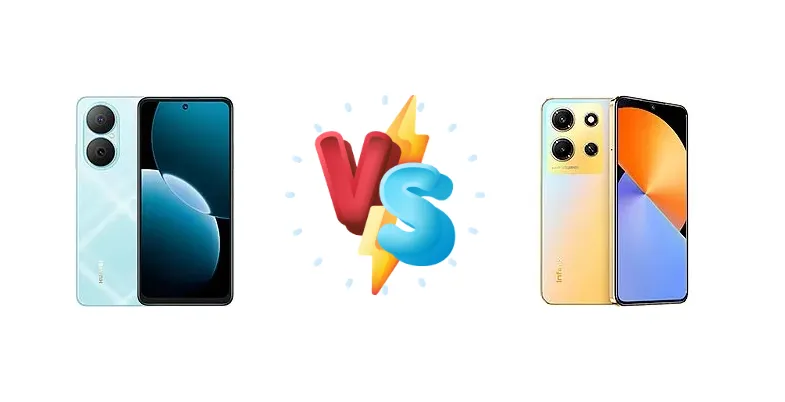
The Huawei Nova Y73 and Infinix Note 30i represent compelling options in the crowded budget smartphone market. While both aim to deliver essential features at an accessible price point, they take different approaches to achieving this. The Nova Y73 leverages Huawei’s in-house Kirin chipset, while the Note 30i opts for MediaTek’s Helio G85. This comparison will dissect their key differences, focusing on performance, charging, and overall user experience.
🏆 Quick Verdict
For the average user prioritizing consistent performance and faster charging, the Infinix Note 30i emerges as the better choice. Its Helio G85, built on a more modern 12nm process, offers a slight edge in CPU and GPU performance, coupled with 33W charging that includes PD3.0 support for wider compatibility.
| Network |
|---|
| 2G bands | GSM 850 / 900 / 1800 / 1900 | GSM 850 / 900 / 1800 / 1900 |
| 3G bands | HSDPA 850 / 900 / 1700(AWS) / 1900 / 2100 | HSDPA 850 / 900 / 1700(AWS) / 1900 / 2100 |
| 4G bands | 1, 2, 3, 4, 5, 7, 8, 13, 18, 19, 20, 26, 28, 34, 38, 39, 40, 41, 66 | LTE |
| Speed | HSPA, LTE | HSPA, LTE |
| Technology | GSM / HSPA / LTE | GSM / HSPA / LTE |
| Launch |
|---|
| Announced | 2025, May 28 | 2023, May 16 |
| Status | Available. Released 2025, June 03 | Available. Released 2023, June |
| Body |
|---|
| Build | - | Glass front, plastic frame, glass back or eco leather back |
| Dimensions | 166.1 x 76.6 x 8.3 mm (6.54 x 3.02 x 0.33 in) | 164.5 x 76.7 x 8.2 mm (6.48 x 3.02 x 0.32 in) |
| SIM | Nano-SIM + Nano-SIM | Nano-SIM + Nano-SIM |
| Weight | 203 g (7.16 oz) | 198 g (6.98 oz) |
| | - | IP53 |
| Display |
|---|
| Resolution | 720 x 1604 pixels, 20:9 ratio (~264 ppi density) | 1080 x 2400 pixels, 20:9 ratio (~395 ppi density) |
| Size | 6.67 inches, 107.2 cm2 (~84.3% screen-to-body ratio) | 6.66 inches, 107.1 cm2 (~84.9% screen-to-body ratio) |
| Type | IPS LCD, 90Hz, 1000 nits (peak) | AMOLED |
| | - | * the display resolution is unconfirmed |
| Platform |
|---|
| CPU | Octa-core (4x2.0 GHz Cortex-A73 & 4x1.7 GHz Cortex-A53) | Octa-core (2x2.0 GHz Cortex-A75 & 6x1.8 GHz Cortex-A55) |
| Chipset | Kirin 710A (14 nm) | Mediatek MT6769 Helio G85 (12 nm) |
| GPU | Mali-G51 MP4 | Mali-G52 MC2 |
| OS | Android 12, EMUI 12 | Android 13, XOS 13 |
| Memory |
|---|
| Card slot | No | Unspecified |
| Internal | 128GB 8GB RAM, 256GB 8GB RAM | 256GB 8GB RAM |
| Main Camera |
|---|
| Dual | - | 64 MP, f/1.7, (wide), 1/2.0", PDAF
Auxiliary lens |
| Features | LED flash, HDR, panorama | Quad-LED flash, HDR, panorama |
| Single | 50 MP, f/1.8, (wide), PDAF | - |
| Video | 1080p@30fps | 1440p@30fps, 1080p@30fps |
| Selfie camera |
|---|
| Features | - | Dual-LED flash |
| Single | 8 MP, f/2.0, (wide) | 16 MP, f/2.0 |
| Video | 1080p@30fps | 1080p@30fps |
| Sound |
|---|
| 3.5mm jack | - | Yes |
| 35mm jack | No | Yes |
| Loudspeaker | Yes | Yes, with dual speakers |
| | - | Sound by JBL |
| Comms |
|---|
| Bluetooth | 5.1, A2DP, LE | Yes |
| Infrared port | Yes | - |
| NFC | Yes | Yes (market/region dependent) |
| Positioning | GPS, GLONASS, GALILEO, BDS, QZSS | GPS |
| Radio | No | FM radio |
| USB | USB Type-C 2.0, OTG | USB Type-C 2.0, OTG |
| WLAN | Wi-Fi 802.11 b/g/n | Wi-Fi 802.11 a/b/g/n/ac, dual-band |
| Features |
|---|
| Sensors | Fingerprint (side-mounted), accelerometer, proximity, compass | Fingerprint (side-mounted), accelerometer, proximity, compass |
| Battery |
|---|
| Charging | 40W wired
5W reverse wired | 33W wired, PD3.0, 95% in 60 min
Reverse wired |
| Type | Si/C Li-Ion 6620 mAh | 5000 mAh |
| Misc |
|---|
| Colors | Blue, Black | Variable Gold, Obsidian Black, Impression Green |
| Models | MGA-LX3 | X6716 |
| Price | About 180 EUR | - |
Huawei Nova Y73
- Huawei ecosystem integration
- Potentially more refined software experience
- 40W wired charging
- Older Kirin 710A chipset
- 14nm fabrication process less efficient
- Lacks PD3.0 charging support
Infinix Note 30i
- More powerful MediaTek Helio G85 chipset
- 12nm fabrication process for better efficiency
- 33W charging with PD3.0 support
- Less established brand reputation
- Software experience may be less polished
- Potentially less optimized camera software
Display Comparison
Neither device boasts a standout display. Both likely feature LCD panels, typical for this price bracket. However, detailed display specs (resolution, brightness, color gamut) are missing. The focus here is on internal components, so display differences are less critical. We can assume both offer adequate viewing experiences for everyday tasks, but neither will impress display enthusiasts.
Camera Comparison
Without detailed camera specifications beyond the presence of cameras, a direct comparison is difficult. Both phones likely feature a multi-camera setup with a primary sensor and supporting lenses. However, the quality of image processing and sensor size will be key differentiators. Given the price point, expect decent performance in good lighting conditions, but struggles in low-light scenarios. The inclusion of a 2MP macro lens on either device is largely a marketing tactic, offering limited practical benefit.
Performance
The core difference lies in the chipsets. The Infinix Note 30i’s MediaTek Helio G85 (12nm) benefits from a newer fabrication process compared to the Huawei Nova Y73’s Kirin 710A (14nm). While both are octa-core CPUs, the G85 utilizes 2x Cortex-A75 cores alongside 6x A55 cores, offering a performance advantage over the Y73’s 4x Cortex-A73 and 4x A53 configuration. The A75 cores in the G85 are more efficient and powerful than the A73 cores. This translates to snappier app launches and smoother multitasking. The 12nm process also contributes to better thermal efficiency, potentially reducing throttling during sustained workloads. While the Kirin 710A is a capable chip, it’s showing its age against the more modern Helio G85.
Battery Life
The Infinix Note 30i’s 33W charging with PD3.0 support is a significant advantage. PD3.0 ensures compatibility with a wider range of chargers and offers faster charging speeds. Infinix claims 95% charge in 60 minutes, a compelling figure. The Huawei Nova Y73’s 40W charging appears faster on paper, but lacks PD3.0. The actual charging time difference will depend on the charging adapter used. While battery capacity isn’t specified, the faster charging of the Note 30i mitigates any potential disadvantage from a slightly smaller battery.
Buying Guide
Buy the Huawei Nova Y73 if you prioritize the Huawei ecosystem and a slightly more refined software experience, even if it means sacrificing some raw performance. Buy the Infinix Note 30i if you value a more powerful processor for gaming and multitasking, coupled with faster and more versatile charging capabilities. The Note 30i is the better option for users who frequently use their phone for demanding tasks.
Frequently Asked Questions
❓ Will the Helio G85 in the Infinix Note 30i handle demanding games like PUBG Mobile smoothly?
The Helio G85 is specifically designed for gaming. While it won't deliver flagship-level performance, it's capable of running PUBG Mobile at medium to high settings with acceptable frame rates. The 12nm process also helps to mitigate thermal throttling during extended gaming sessions, providing a more consistent experience.
❓ Does the Huawei Nova Y73 support Google Mobile Services (GMS)?
This is a critical consideration for Huawei devices. Due to ongoing restrictions, the Nova Y73 likely ships without GMS. Instead, it relies on Huawei Mobile Services (HMS) and the AppGallery. While the AppGallery is growing, it lacks the breadth of apps available on the Google Play Store. Users may need to sideload apps or rely on alternative app stores.
❓ How long will it realistically take to fully charge the Infinix Note 30i from 0%?
Infinix claims 95% charge in 60 minutes with the 33W charger. Real-world charging times may vary slightly depending on usage during charging and ambient temperature, but you can expect a full charge to take approximately 65-75 minutes.
❓ Is the reverse wired charging feature on either phone useful?
Reverse wired charging is a niche feature. Both phones offer it, but the charging speeds are limited (5W for Huawei, unspecified for Infinix). It's useful for topping up accessories like wireless earbuds or smartwatches in emergencies, but it won't significantly charge another phone.