
Huawei Nova Y72S vs. Infinix Note 30 Pro: A Detailed Comparison
| Phones Images | |||||
|---|---|---|---|---|---|
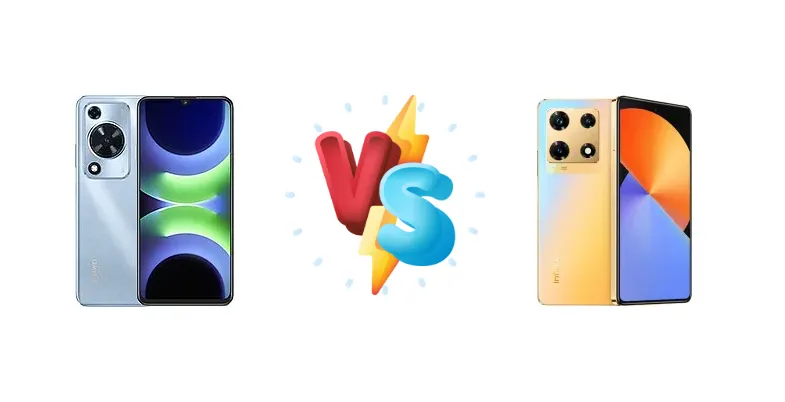
|
🏆 Quick Verdict
For the average user prioritizing fast charging and a more responsive experience, the Infinix Note 30 Pro is the clear winner. Its 68W charging and Helio G99 chipset offer a significant advantage over the Nova Y72S’s 22.5W charging and Snapdragon 680, despite the latter’s efficiency benefits.
| PHONES | ||
|---|---|---|
| Phone Names | Huawei Nova Y72S | Infinix Note 30 Pro |
| Network | ||
|---|---|---|
| 2G bands | GSM 850 / 900 / 1800 / 1900 | GSM 850 / 900 / 1800 / 1900 |
| 3G bands | HSDPA 850 / 900 / 1700(AWS) / 1900 / 2100 | HSDPA 850 / 900 / 1700(AWS) / 1900 / 2100 |
| 4G bands | 1, 2, 3, 4, 5, 7, 8, 13, 18, 19, 20, 26, 28, 34, 38, 39, 40, 41, 66 | 1, 2, 3, 4, 5, 7, 8, 12, 17, 20, 28, 38, 40, 41, 66 |
| Speed | HSPA, LTE | HSPA, LTE |
| Technology | GSM / HSPA / LTE | GSM / HSPA / LTE |
| Launch | ||
|---|---|---|
| Announced | 2025, April | 2023, May 22 |
| Status | Available. Released 2025, April | Available. Released 2023, May 22 |
| Body | ||
|---|---|---|
| Build | - | Glass front, plastic frame, glass back |
| Dimensions | 168.3 x 77.7 x 8.9 mm (6.63 x 3.06 x 0.35 in) | 162.7 x 76 x 8.2 mm (6.41 x 2.99 x 0.32 in) |
| SIM | Nano-SIM + Nano-SIM | Nano-SIM + Nano-SIM |
| Weight | 207 g (7.30 oz) | 203 g (7.16 oz) |
| - | IP53 | |
| Display | ||
|---|---|---|
| Resolution | 720 x 1600 pixels, 20:9 ratio (~260 ppi density) | 1080 x 2400 pixels, 20:9 ratio (~395 ppi density) |
| Size | 6.75 inches, 110.0 cm2 (~84.1% screen-to-body ratio) | 6.67 inches, 107.4 cm2 (~86.9% screen-to-body ratio) |
| Type | IPS LCD, 90Hz | AMOLED, 1B colors, 120Hz, 900 nits (peak) |
| - | * the display diagonal size and resolution is unconfirmed | |
| Platform | ||
|---|---|---|
| CPU | Octa-core (4x2.4 GHz Kryo 265 Gold & 4x1.9 GHz Kryo 265 Silver) | Octa-core (2x2.2 GHz Cortex-A76 & 6x2.0 GHz Cortex-A55) |
| Chipset | Qualcomm SM6225 Snapdragon 680 4G (6 nm) | Mediatek Helio G99 (6 nm) |
| GPU | Adreno 610 | Mali-G57 MC2 |
| OS | Android 12, EMUI 14, no Google Play Services | Android 13, XOS 13 |
| Memory | ||
|---|---|---|
| Card slot | No | microSDXC (dedicated slot) |
| Internal | 128GB 8GB RAM, 256GB 8GB RAM | 256GB 8GB RAM |
| Main Camera | ||
|---|---|---|
| Dual | 50 MP, f/1.8, 26mm (wide), PDAF 2 MP (macro) | - |
| Features | LED flash, HDR, panorama | Quad-LED flash, HDR, panorama |
| Triple | - | 108 MP, (wide), 1/1.67", PDAF 2 MP (macro) Auxiliary lens |
| Video | 1080p@30fps | 1440p@30fps, 1080p@30fps |
| Selfie camera | ||
|---|---|---|
| Features | - | LED flash, HDR |
| Single | 8 MP, f/2.0, (wide) | 32 MP, f/2.0, (wide), 1/2.8" |
| Video | 1080p@30fps | 1080p@30fps |
| Sound | ||
|---|---|---|
| 3.5mm jack | - | Yes |
| 35mm jack | No | Yes |
| Loudspeaker | Yes | Yes, with dual speakers |
| - | Sound by JBL 24-bit/192kHz audio | |
| Comms | ||
|---|---|---|
| Bluetooth | 5.0, A2DP, LE | Yes |
| NFC | Yes | Yes (market/region dependent) |
| Positioning | GPS, GALILEO, GLONASS, BDS, QZSS | GPS |
| Radio | No | FM radio |
| USB | USB Type-C 2.0 | USB Type-C 2.0, OTG |
| WLAN | Wi-Fi 802.11 a/b/g/n/ac, dual-band | Wi-Fi 802.11 a/b/g/n/ac, dual-band, Wi-Fi Direct |
| Features | ||
|---|---|---|
| Sensors | Fingerprint (side-mounted), accelerometer, proximity, compass | Fingerprint (side-mounted), accelerometer, gyro, proximity, compass |
| Battery | ||
|---|---|---|
| Charging | 22.5W wired | 68W wired, PD3.0, 80% in 30 min 15W wireless Reverse wireless |
| Type | 6000 mAh | 5000 mAh |
| Misc | ||
|---|---|---|
| Colors | Blue, Black | Magic Black, Variable Gold |
| Models | GFY-LX1 | X678B |
| Price | About 240 EUR | - |
Huawei Nova Y72S
- Excellent power efficiency with Snapdragon 680
- Potentially longer standby time
- Reliable Qualcomm chipset
- Slow 22.5W charging
- Less powerful processor for demanding tasks
- Lacks wireless charging
Infinix Note 30 Pro
- Significantly faster 68W wired charging
- More powerful MediaTek Helio G99 processor
- Wireless and reverse wireless charging
- Potentially lower battery life due to more powerful processor
- MediaTek chipset may not have the same software support as Qualcomm
- Image processing may not appeal to all users
Display Comparison
Neither device boasts a standout display. Both likely utilize LCD panels, common in this price bracket. The focus here isn't on cutting-edge tech, but on usability. While specific display specs (resolution, brightness) are missing, the real differentiator will be color accuracy and viewing angles, areas where we'd expect similar performance given the price point. Bezels are likely comparable, prioritizing cost-effectiveness over ultra-slim designs.
Camera Comparison
Without detailed camera specs, a direct comparison is challenging. However, the market segment suggests both phones will rely on primary sensors around the 50MP mark. The aperture and sensor size will be key determinants of low-light performance. Image processing algorithms will also play a significant role, with Huawei historically emphasizing color vibrancy and detail enhancement, while Infinix often aims for a more natural look. The presence of OIS (Optical Image Stabilization) would be a major advantage, but is not specified for either device. The inclusion of 2MP macro lenses on both is largely marketing fluff and shouldn't influence purchasing decisions.
Performance
The core difference lies in the chipsets. The Infinix Note 30 Pro’s MediaTek Helio G99, built on a 6nm process, features two Cortex-A76 cores clocked at 2.2 GHz, offering a noticeable performance boost over the Huawei Nova Y72S’s Snapdragon 680. The Snapdragon 680, also 6nm, employs a more conservative octa-core configuration with Kryo 265 Gold cores peaking at 2.4 GHz. While the Snapdragon 680 excels in power efficiency, the Helio G99’s architecture provides superior multi-core performance, translating to smoother multitasking and a more responsive gaming experience. The Note 30 Pro is likely to handle demanding apps and games with greater ease. RAM configurations are crucial here, but absent from the data, impacting overall responsiveness.
Battery Life
The Infinix Note 30 Pro’s 68W wired charging is a game-changer. The advertised 80% charge in 30 minutes significantly reduces downtime compared to the Nova Y72S’s 22.5W charging. The addition of 15W wireless charging and reverse wireless charging on the Note 30 Pro adds further convenience. While battery capacity isn’t specified, the faster charging speeds of the Note 30 Pro effectively mitigate any potential disadvantage from a slightly smaller battery. The Snapdragon 680’s efficiency in the Nova Y72S will contribute to longer standby times, but the Note 30 Pro’s charging speed will likely be more impactful for most users.
Buying Guide
Buy the Huawei Nova Y72S if you prioritize long-term battery life and a consistently stable, if less powerful, experience. It’s ideal for users who primarily browse, use social media, and make calls. Buy the Infinix Note 30 Pro if you value faster charging speeds, a more capable processor for light gaming, and the convenience of wireless charging. This phone suits users who need a bit more performance for everyday tasks and occasional gaming.