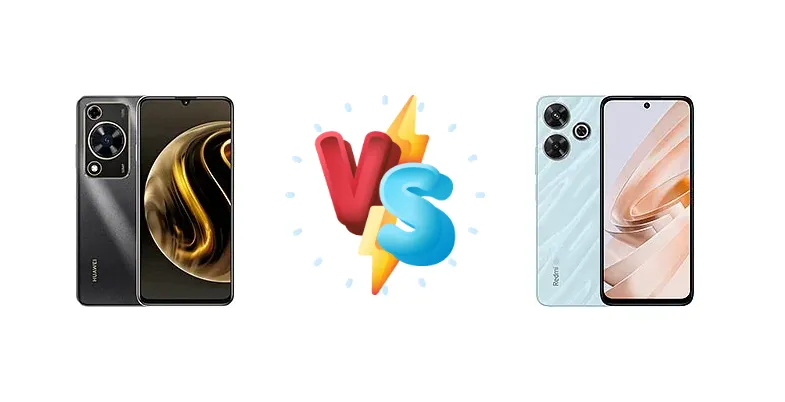
The Huawei nova Y72 and Xiaomi Redmi Note 13R represent compelling options in the crowded budget smartphone market. While both aim to deliver essential features at an accessible price, they take fundamentally different approaches to achieving this. The Y72 relies on Huawei’s in-house Kirin chipset, while the Note 13R leverages the efficiency of Qualcomm’s Snapdragon 4+ Gen 2. This comparison dissects these key differences to determine which device offers the best overall experience.
🏆 Quick Verdict
For most users, the Xiaomi Redmi Note 13R emerges as the stronger contender. Its Snapdragon 4+ Gen 2 chipset, built on a more efficient 4nm process, provides a noticeable performance advantage and improved thermal management compared to the Huawei nova Y72’s older Kirin 710A. The faster 33W charging also gives it an edge in daily usability.
| Network |
|---|
| 2G bands | GSM 850 / 900 / 1800 / 1900 | GSM 850 / 900 / 1800 / 1900 |
| 3G bands | HSDPA 800 / 850 / 900 / 2100 | HSDPA 850 / 900 / 2100 |
| 4G bands | 1, 3, 5, 7, 8, 20, 28, 18, 19, 34, 38, 39, 40, 41 | 1, 3, 5, 8, 34, 38, 39, 40, 41 |
| 5G bands | - | 1, 5, 8, 28, 41, 78 SA/NSA |
| Speed | HSPA, LTE | HSPA, LTE, 5G |
| Technology | GSM / HSPA / LTE | GSM / CDMA / HSPA / EVDO / LTE / 5G |
| Launch |
|---|
| Announced | 2024, January 26 | 2024, May 17 |
| Status | Available. Released 2024, February | Available. Released 2024, May 17 |
| Body |
|---|
| Build | - | Glass front, plastic frame, glass back |
| Dimensions | 168.3 x 77.7 x 8.9 mm (6.63 x 3.06 x 0.35 in) | 168.6 x 76.3 x 8.2 mm (6.64 x 3.00 x 0.32 in) |
| SIM | Nano-SIM + Nano-SIM | Nano-SIM + Nano-SIM |
| Weight | 207 g (7.30 oz) | 205 g (7.23 oz) |
| Display |
|---|
| Resolution | 720 x 1600 pixels, 20:9 ratio (~260 ppi density) | 1080 x 2460 pixels (~396 ppi density) |
| Size | 6.75 inches, 110.0 cm2 (~84.1% screen-to-body ratio) | 6.79 inches, 109.5 cm2 (~85.1% screen-to-body ratio) |
| Type | TFT LCD | IPS LCD, 120Hz, 550 nits |
| Platform |
|---|
| CPU | Octa-core (4x2.0 GHz Cortex-A73 & 4x1.7 GHz Cortex-A53) | Octa-core (2x2.3 GHz Cortex-A78 & 6x1.95 GHz Cortex-A55) |
| Chipset | Kirin 710A (14 nm) | Qualcomm SM4450 Snapdragon 4+ Gen 2 (4 nm) |
| GPU | Mali-G51 MP4 | Adreno 613 |
| OS | Android 12, EMUI 14, no Google Play Services | Android 14, HyperOS |
| Memory |
|---|
| Card slot | No | No |
| Internal | 128GB 8GB RAM, 256GB 8GB RAM | 128GB 6GB RAM, 128GB 8GB RAM, 256GB 8GB RAM, 256GB 12GB RAM, 512GB 12GB RAM |
| Main Camera |
|---|
| Dual | 50 MP, f/1.8, (wide), AF
2 MP (macro) | 50 MP, f/1.8, (wide), 1/2.76", 0.64µm, PDAF
2 MP (macro) |
| Features | LED flash, HDR, panorama | LED flash, HDR |
| Video | 1080p@30fps | 1080p@30fps |
| Selfie camera |
|---|
| Single | 8 MP, f/2.0, (wide) | 8 MP, (wide), 1/4.0", 1.12µm |
| Video | 1080p@30fps | 1080p@30fps |
| Sound |
|---|
| 35mm jack | No | Yes |
| Loudspeaker | Yes | Yes |
| Comms |
|---|
| Bluetooth | 5.1, A2DP, LE | 5.3, A2DP, LE |
| Infrared port | - | Yes |
| NFC | Yes (market/region dependent) | Yes |
| Positioning | GPS, GLONASS, GALILEO, BDS, QZSS | GPS, GLONASS, GALILEO, BDS |
| Radio | No | No |
| USB | USB Type-C 2.0, OTG | USB Type-C |
| WLAN | Wi-Fi 802.11 a/b/g/n/ac, dual-band | Wi-Fi 802.11 a/b/g/n/ac, dual-band |
| Features |
|---|
| Sensors | Fingerprint (side-mounted), accelerometer, proximity, compass | Fingerprint (side-mounted), accelerometer, compass |
| Battery |
|---|
| Charging | 22.5W wired | 33W wired |
| Type | 6000 mAh | 5030 mAh |
| Misc |
|---|
| Colors | Black, Green | Black, Blue, Silver |
| Models | MGA-LX3 | 2406ERN9CC |
| Price | About 240 EUR | About 180 EUR |
Huawei nova Y72
- Huawei ecosystem integration
- Potentially unique design aesthetic
- Established brand recognition
- Older, less efficient Kirin 710A chipset
- Slower 22.5W charging
- Potential software limitations due to geopolitical factors
Xiaomi Redmi Note 13R
- More efficient Snapdragon 4+ Gen 2 chipset
- Faster 33W charging
- Likely better sustained performance
- Wider software support and updates
- Xiaomi’s MIUI software can be polarizing
- May lack certain Huawei-specific features
Display Comparison
Neither device boasts a standout display. While specific panel details (like peak brightness or color gamut coverage) are unavailable, the focus here is on the underlying processors impacting the user experience *while* using the display. The Redmi Note 13R’s more efficient chipset allows for smoother scrolling and app transitions, contributing to a more responsive visual experience. Bezels are likely comparable given the price points, and color accuracy will likely be standard for this segment.
Camera Comparison
Without detailed camera specs beyond the presence of sensors, a direct comparison is limited. However, the Redmi Note 13R’s more powerful processor enables more sophisticated image processing algorithms, potentially leading to better dynamic range and noise reduction. The Kirin 710A, while capable, will likely struggle to keep pace in complex scenes. The absence of Optical Image Stabilization (OIS) on either device suggests a reliance on software stabilization, where the Snapdragon’s processing power will again be advantageous.
Performance
The core difference lies in the chipsets. The Xiaomi Redmi Note 13R’s Qualcomm SM4450 Snapdragon 4+ Gen 2 (4nm) is a significant upgrade over the Huawei nova Y72’s Kirin 710A (14nm). The 4nm fabrication process translates to superior power efficiency and reduced heat generation, meaning the Redmi Note 13R will sustain peak performance for longer periods. The Snapdragon’s CPU configuration – 2x2.3 GHz Cortex-A78 & 6x1.95 GHz Cortex-A55 – also offers a performance boost over the Kirin’s 4x2.0 GHz Cortex-A73 & 4x1.7 GHz Cortex-A53, particularly in multi-threaded tasks. This benefits users engaged in demanding applications or multitasking.
Battery Life
The Redmi Note 13R’s 33W wired charging is a clear advantage over the nova Y72’s 22.5W charging. This translates to significantly faster top-up times, reducing downtime. While battery capacity isn’t specified, the Snapdragon 4+ Gen 2’s efficiency means the Redmi Note 13R will likely deliver comparable or better real-world battery life despite potentially having a similar or even slightly smaller battery capacity. Users who frequently find themselves needing a quick charge will greatly benefit from the Redmi Note 13R.
Buying Guide
Buy the Huawei nova Y72 if you prioritize brand familiarity within the Huawei ecosystem and are comfortable with potential software limitations. Its design may also appeal to those seeking a specific aesthetic. Buy the Xiaomi Redmi Note 13R if you prioritize raw performance, battery efficiency, and faster charging speeds, making it ideal for users who frequently game, stream, or rely heavily on their smartphone throughout the day.
Frequently Asked Questions
❓ Will the Kirin 710A in the Huawei nova Y72 struggle with demanding games like PUBG Mobile?
Yes, the Kirin 710A is likely to exhibit noticeable frame drops and throttling during extended gaming sessions, particularly with graphically intensive titles like PUBG Mobile. The Snapdragon 4+ Gen 2 in the Redmi Note 13R offers significantly better sustained performance for gaming due to its more efficient architecture and superior thermal management.
❓ Does the 33W charging on the Redmi Note 13R translate to a substantial time saving compared to the nova Y72’s 22.5W charging?
Absolutely. While exact charging times depend on battery capacity, 33W charging will typically reduce a 0-100% charge time by 30-60 minutes compared to 22.5W. This is a significant benefit for users who need to quickly top up their phone throughout the day.
❓ Are there any concerns about software updates and support for the Huawei nova Y72?
Huawei’s access to Google Mobile Services (GMS) is limited due to geopolitical factors. This means the nova Y72 relies on Huawei’s AppGallery and HMS ecosystem, which may lack some popular apps and services. Software updates may also be less frequent and slower to arrive compared to the Redmi Note 13R, which benefits from Xiaomi’s robust software support.