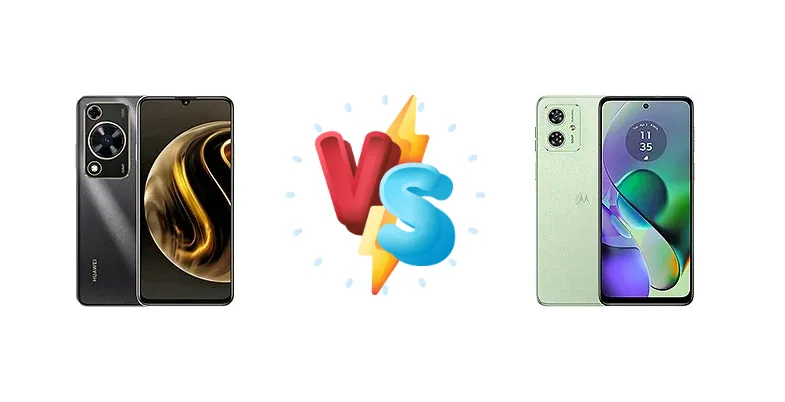
The Huawei nova Y72 and Motorola Moto G54 represent compelling options in the crowded sub-$250 smartphone market. The Y72, leveraging Huawei’s established brand, focuses on a refined user experience within its ecosystem. Conversely, the Moto G54 aims to deliver raw performance and modern features at an aggressive price point, making this a battle between software polish and processing power.
🏆 Quick Verdict
For the average user prioritizing performance and future-proofing, the Motorola Moto G54 is the clear winner. Its Mediatek Dimensity 7020 chipset, built on a 6nm process, provides a substantial performance advantage over the Huawei nova Y72’s older Kirin 710A. However, users deeply invested in the Huawei ecosystem may find the Y72’s software experience more appealing.
| Network |
|---|
| 2G bands | GSM 850 / 900 / 1800 / 1900 | GSM 850 / 900 / 1800 / 1900 |
| 3G bands | HSDPA 800 / 850 / 900 / 2100 | HSDPA 850 / 900 / 1900 / 2100 |
| 4G bands | 1, 3, 5, 7, 8, 20, 28, 18, 19, 34, 38, 39, 40, 41 | 1, 2, 3, 5, 7, 8, 20, 26, 28, 32, 38, 40, 41, 42 |
| 5G bands | - | 1, 3, 5, 7, 8, 20, 26, 28, 38, 40, 41, 77, 78 SA/NSA |
| Speed | HSPA, LTE | HSPA, LTE, 5G |
| Technology | GSM / HSPA / LTE | GSM / HSPA / LTE / 5G |
| Launch |
|---|
| Announced | 2024, January 26 | 2023, September 05 |
| Status | Available. Released 2024, February | Available. Released 2023, September 05 |
| Body |
|---|
| Build | - | Glass front, plastic back or silicone polymer back (eco leather), plastic frame |
| Dimensions | 168.3 x 77.7 x 8.9 mm (6.63 x 3.06 x 0.35 in) | 161.6 x 73.8 x 8 mm (6.36 x 2.91 x 0.31 in) |
| SIM | Nano-SIM + Nano-SIM | · Nano-SIM + eSIM· Nano-SIM + Nano-SIM |
| Weight | 207 g (7.30 oz) | 177 g (6.24 oz) |
| Display |
|---|
| Resolution | 720 x 1600 pixels, 20:9 ratio (~260 ppi density) | 1080 x 2400 pixels, 20:9 ratio (~405 ppi density) |
| Size | 6.75 inches, 110.0 cm2 (~84.1% screen-to-body ratio) | 6.5 inches, 102.0 cm2 (~85.5% screen-to-body ratio) |
| Type | TFT LCD | IPS LCD, 120Hz |
| Platform |
|---|
| CPU | Octa-core (4x2.0 GHz Cortex-A73 & 4x1.7 GHz Cortex-A53) | Octa-core (2x2.2 GHz Cortex-A78 & 6x2.0 GHz Cortex-A55) |
| Chipset | Kirin 710A (14 nm) | Mediatek Dimensity 7020 (6 nm) |
| GPU | Mali-G51 MP4 | IMG BXM-8-256 |
| OS | Android 12, EMUI 14, no Google Play Services | Android 13, upgradable to Android 15 |
| Memory |
|---|
| Card slot | No | microSDXC (dedicated slot) - InternationalmicroSDXC (uses shared SIM slot) - China |
| Internal | 128GB 8GB RAM, 256GB 8GB RAM | 128GB 4GB RAM, 128GB 8GB RAM, 256GB 4GB RAM, 256GB 8GB RAM, 256GB 12GB RAM |
| Main Camera |
|---|
| Dual | 50 MP, f/1.8, (wide), AF
2 MP (macro) | 50 MP, f/1.8 (wide), 0.61µm, PDAF, OIS
2 MP (macro) |
| Features | LED flash, HDR, panorama | Dual-LED dual-tone flash, HDR, panorama |
| Video | 1080p@30fps | 1080p@30/60fps |
| Selfie camera |
|---|
| Features | - | HDR |
| Single | 8 MP, f/2.0, (wide) | 16 MP, f/2.4, (wide), 1.0µm |
| Video | 1080p@30fps | 1080p@30fps |
| Sound |
|---|
| 35mm jack | No | Yes |
| Loudspeaker | Yes | Yes, with stereo speakers |
| Comms |
|---|
| Bluetooth | 5.1, A2DP, LE | 5.3, A2DP, LE |
| NFC | Yes (market/region dependent) | Yes |
| Positioning | GPS, GLONASS, GALILEO, BDS, QZSS | GPS, GLONASS, GALILEO, BDS, QZSS |
| Radio | No | FM radio (market/region dependent) |
| USB | USB Type-C 2.0, OTG | USB Type-C 2.0, OTG |
| WLAN | Wi-Fi 802.11 a/b/g/n/ac, dual-band | Wi-Fi 802.11 a/b/g/n/ac, dual-band |
| Features |
|---|
| Sensors | Fingerprint (side-mounted), accelerometer, proximity, compass | Fingerprint (side-mounted), accelerometer, gyro, proximity, compass |
| Battery |
|---|
| Charging | 22.5W wired | 15W wired
Reverse wired |
| Type | 6000 mAh | Li-Po 5000 mAh |
| Misc |
|---|
| Colors | Black, Green | Midnight blue, Indigo blue, Glacier blue, Mint green |
| Models | MGA-LX3 | XT2343-1, XT2343-2 |
| Price | About 240 EUR | € 147.00 / $ 189.99 / £ 161.57 |
Huawei nova Y72
- Faster wired charging (22.5W)
- Potentially more refined software experience (HMS)
- Established Huawei brand reputation
- Older, less efficient Kirin 710A chipset
- Likely lower performance in demanding tasks
- Limited software update support compared to Motorola
Motorola Moto G54
- More powerful and efficient Dimensity 7020 chipset
- Reverse wired charging capability
- Near-stock Android experience with faster updates
- Slower wired charging (15W)
- Motorola’s software support can be inconsistent
- Less brand recognition than Huawei in some markets
Display Comparison
Neither device boasts a standout display. While specific panel details (like peak brightness or color gamut coverage) are unavailable, the core difference lies in the underlying chipsets’ ability to drive them efficiently. The Moto G54’s Dimensity 7020, with its more modern architecture, likely handles display rendering with greater ease. Bezels are expected to be comparable given the price bracket, and both will likely utilize IPS LCD panels, meaning color accuracy won't be a primary differentiator.
Camera Comparison
Without detailed camera specs, a direct comparison is difficult. However, given the price points, both phones likely feature a primary sensor around the 50MP mark. The Moto G54’s more powerful ISP (Image Signal Processor) within the Dimensity 7020 chipset will likely result in better image processing, particularly in low-light conditions. The Y72 may rely more heavily on software algorithms to compensate for a less capable ISP. Expect both phones to include standard features like HDR and portrait modes, but the G54 should offer a more consistent and detailed image quality.
Performance
The performance gap is the most significant differentiator. The Motorola Moto G54’s Mediatek Dimensity 7020 (6nm) is a substantial upgrade over the Huawei nova Y72’s Kirin 710A (14nm). The 6nm process node translates to significantly improved power efficiency and thermal management, allowing the Dimensity 7020 to sustain peak performance for longer periods. Furthermore, the Dimensity 7020’s CPU configuration – 2x2.2 GHz Cortex-A78 & 6x2.0 GHz Cortex-A55 – offers a more modern and efficient architecture compared to the Y72’s 4x2.0 GHz Cortex-A73 & 4x1.7 GHz Cortex-A53. This means faster app loading times, smoother multitasking, and a better gaming experience on the Moto G54.
Battery Life
The Huawei nova Y72 supports 22.5W wired charging, while the Motorola Moto G54 offers 15W wired charging with the added benefit of reverse wired charging. While the Y72 charges faster on paper, the Dimensity 7020’s superior power efficiency in the G54 means it will likely consume less battery during typical usage. The reverse wired charging on the G54 is a useful feature for topping up accessories like earbuds or smartwatches, a feature absent on the Y72. Real-world battery life will depend heavily on usage patterns, but the G54’s efficiency gives it an edge.
Buying Guide
Buy the Huawei nova Y72 if you prioritize a familiar Huawei software experience (HMS) and value a potentially more refined, albeit less powerful, user interface. Buy the Motorola Moto G54 if you prioritize raw performance for gaming and multitasking, and appreciate a cleaner, near-stock Android experience with faster software updates. The G54 is the better choice for users who want a phone that will feel faster and more responsive for longer.
Frequently Asked Questions
❓ Does the Mediatek Dimensity 7020 in the Moto G54 get hot during extended gaming sessions?
The Dimensity 7020 is built on a 6nm process, which is significantly more efficient than the 14nm Kirin 710A in the Y72. This means it generates less heat under load, resulting in less thermal throttling during gaming. While it will get warm, it's unlikely to reach uncomfortable temperatures or experience significant performance drops.
❓ How does Huawei’s HMS (Huawei Mobile Services) compare to standard Android on the Moto G54 in terms of app availability?
Huawei’s HMS, used on the nova Y72, has improved significantly, but still lacks full access to the Google Play Store. While the AppGallery offers a growing selection of apps, some popular apps may require sideloading or using web versions. The Moto G54, running near-stock Android, has full access to the Google Play Store and a wider range of compatible apps.
❓ Is the 15W charging on the Moto G54 noticeably slower than the 22.5W charging on the Huawei nova Y72?
While 22.5W is faster on paper, the Moto G54’s Dimensity 7020 chipset is more power-efficient. This means the battery depletes slower, lessening the impact of the slower charging speed. In real-world usage, the difference in charging time may not be as significant as the wattage suggests.