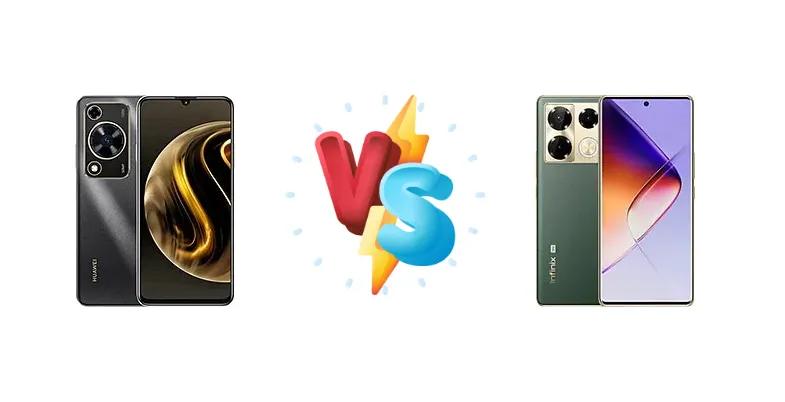
The mid-range smartphone market is fiercely competitive, and the Huawei nova Y72 and Infinix Note 40 Pro represent compelling options for budget-conscious buyers. While both aim to deliver a solid experience, they take distinctly different approaches to chipset architecture and charging technology. This comparison dissects these key differences to determine which device offers the best overall package.
🏆 Quick Verdict
For most users, the Infinix Note 40 Pro emerges as the stronger contender. Its Mediatek Dimensity 7020, built on a more efficient 6nm process, provides a noticeable performance advantage over the Huawei nova Y72’s Kirin 710A. Coupled with significantly faster 45W wired and 20W wireless charging, the Note 40 Pro offers a more future-proof and convenient experience.
| Network |
|---|
| 2G bands | GSM 850 / 900 / 1800 / 1900 | GSM 850 / 900 / 1800 / 1900 |
| 3G bands | HSDPA 800 / 850 / 900 / 2100 | HSDPA 850 / 900 / 1700(AWS) / 1900 / 2100 |
| 4G bands | 1, 3, 5, 7, 8, 20, 28, 18, 19, 34, 38, 39, 40, 41 | 1, 2, 3, 4, 5, 7, 8, 12, 17, 20, 28, 38, 40, 41, 42, 66 |
| 5G bands | - | 1, 3, 5, 7, 8, 12, 20, 28, 38, 40, 41, 66, 77, 78 SA/NSA |
| Speed | HSPA, LTE | HSPA, LTE, 5G |
| Technology | GSM / HSPA / LTE | GSM / HSPA / LTE / 5G |
| Launch |
|---|
| Announced | 2024, January 26 | 2024, March 18 |
| Status | Available. Released 2024, February | Available. Released 2024, March 19 |
| Body |
|---|
| Dimensions | 168.3 x 77.7 x 8.9 mm (6.63 x 3.06 x 0.35 in) | 164.3 x 74.5 x 8.1 mm (6.47 x 2.93 x 0.32 in) |
| SIM | Nano-SIM + Nano-SIM | Nano-SIM + Nano-SIM |
| Weight | 207 g (7.30 oz) | 190 g or 196 g (6.70 oz) |
| Display |
|---|
| Protection | - | Corning Gorilla Glass |
| Resolution | 720 x 1600 pixels, 20:9 ratio (~260 ppi density) | 1080 x 2436 pixels (~393 ppi density) |
| Size | 6.75 inches, 110.0 cm2 (~84.1% screen-to-body ratio) | 6.78 inches, 109.9 cm2 (~89.8% screen-to-body ratio) |
| Type | TFT LCD | AMOLED, 1B colors, 120Hz, 2160Hz PWM, 1300 nits (peak) |
| Platform |
|---|
| CPU | Octa-core (4x2.0 GHz Cortex-A73 & 4x1.7 GHz Cortex-A53) | Octa-core (2x2.2 GHz Cortex-A78 & 6x2.0 GHz Cortex-A55) |
| Chipset | Kirin 710A (14 nm) | Mediatek Dimensity 7020 (6 nm) |
| GPU | Mali-G51 MP4 | IMG BXM-8-256 |
| OS | Android 12, EMUI 14, no Google Play Services | Android 14, XOS 14 |
| Memory |
|---|
| Card slot | No | Unspecified |
| Internal | 128GB 8GB RAM, 256GB 8GB RAM | 256GB 8GB RAM |
| Main Camera |
|---|
| Dual | 50 MP, f/1.8, (wide), AF
2 MP (macro) | - |
| Features | LED flash, HDR, panorama | Dual-LED flash, HDR, panorama |
| Triple | - | 108 MP, f/1.8, (wide), PDAF, OIS
2 MP, f/2.4
2 MP, f/2.4 |
| Video | 1080p@30fps | 1440p@30fps, 1080p@30/60fps |
| Selfie camera |
|---|
| Features | - | Dual-LED flash |
| Single | 8 MP, f/2.0, (wide) | 32 MP, f/2.2, (wide), 1/3.1" |
| Video | 1080p@30fps | 1080p@30fps |
| Sound |
|---|
| 35mm jack | No | No |
| Loudspeaker | Yes | Yes, with stereo speakers |
| Comms |
|---|
| Bluetooth | 5.1, A2DP, LE | Yes |
| Infrared port | - | Yes |
| NFC | Yes (market/region dependent) | Yes (market/region dependent) |
| Positioning | GPS, GLONASS, GALILEO, BDS, QZSS | GPS |
| Radio | No | FM radio |
| USB | USB Type-C 2.0, OTG | USB Type-C 2.0, OTG |
| WLAN | Wi-Fi 802.11 a/b/g/n/ac, dual-band | Wi-Fi 802.11 a/b/g/n/ac, dual-band |
| Features |
|---|
| Sensors | Fingerprint (side-mounted), accelerometer, proximity, compass | Fingerprint (under display, optical), accelerometer, gyro, proximity, compass |
| Battery |
|---|
| Charging | 22.5W wired | 45W wired, 50% in 26 min
20W wireless MagCharge
Reverse wired
Reverse wireless |
| Type | 6000 mAh | 5000 mAh |
| Misc |
|---|
| Colors | Black, Green | Vintage Green, Titan Gold, Racing Edition |
| Models | MGA-LX3 | X6851 |
| Price | About 240 EUR | About 280 EUR |
Huawei nova Y72
- Potential Huawei ecosystem integration
- Likely more affordable price point
- Clean software experience (depending on EMUI version)
- Outdated Kirin 710A chipset
- Slow 22.5W charging
- No wireless charging
Infinix Note 40 Pro
- Powerful Mediatek Dimensity 7020 chipset
- 45W wired and 20W wireless MagCharge
- Reverse charging capabilities
- Infinix’s software experience can be polarizing
- Potential for bloatware
- Build quality may not match premium brands
Display Comparison
Neither device boasts a standout display. While specific panel details (like OLED vs. LCD) are missing for the Y72, its market positioning suggests an LCD panel. The Note 40 Pro’s display specs are also absent, but both likely target a 6.6-6.7 inch size range. The key differentiator here will be color accuracy and peak brightness, which are unknown. However, the Note 40 Pro’s potential for a higher refresh rate (a common feature in this price bracket) would provide a smoother user experience.
Camera Comparison
Without detailed camera specs, a direct comparison is challenging. However, the market segment suggests both phones will feature a multi-camera setup with a primary sensor, ultrawide, and potentially a depth or macro lens. The absence of Optical Image Stabilization (OIS) is likely on both. Image processing will be a key differentiator; Huawei historically emphasizes color science, while Infinix tends towards more vibrant, saturated images. The Note 40 Pro’s more powerful chipset could enable more sophisticated image processing algorithms.
Performance
The performance gap is the most significant distinction. The Infinix Note 40 Pro’s Mediatek Dimensity 7020, fabricated on a 6nm process, is a clear upgrade over the Huawei nova Y72’s Kirin 710A (14nm). The Dimensity 7020 utilizes more modern CPU cores – Cortex-A78 versus the Y72’s Cortex-A73 – resulting in superior single-core and multi-core performance. This translates to snappier app launches, smoother multitasking, and a more enjoyable gaming experience. The 6nm node also contributes to better thermal efficiency, potentially reducing throttling during sustained workloads. The Y72’s older architecture will struggle with demanding applications.
Battery Life
The Infinix Note 40 Pro’s charging capabilities are a major advantage. Its 45W wired charging, capable of delivering 50% charge in just 26 minutes, significantly outpaces the Huawei nova Y72’s 22.5W charging. Furthermore, the Note 40 Pro adds 20W wireless MagCharge, reverse wired charging, and reverse wireless charging – features entirely absent on the Y72. While battery capacity isn’t specified, the faster charging speeds on the Note 40 Pro mitigate the impact of a potentially smaller battery, offering greater convenience and reduced downtime.
Buying Guide
Buy the Huawei nova Y72 if you prioritize brand familiarity within the Huawei ecosystem and are comfortable with a more modest performance profile. It’s a sensible choice for basic smartphone tasks and light usage. Buy the Infinix Note 40 Pro if you demand faster processing speeds for gaming or multitasking, and value the convenience of rapid charging – both wired and wireless – alongside modern features like MagCharge and reverse charging.
Frequently Asked Questions
❓ Does the Mediatek Dimensity 7020 in the Infinix Note 40 Pro get hot during extended gaming sessions?
The Dimensity 7020 is built on a 6nm process, which is more efficient than the 14nm Kirin 710A in the Huawei nova Y72. This improved efficiency translates to lower heat generation. While some warming is expected during prolonged gaming, the Note 40 Pro is less likely to experience significant throttling compared to the Y72.
❓ Is the MagCharge feature on the Infinix Note 40 Pro compatible with all magnetic accessories?
The Infinix Note 40 Pro utilizes the MagCharge standard, which is based on the MagSafe technology popularized by Apple. While it’s designed to work with Infinix’s own magnetic accessories, compatibility with third-party MagSafe accessories is generally good, but not guaranteed. Some accessories may not adhere as strongly or may not support full charging speeds.
❓ How does the software experience differ between the Huawei nova Y72 and the Infinix Note 40 Pro?
Huawei’s EMUI (or HarmonyOS, depending on the region) is known for its customization options and focus on privacy. However, it can also be resource-intensive. Infinix’s XOS is more lightweight but often includes pre-installed apps (bloatware) and a more aggressive notification system. User preference plays a large role here; some prefer the polish of EMUI, while others prefer the simplicity of XOS.