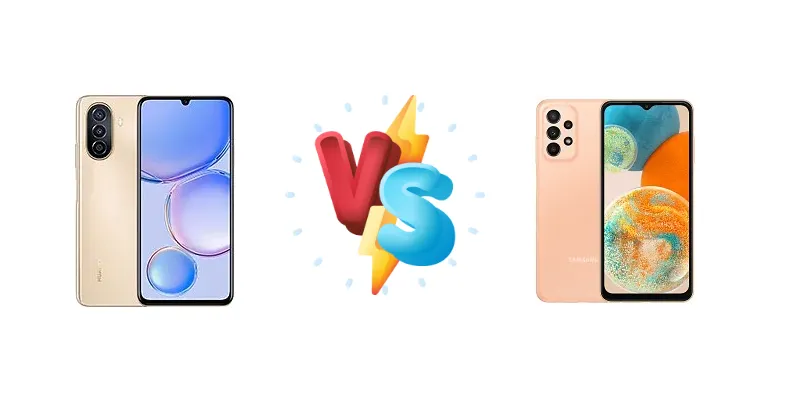
The Huawei nova Y71 and Samsung Galaxy A23 5G represent compelling options in the increasingly competitive sub-$250 smartphone market. While both offer 5G connectivity, they diverge significantly in their underlying hardware, impacting performance, efficiency, and overall user experience. This comparison dissects these differences to determine which device delivers the best value.
🏆 Quick Verdict
For the average user prioritizing sustained performance and future-proofing, the Samsung Galaxy A23 5G is the better choice. Its Snapdragon 695, built on a 6nm process, offers superior efficiency and processing power compared to the Huawei nova Y71’s older 14nm Kirin 710A, despite similar CPU core counts.
| Network |
|---|
| 2G bands | GSM 850 / 900 / 1800 / 1900 | GSM 850 / 900 / 1800 / 1900 |
| 3G bands | HSDPA 850 / 900 / 1900 / 2100 | HSDPA 850 / 900 / 1700(AWS) / 1900 / 2100 |
| 4G bands | 1, 3, 5, 7, 8, 20, 28, 38, 40, 41 | 1, 2, 3, 4, 5, 7, 8, 12, 17, 20, 26, 28, 32, 38, 40, 41, 66 - International |
| 5G bands | - | 1, 3, 7, 8, 20, 28, 38, 40, 41, 77, 78 SA/NSA/Sub6 - International |
| Speed | HSPA, LTE | HSPA, LTE, 5G |
| Technology | GSM / HSPA / LTE | GSM / HSPA / LTE / 5G |
| | - | 2, 5, 30, 66, 77 SA/NSA/Sub6/mmWave - USA |
| Launch |
|---|
| Announced | 2023, May 09 | 2022, August 05 |
| Status | Available. Released 2023, June | Available. Released 2022, September 02 |
| Body |
|---|
| Build | - | Glass front (Gorilla Glass 5), plastic frame, plastic back |
| Dimensions | 168.3 x 77.7 x 9 mm (6.63 x 3.06 x 0.35 in) | 165.4 x 76.9 x 8.4 mm (6.51 x 3.03 x 0.33 in) |
| SIM | · Nano-SIM· Nano-SIM + Nano-SIM | · Nano-SIM· Nano-SIM + Nano-SIM |
| Weight | 199 g (7.02 oz) | 197 g (6.95 oz) |
| Display |
|---|
| Protection | - | Corning Gorilla Glass 5 |
| Resolution | 720 x 1600 pixels, 20:9 ratio (~260 ppi density) | 1080 x 2408 pixels, 20:9 ratio (~400 ppi density) |
| Size | 6.75 inches, 110.0 cm2 (~84.1% screen-to-body ratio) | 6.6 inches, 104.9 cm2 (~82.5% screen-to-body ratio) |
| Type | IPS LCD | PLS LCD, 120Hz |
| Platform |
|---|
| CPU | Octa-core (4x2.0 GHz Cortex-A73 & 4x1.7 GHz Cortex-A53) | Octa-core (2x2.2 GHz Kryo 660 Gold & 6x1.7 GHz Kryo 660 Silver) |
| Chipset | Kirin 710A (14 nm) | Qualcomm SM6375 Snapdragon 695 5G (6 nm) |
| GPU | Mali-G51 MP4 | Adreno 619 |
| OS | EMUI 12, no Google Play Services | Android 12, upgradable to Android 14, One UI 6 |
| Memory |
|---|
| Card slot | microSDXC (uses shared SIM slot) | microSDXC (dedicated slot) |
| Internal | 128GB 8GB RAM | 64GB 4GB RAM, 64GB 6GB RAM, 128GB 4GB RAM, 128GB 6GB RAM, 128GB 8GB RAM |
| Main Camera |
|---|
| Features | LED flash, HDR, panorama | LED flash, panorama, HDR |
| Quad | - | 50 MP, f/1.8, 26mm (wide), 1/2.76", 0.64µm, PDAF, OIS
5 MP, f/2.2, 13mm, 123˚ (ultrawide), 1/5.0", 1.12µm
2 MP (macro)
Auxiliary lens |
| Triple | 48 MP, f/1.8, 26mm (wide), PDAF
5 MP, f/2.2, 120˚ (ultrawide)
Auxiliary lens | - |
| Video | 1080p@30fps | 1080p@30fps |
| Selfie camera |
|---|
| Features | HDR | - |
| Single | 8 MP, f/2.0 | 8 MP, f/2.0, 25mm (wide), 1/4.0", 1.12µm - USA
8 MP, f/2.2, 25mm (wide), 1/4.0", 1.12µm - International |
| Video | 1080p@30fps | 1080p@30fps |
| Sound |
|---|
| 3.5mm jack | Yes | Yes |
| 35mm jack | Yes | Yes |
| Loudspeaker | Yes | Yes |
| Comms |
|---|
| Bluetooth | 5.1, A2DP, LE | 5.1, A2DP, LE |
| NFC | No | Yes |
| Positioning | GPS, GLONASS, GALILEO, BDS, QZSS | GPS, GLONASS, GALILEO, BDS |
| Radio | No | FM radio (market/region dependent) |
| USB | USB Type-C 2.0, OTG | USB Type-C 2.0 |
| WLAN | Wi-Fi 802.11 b/g/n | Wi-Fi 802.11 a/b/g/n/ac, dual-band, Wi-Fi Direct |
| Features |
|---|
| Sensors | Fingerprint (side-mounted), accelerometer, proximity, compass | Fingerprint (side-mounted), accelerometer, gyro, compass, barometer (USA only) |
| | - | Virtual proximity sensing |
| Battery |
|---|
| Charging | 22.5W wired | 25W wired |
| Type | Li-Po 6000 mAh | Li-Po 5000 mAh |
| Misc |
|---|
| Colors | Black, Gold | Black, White, Peach, Blue |
| Models | - | SM-A236U, SM-A236U1, SM-A236B, SM-A236B/DS, SM-A236B/DSN, SM-A236E, SM-S236DL |
| Price | About 190 EUR | $ 84.44 / £ 129.00 / € 125.28 / ₹ 21,000 |
| SAR | - | 0.68 W/kg (head) 0.57 W/kg (body) |
| SAR EU | - | 1.49 W/kg (head) 1.25 W/kg (body) |
| Tests |
|---|
| Battery life | - |
Endurance rating 138h
|
| Camera | - |
Photo / Video |
| Display | - |
Contrast ratio: 1328:1 (nominal) |
| Loudspeaker | - |
-25.9 LUFS (Very good)
|
| Performance | - |
AnTuTu: 318821 (v9)
GeekBench: 1940 (v5.1)
GFXBench: 16fps (ES 3.1 onscreen) |
Huawei nova Y71
- Potentially lower price point
- Huawei’s EMUI software (preference-based)
- Simple and streamlined user experience
- Older, less efficient Kirin 710A chipset
- Limited Google Mobile Services support
- Potentially slower software updates
Samsung Galaxy A23 5G
- More efficient Snapdragon 695 5G chipset
- Open Android ecosystem with Google Mobile Services
- Faster 25W charging
- May be slightly more expensive
- Samsung’s One UI can be resource-intensive
- Build quality may feel less premium
Display Comparison
Both devices offer adequate displays for their price point, but the Samsung Galaxy A23 5G holds a slight edge. Both share a contrast ratio of 1328:1, indicating similar color reproduction capabilities. However, the A23 5G’s measured peak brightness of 508 nits is a tangible advantage, ensuring better visibility in outdoor conditions. While neither boasts high refresh rates, the A23 5G’s panel is likely to be more power-efficient due to the more modern manufacturing process of the entire device.
Camera Comparison
Both phones feature a 'Photo / Video' camera setup, but detailed sensor information is lacking. Without specifics, it’s difficult to make a definitive judgment. However, Samsung generally employs more sophisticated image processing algorithms. Given the A23 5G’s more powerful processor, it’s likely to handle computational photography tasks – like night mode and HDR – more effectively. The presence of OIS (Optical Image Stabilization) on the A23 5G, if equipped, would further enhance image quality, particularly in low-light conditions. We can assume both phones include a standard macro lens, but these are typically of limited utility.
Performance
The core difference lies in the chipsets. The Samsung Galaxy A23 5G’s Qualcomm Snapdragon 695 5G (6nm) is a significant upgrade over the Huawei nova Y71’s Kirin 710A (14nm). The 6nm process node translates to better thermal efficiency, meaning the A23 5G will experience less throttling under sustained load. While both CPUs feature octa-core configurations, the Snapdragon 695 utilizes newer Kryo cores, offering improved single-core and multi-core performance. The Kirin 710A, while capable for basic tasks, will struggle with demanding applications and multitasking. The A23 5G’s GPU will also provide a smoother gaming experience.
Battery Life
Both devices achieve an endurance rating of 138 hours, suggesting comparable battery life in typical usage scenarios. However, the Snapdragon 695’s superior efficiency gives the A23 5G an advantage in real-world scenarios, especially with 5G enabled. The A23 5G offers 25W wired charging, slightly faster than the nova Y71’s 22.5W, potentially reducing charging times. While the mAh capacity isn’t specified, the more efficient chipset of the A23 5G will likely translate to longer screen-on time.
Buying Guide
Buy the Huawei nova Y71 if you prioritize a simple, streamlined user experience within the Huawei ecosystem and are comfortable with potential limitations regarding Google Mobile Services. Buy the Samsung Galaxy A23 5G if you prefer a more open Android experience, demand better performance for multitasking and gaming, and value the benefits of a more modern and efficient chipset.
Frequently Asked Questions
❓ Does the Kirin 710A in the Huawei nova Y71 struggle with demanding games like PUBG Mobile?
Yes, the Kirin 710A is likely to exhibit noticeable frame drops and stuttering in graphically intensive games like PUBG Mobile, even at medium settings. The Snapdragon 695 in the A23 5G offers a significantly smoother gaming experience due to its more powerful GPU and efficient thermal management.
❓ How does the lack of Google Mobile Services (GMS) on the Huawei nova Y71 affect usability?
The absence of GMS means you won't have direct access to the Google Play Store and core Google apps like Gmail, YouTube, and Maps. Huawei provides its own AppGallery and HMS Core as alternatives, but app availability and compatibility can be limited. Sideloading apps is possible, but requires technical knowledge and carries security risks.
❓ Is the 25W charging on the Samsung Galaxy A23 5G significantly faster than the 22.5W charging on the Huawei nova Y71?
While the difference is not massive, the 25W charging on the A23 5G will likely result in a slightly faster 0-100% charge time. The more efficient chipset of the A23 5G also means it may reach a usable charge level (e.g., 50%) quicker than the nova Y71.
❓ Will the Samsung Galaxy A23 5G receive more software updates than the Huawei nova Y71?
Generally, Samsung provides more consistent and long-term software support for its devices compared to Huawei, particularly for models in this price range. Huawei’s update schedule can be less predictable, and the lack of GMS can further complicate future updates.