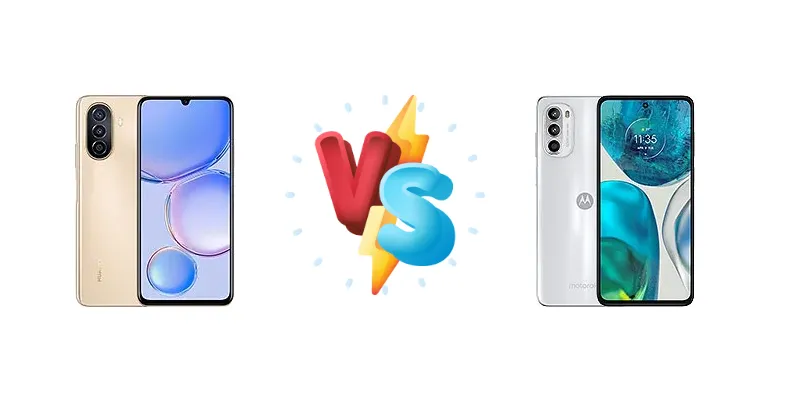
The Huawei nova Y71 and Motorola Moto G52 represent compelling options in the crowded budget smartphone market. While both aim to deliver essential features at an accessible price point, they take distinctly different approaches to achieving this. The nova Y71 relies on Huawei’s in-house Kirin chipset, while the Moto G52 leverages Qualcomm’s Snapdragon 680. This comparison dives deep into the specifics to determine which device offers the best value.
🏆 Quick Verdict
For the average user prioritizing efficiency and future-proofing, the Motorola Moto G52 emerges as the stronger contender. Its Snapdragon 680, built on a more modern 6nm process, offers better power efficiency and sustained performance compared to the older 14nm Kirin 710A in the Huawei nova Y71. While the Y71 offers slightly faster wired charging, the G52’s overall package is more compelling.
| Network |
|---|
| 2G bands | GSM 850 / 900 / 1800 / 1900 | GSM 850 / 900 / 1800 / 1900 |
| 3G bands | HSDPA 850 / 900 / 1900 / 2100 | HSDPA 850 / 900 / 1700(AWS) / 1900 / 2100 |
| 4G bands | 1, 3, 5, 7, 8, 20, 28, 38, 40, 41 | LTE |
| Speed | HSPA, LTE | HSPA, LTE |
| Technology | GSM / HSPA / LTE | GSM / HSPA / LTE |
| Launch |
|---|
| Announced | 2023, May 09 | 2022, April 12 |
| Status | Available. Released 2023, June | Available. Released 2022, April 20 |
| Body |
|---|
| Dimensions | 168.3 x 77.7 x 9 mm (6.63 x 3.06 x 0.35 in) | 160.1 x 74.5 x 8 mm (6.30 x 2.93 x 0.31 in) |
| SIM | · Nano-SIM· Nano-SIM + Nano-SIM | Nano-SIM + Nano-SIM |
| Weight | 199 g (7.02 oz) | 169 g (5.96 oz) |
| | - | Water-repellent design |
| Display |
|---|
| Resolution | 720 x 1600 pixels, 20:9 ratio (~260 ppi density) | 1080 x 2400 pixels, 20:9 ratio (~402 ppi density) |
| Size | 6.75 inches, 110.0 cm2 (~84.1% screen-to-body ratio) | 6.6 inches, 103.6 cm2 (~86.9% screen-to-body ratio) |
| Type | IPS LCD | AMOLED, 90Hz |
| Platform |
|---|
| CPU | Octa-core (4x2.0 GHz Cortex-A73 & 4x1.7 GHz Cortex-A53) | Octa-core (4x2.4 GHz Kryo 265 Gold & 4x1.9 GHz Kryo 265 Silver) |
| Chipset | Kirin 710A (14 nm) | Qualcomm SM6225 Snapdragon 680 4G (6 nm) |
| GPU | Mali-G51 MP4 | Adreno 610 |
| OS | EMUI 12, no Google Play Services | Android 12, planned upgrade to Android 13 |
| Memory |
|---|
| Card slot | microSDXC (uses shared SIM slot) | microSDXC (uses shared SIM slot) |
| Internal | 128GB 8GB RAM | 64GB 4GB RAM, 128GB 4GB RAM, 128GB 6GB RAM, 256GB 6GB RAM |
| Main Camera |
|---|
| Features | LED flash, HDR, panorama | LED flash, HDR, panorama |
| Triple | 48 MP, f/1.8, 26mm (wide), PDAF
5 MP, f/2.2, 120˚ (ultrawide)
Auxiliary lens | 50 MP, f/1.8 (wide), 1/2.76", 0.64µm, PDAF
8 MP, f/2.2, 118˚ (ultrawide), 1/4.0", 1.12µm
2 MP (macro) |
| Video | 1080p@30fps | 1080p@30fps |
| Selfie camera |
|---|
| Features | HDR | - |
| Single | 8 MP, f/2.0 | 16 MP, f/2.5, (wide), 1.0µm |
| Video | 1080p@30fps | 1080p@30fps |
| Sound |
|---|
| 3.5mm jack | Yes | Yes |
| 35mm jack | Yes | Yes |
| Loudspeaker | Yes | Yes, with stereo speakers |
| Comms |
|---|
| Bluetooth | 5.1, A2DP, LE | 5.0, A2DP, LE |
| NFC | No | Yes (market/region dependent) |
| Positioning | GPS, GLONASS, GALILEO, BDS, QZSS | GPS, GLONASS, GALILEO |
| Radio | No | Unspecified |
| USB | USB Type-C 2.0, OTG | USB Type-C 2.0 |
| WLAN | Wi-Fi 802.11 b/g/n | Wi-Fi 802.11 a/b/g/n/ac, dual-band, Wi-Fi Direct |
| Features |
|---|
| Sensors | Fingerprint (side-mounted), accelerometer, proximity, compass | Fingerprint (side-mounted), accelerometer, gyro, proximity, compass |
| Battery |
|---|
| Charging | 22.5W wired | 30W wired |
| Type | Li-Po 6000 mAh | Li-Po 5000 mAh |
| Misc |
|---|
| Colors | Black, Gold | Charcoal Gray, Porcelain White |
| Models | - | XT2221-1, XT2221-2 |
| Price | About 190 EUR | About 470 EUR |
Huawei nova Y71
- Faster wired charging (22.5W)
- Huawei’s established camera processing style (for those who prefer it)
- Potentially lower price point (depending on region)
- Older, less efficient Kirin 710A chipset
- 14nm process leads to higher heat and lower battery life
- Potential limitations with Google Mobile Services
Motorola Moto G52
- More efficient Snapdragon 680 chipset (6nm)
- Cleaner Android experience
- Likely longer software support
- Slightly slower wired charging (30W)
- May be slightly more expensive
- Motorola’s software update track record isn’t always the fastest
Display Comparison
Neither device boasts a standout display. Specifications are not provided for either display, so we must rely on market positioning. Given the price bracket, both likely feature 1080p LCD panels. However, the Moto G52, being a newer device, may benefit from slightly improved color accuracy and viewing angles. The absence of high refresh rates on either device suggests a focus on battery conservation rather than visual fluidity.
Camera Comparison
Without detailed sensor information, a direct comparison is challenging. However, the market segment suggests both phones will feature a primary camera around the 50MP mark, accompanied by auxiliary lenses of limited utility. Image processing will likely be the differentiating factor. Huawei historically emphasizes vibrant, sometimes oversaturated colors, while Motorola tends towards a more natural look. The Snapdragon 680’s ISP (Image Signal Processor) is generally more advanced, potentially leading to better dynamic range and low-light performance on the Moto G52.
Performance
The core difference lies in the chipsets. The Motorola Moto G52’s Qualcomm Snapdragon 680 (6nm) is a significant advantage over the Huawei nova Y71’s Kirin 710A (14nm). The 6nm process inherently provides better power efficiency, translating to longer battery life and less heat generation under load. While the Kirin 710A’s Cortex-A73 cores offer a peak clock speed of 2.0 GHz, the Snapdragon 680’s Kryo 265 Gold cores at 2.4 GHz, coupled with the more efficient architecture, will likely deliver a smoother experience in demanding applications. The Snapdragon 680 also benefits from Qualcomm’s optimized software and GPU drivers.
Battery Life
The Huawei nova Y71 features 22.5W wired charging, while the Motorola Moto G52 supports 30W. This means the Y71 will take longer to fully charge. However, the Snapdragon 680’s superior power efficiency in the Moto G52 means it will likely consume less energy during typical usage, potentially offsetting the smaller battery capacity (assuming similar battery sizes, which is likely given the price point). The G52’s faster charging and efficient chipset combine for a more convenient user experience.
Buying Guide
Buy the Huawei nova Y71 if you prioritize a slightly faster charging experience and are comfortable with the Huawei ecosystem, understanding potential limitations with Google Mobile Services. Buy the Motorola Moto G52 if you value a more efficient processor, a cleaner Android experience, and a chipset that’s likely to receive longer software support. The G52 is ideal for users who frequently multitask or enjoy light gaming.
Frequently Asked Questions
❓ Will the Kirin 710A struggle with demanding games like PUBG Mobile?
The Kirin 710A can run PUBG Mobile, but you’ll likely need to lower the graphics settings to achieve a consistently smooth frame rate. The Snapdragon 680 in the Moto G52 will offer a more stable gaming experience at medium settings due to its more efficient architecture and GPU.
❓ Does the Huawei nova Y71 have full access to Google Play Services?
The Huawei nova Y71, due to ongoing restrictions, does not come with full Google Mobile Services (GMS) pre-installed. It uses Huawei Mobile Services (HMS) instead, which requires using the AppGallery and potentially workarounds to install certain Google apps. This can be a significant inconvenience for some users.
❓ How long will it take to fully charge each phone from 0%?
With its 22.5W charging, the Huawei nova Y71 will likely take around 1 hour and 45 minutes to 2 hours for a full charge. The Motorola Moto G52’s 30W charging should complete a full charge in approximately 1 hour and 30 minutes, offering a noticeable time saving.