
Huawei nova Y70 Plus vs. Samsung Galaxy A23 5G: Which Budget 5G Phone Wins?
| Phones Images | |||||
|---|---|---|---|---|---|
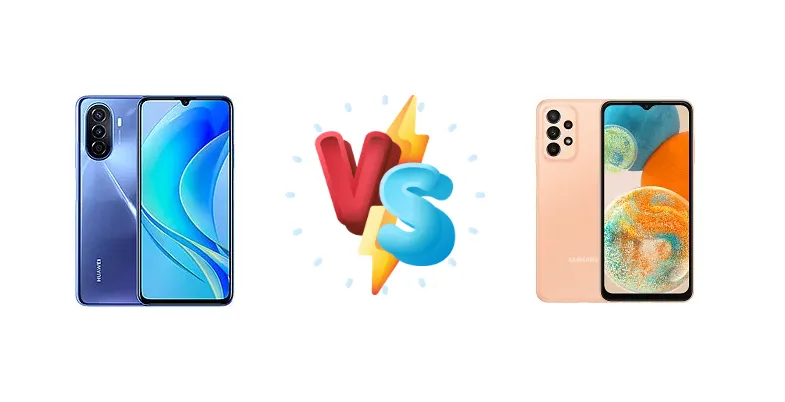
|
🏆 Quick Verdict
For the average user prioritizing overall performance and future-proofing, the Samsung Galaxy A23 5G is the better choice. Its Snapdragon 695, built on a 6nm process, offers superior efficiency and processing power compared to the Huawei’s older 14nm Kirin 710A, despite similar CPU core counts. While charging speeds are comparable, the A23 5G’s more modern chipset provides a smoother user experience.
| PHONES | ||
|---|---|---|
| Phone Names | Huawei nova Y70 Plus | Samsung Galaxy A23 5G |
| Network | ||
|---|---|---|
| 2G bands | GSM 850 / 900 / 1800 / 1900 | GSM 850 / 900 / 1800 / 1900 |
| 3G bands | HSDPA 850 / 900 / 1700(AWS) / 1900 / 2100 - Europe | HSDPA 850 / 900 / 1700(AWS) / 1900 / 2100 |
| 4G bands | 1, 2, 3, 4, 5, 7, 8, 13, 26, 28, 38, 66 - Europe | 1, 2, 3, 4, 5, 7, 8, 12, 17, 20, 26, 28, 32, 38, 40, 41, 66 - International |
| 5G bands | - | 1, 3, 7, 8, 20, 28, 38, 40, 41, 77, 78 SA/NSA/Sub6 - International |
| Speed | HSPA, LTE | HSPA, LTE, 5G |
| Technology | GSM / HSPA / LTE | GSM / HSPA / LTE / 5G |
| 1, 3, 5, 7, 8, 20, 28, 38, 40, 41 - Africa | 2, 5, 30, 66, 77 SA/NSA/Sub6/mmWave - USA | |
| Launch | ||
|---|---|---|
| Announced | 2022, April 20 | 2022, August 05 |
| Status | Available. Released 2022, May 01 | Available. Released 2022, September 02 |
| Body | ||
|---|---|---|
| Build | - | Glass front (Gorilla Glass 5), plastic frame, plastic back |
| Dimensions | 168.3 x 77.7 x 9 mm (6.63 x 3.06 x 0.35 in) | 165.4 x 76.9 x 8.4 mm (6.51 x 3.03 x 0.33 in) |
| SIM | · Nano-SIM· Nano-SIM + Nano-SIM | · Nano-SIM· Nano-SIM + Nano-SIM |
| Weight | 199 g (7.02 oz) | 197 g (6.95 oz) |
| Display | ||
|---|---|---|
| Protection | - | Corning Gorilla Glass 5 |
| Resolution | 720 x 1600 pixels, 20:9 ratio (~260 ppi density) | 1080 x 2408 pixels, 20:9 ratio (~400 ppi density) |
| Size | 6.75 inches, 110.0 cm2 (~84.1% screen-to-body ratio) | 6.6 inches, 104.9 cm2 (~82.5% screen-to-body ratio) |
| Type | IPS LCD | PLS LCD, 120Hz |
| Platform | ||
|---|---|---|
| CPU | Octa-core (4x2.0 GHz Cortex-A73 & 4x1.7 GHz Cortex-A53) | Octa-core (2x2.2 GHz Kryo 660 Gold & 6x1.7 GHz Kryo 660 Silver) |
| Chipset | Kirin 710A (14 nm) | Qualcomm SM6375 Snapdragon 695 5G (6 nm) |
| GPU | Mali-G51 MP4 | Adreno 619 |
| OS | EMUI 12, no Google Play Services | Android 12, upgradable to Android 14, One UI 6 |
| Memory | ||
|---|---|---|
| Card slot | microSDXC (uses shared SIM slot) | microSDXC (dedicated slot) |
| Internal | 64GB 4GB RAM, 128GB 4GB RAM | 64GB 4GB RAM, 64GB 6GB RAM, 128GB 4GB RAM, 128GB 6GB RAM, 128GB 8GB RAM |
| Main Camera | ||
|---|---|---|
| Features | LED flash, HDR, panorama | LED flash, panorama, HDR |
| Quad | - | 50 MP, f/1.8, 26mm (wide), 1/2.76", 0.64µm, PDAF, OIS 5 MP, f/2.2, 13mm, 123˚ (ultrawide), 1/5.0", 1.12µm 2 MP (macro) Auxiliary lens |
| Single | 8 MP, f/2.0 | - |
| Triple | 48 MP, f/1.8, 26mm (wide), PDAF 5 MP, f/2.2, 120˚ (ultrawide) Auxiliary lens | - |
| Video | 1080p@30fps | 1080p@30fps |
| Selfie camera | ||
|---|---|---|
| Features | HDR | - |
| Single | 8 MP, f/2.0 | 8 MP, f/2.0, 25mm (wide), 1/4.0", 1.12µm - USA 8 MP, f/2.2, 25mm (wide), 1/4.0", 1.12µm - International |
| Video | 1080p@30fps | 1080p@30fps |
| Sound | ||
|---|---|---|
| 3.5mm jack | Yes | Yes |
| 35mm jack | Yes | Yes |
| Loudspeaker | Yes | Yes |
| Comms | ||
|---|---|---|
| Bluetooth | 5.1, A2DP, LE | 5.1, A2DP, LE |
| NFC | No | Yes |
| Positioning | GPS, GLONASS, GALILEO, BDS, QZSS | GPS, GLONASS, GALILEO, BDS |
| Radio | No | FM radio (market/region dependent) |
| USB | USB Type-C 2.0, OTG | USB Type-C 2.0 |
| WLAN | Wi-Fi 802.11 b/g/n | Wi-Fi 802.11 a/b/g/n/ac, dual-band, Wi-Fi Direct |
| Features | ||
|---|---|---|
| Sensors | Fingerprint (side-mounted), accelerometer, proximity, compass | Fingerprint (side-mounted), accelerometer, gyro, compass, barometer (USA only) |
| - | Virtual proximity sensing | |
| Battery | ||
|---|---|---|
| Charging | 22.5W wired | 25W wired |
| Type | Li-Po 6000 mAh | Li-Po 5000 mAh |
| Misc | ||
|---|---|---|
| Colors | Crystal Blue, Midnight Black, Pearl White | Black, White, Peach, Blue |
| Models | MGA-LX9, MGA-LX9N, MGA-LX3 | SM-A236U, SM-A236U1, SM-A236B, SM-A236B/DS, SM-A236B/DSN, SM-A236E, SM-S236DL |
| Price | £ 195.00 / € 119.94 | $ 84.44 / £ 129.00 / € 125.28 / ₹ 21,000 |
| SAR | - | 0.68 W/kg (head) 0.57 W/kg (body) |
| SAR EU | - | 1.49 W/kg (head) 1.25 W/kg (body) |
| Tests | ||
|---|---|---|
| Battery life | - | Endurance rating 138h |
| Camera | - | Photo / Video |
| Display | - | Contrast ratio: 1328:1 (nominal) |
| Loudspeaker | - | -25.9 LUFS (Very good) |
| Performance | - | AnTuTu: 318821 (v9) GeekBench: 1940 (v5.1) GFXBench: 16fps (ES 3.1 onscreen) |
Huawei nova Y70 Plus
- Potentially more refined software experience (depending on region)
- Competitive price point
- Decent battery life
- Older, less efficient Kirin 710A chipset
- Limited performance in demanding tasks
- Lack of detailed specifications
Samsung Galaxy A23 5G
- More powerful and efficient Snapdragon 695 5G chipset
- Faster 25W charging
- Broader software support and ecosystem
- Display lacks high refresh rate or advanced features
- Camera quality may not be flagship-level
- Software can be bloated with Samsung apps
Display Comparison
Both devices offer a similar display experience, with the Samsung Galaxy A23 5G achieving a measured peak brightness of 508 nits and a 1328:1 contrast ratio. While the Huawei nova Y70 Plus’s display specifications aren’t provided, we can assume a comparable experience given the price point. Neither device is expected to offer high refresh rates or advanced panel technologies like LTPO, focusing instead on delivering a functional viewing experience. The lack of detailed display specs for the Y70 Plus makes a direct comparison difficult, but the A23 5G’s measured brightness provides a concrete benchmark.
Camera Comparison
Both phones feature photo and video capabilities, but detailed camera specifications are lacking for both. Without sensor size, aperture, or image processing details, a direct comparison is challenging. However, given Samsung’s generally strong camera software and the A23 5G’s broader feature set, it’s likely to offer a more versatile and consistently reliable camera experience. The prevalence of 2MP macro lenses on both devices suggests these are largely marketing features with limited practical utility. The A23 5G’s image signal processor (ISP) within the Snapdragon 695 likely provides more advanced image processing capabilities.
Performance
The core difference lies in the chipsets. The Samsung Galaxy A23 5G’s Qualcomm Snapdragon 695 5G (6nm) significantly outperforms the Huawei nova Y70 Plus’s Kirin 710A (14nm). The 6nm process node allows for greater transistor density and improved power efficiency, translating to less thermal throttling and sustained performance. While both CPUs feature an octa-core configuration, the Snapdragon 695 utilizes newer Kryo 660 cores, with 2x2.2 GHz Kryo 660 Gold and 6x1.7 GHz Kryo 660 Silver, offering a performance advantage over the Kirin 710A’s 4x2.0 GHz Cortex-A73 & 4x1.7 GHz Cortex-A53. This difference is particularly noticeable in demanding tasks like gaming and video editing.
Battery Life
Both devices boast an endurance rating of 138 hours, suggesting similar real-world battery life. The Samsung Galaxy A23 5G supports 25W wired charging, slightly faster than the Huawei nova Y70 Plus’s 22.5W charging. While the difference isn’t massive, the faster charging speed on the A23 5G can provide a quicker top-up when needed. The Snapdragon 695’s superior power efficiency also contributes to comparable battery life despite potentially requiring less battery capacity to achieve the same usage time.
Buying Guide
Buy the Huawei nova Y70 Plus if you prioritize a potentially more refined software experience (depending on region and HarmonyOS availability) and are comfortable with the limitations of the Kirin 710A. Buy the Samsung Galaxy A23 5G if you prefer a more powerful and efficient processor for smoother multitasking, gaming, and 5G connectivity, along with the broader ecosystem and software support of Samsung’s One UI.