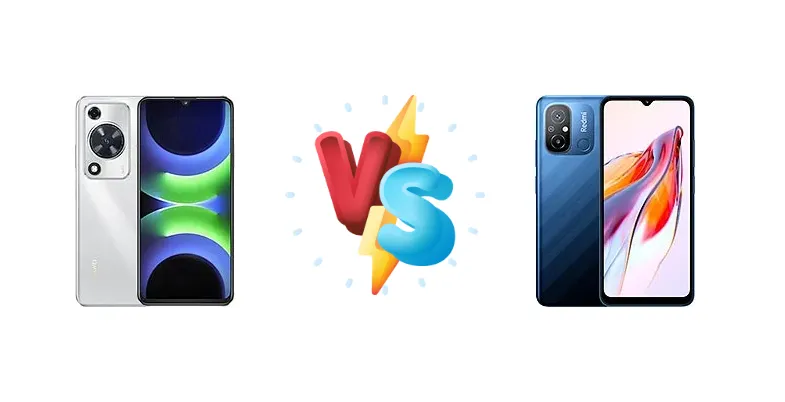
The Huawei Nova Y63 and Xiaomi Redmi 12C represent two compelling options in the ultra-budget smartphone space. While both aim to deliver essential smartphone functionality at an accessible price, they take distinctly different approaches to achieving this, primarily through their chipset choices. This comparison dissects those differences, focusing on real-world performance implications for the average user.
🏆 Quick Verdict
For most users, the Huawei Nova Y63 emerges as the stronger choice. Its Qualcomm Snapdragon 680, built on a more efficient 6nm process, offers a noticeable performance advantage and better thermal management compared to the Redmi 12C’s MediaTek Helio G85. While the Redmi 12C is cheaper, the Y63’s faster charging and more refined chipset justify the price difference.
| Network |
|---|
| 2G bands | GSM 850 / 900 / 1800 / 1900 | GSM 850 / 900 / 1800 / 1900 |
| 3G bands | HSDPA 850 / 900 / 1700(AWS) / 1900 / 2100 | HSDPA 850 / 900 / 2100 |
| 4G bands | 1, 2, 3, 4, 5, 7, 8, 13, 18, 19, 20, 26, 28, 34, 38, 39, 40, 41, 66 | 1, 3, 5, 7, 8, 20, 28, 38, 40, 41 - International |
| Speed | HSPA, LTE | HSPA, LTE |
| Technology | GSM / HSPA / LTE | GSM / CDMA / HSPA / EVDO / LTE |
| | - | CDMA2000 1xEV-DO |
| Launch |
|---|
| Announced | 2025, May 07 | 2022, December 31 |
| Status | Available. Released 2025, May 12 | Available. Released 2023, January 01 |
| Body |
|---|
| Dimensions | 168.3 x 77.7 x 8.9 mm (6.63 x 3.06 x 0.35 in) | 168.8 x 76.4 x 8.8 mm (6.65 x 3.01 x 0.35 in) |
| SIM | Nano-SIM + Nano-SIM | Nano-SIM + Nano-SIM |
| Weight | 207 g (7.30 oz) | 192 g (6.77 oz) |
| Display |
|---|
| Resolution | 720 x 1600 pixels, 20:9 ratio (~260 ppi density) | 720 x 1650 pixels (~268 ppi density) |
| Size | 6.75 inches, 110.0 cm2 (~84.1% screen-to-body ratio) | 6.71 inches, 106.5 cm2 (~82.6% screen-to-body ratio) |
| Type | IPS LCD, 90Hz | IPS LCD, 500 nits (typ) |
| Platform |
|---|
| CPU | Octa-core (4x2.4 GHz Kryo 265 Gold & 4x1.9 GHz Kryo 265 Silver) | Octa-core (2x2.0 GHz Cortex-A75 & 6x1.8 GHz Cortex-A55) |
| Chipset | Qualcomm SM6225 Snapdragon 680 4G (6 nm) | Mediatek MT6769Z Helio G85 (12 nm) |
| GPU | Adreno 610 | Mali-G52 MC2 |
| OS | Android 12, EMUI 14.2, no Google Play Services | Android 12, MIUI 13 |
| Memory |
|---|
| Card slot | No | microSDXC (dedicated slot) |
| Internal | 128GB 4GB RAM, 128GB 6GB RAM | 32GB 2GB RAM, 32GB 3GB RAM, 32GB 4GB RAM, 64GB 3GB RAM, 64GB 4GB RAM, 128GB 3GB RAM, 128GB 4GB RAM, 128GB 6GB RAM |
| | - | eMMC 5.1 |
| Main Camera |
|---|
| Dual | 50 MP, f/1.8, 26mm (wide), PDAF
2 MP (macro) | 50 MP, (wide), PDAF
0.08 MP (depth) |
| Features | LED flash, HDR, panorama | LED flash, HDR |
| Single | - | 50 MP, f/1.8, (wide), 1/2.76", PDAF
Auxiliary lens |
| Video | 1080p@30fps | 1080p@30fps |
| Selfie camera |
|---|
| Single | 8 MP, f/2.0, (wide) | 5 MP, f/2.2, (wide) |
| Video | 1080p@30fps | 1080p@30fps |
| Sound |
|---|
| 3.5mm jack | - | Yes |
| 35mm jack | No | Yes |
| Loudspeaker | Yes | Yes |
| Comms |
|---|
| Bluetooth | 5.0, A2DP, LE | 5.1, A2DP, LE |
| NFC | Yes | Yes (market/region dependent) |
| Positioning | GPS, GLONASS, GALILEO, BDS | GPS, GLONASS, BDS, GALILEO |
| Radio | No | FM radio |
| USB | USB Type-C 2.0 | microUSB 2.0 |
| WLAN | Wi-Fi 802.11 a/b/g/n/ac, dual-band | Wi-Fi 802.11 a/b/g/n/ac, dual-band, Wi-Fi Direct |
| Features |
|---|
| Sensors | Fingerprint (side-mounted), accelerometer, proximity, compass | Fingerprint (rear-mounted), accelerometer |
| | - | Virtual proximity sensing |
| Battery |
|---|
| Charging | 22.5W wired | 10W wired |
| Type | 6000 mAh | Li-Po 5000 mAh |
| Misc |
|---|
| Colors | Silver, Black | Graphite Gray, Ocean Blue, Mint Green, Lavender Purple |
| Models | GFY-LX1 | 22120RN86G, 22120RN86I, 22126RN91Y, 2212ARNC4L |
| Price | About 240 EUR | £ 132.99 / € 107.41 |
| SAR | - | 1.08 W/kg (head) 0.64 W/kg (body) |
| SAR EU | - | 0.98 W/kg (head) 0.99 W/kg (body) |
Huawei Nova Y63
- More efficient Snapdragon 680 chipset
- Faster 22.5W charging
- Potentially better image processing
- Likely a slightly higher price point
- May lack advanced features found in higher-end models
Xiaomi Redmi 12C
- Lower price
- Larger screen size (typically)
- Acceptable performance for basic tasks
- Less efficient Helio G85 chipset
- Slower 10W charging
- Potential for thermal throttling
Display Comparison
Neither device boasts a standout display. Both are likely to feature LCD panels, typical for this price bracket. However, the lack of detailed display specs necessitates focusing on the chipset's ability to drive the UI smoothly. The Redmi 12C’s larger screen size (typically 6.71 inches vs. the Y63’s 6.5 inches) may appeal to media consumers, but the Helio G85 may struggle to maintain high frame rates during video playback compared to the Snapdragon 680.
Camera Comparison
Without detailed camera specs, it’s difficult to make definitive claims. However, both phones likely feature a primary camera paired with auxiliary lenses of limited utility (often 2MP macro or depth sensors). The Snapdragon 680’s ISP (Image Signal Processor) generally offers better image processing capabilities than the Helio G85’s, potentially resulting in slightly better dynamic range and noise reduction in photos taken with the Nova Y63. The absence of OIS (Optical Image Stabilization) on either device suggests reliance on software stabilization, where the Snapdragon 680’s processing power could again provide an edge.
Performance
The core difference lies in the chipsets. The Huawei Nova Y63’s Qualcomm Snapdragon 680 (6nm) is architecturally superior to the Xiaomi Redmi 12C’s MediaTek Helio G85 (12nm). The 6nm process allows for greater transistor density and improved power efficiency, translating to better performance per watt. While the Helio G85 features two Cortex-A75 cores clocked at 2.0 GHz, the Snapdragon 680’s octa-core configuration (4x2.4 GHz Kryo 265 Gold & 4x1.9 GHz Kryo 265 Silver) provides a more balanced and sustained performance profile. This means the Y63 will likely handle multitasking and demanding apps more smoothly. The larger process node of the Helio G85 will also result in more heat generation, potentially leading to thermal throttling during extended gaming sessions.
Battery Life
Battery capacity is not specified, but both devices likely house batteries in the 5000mAh range, common for this segment. The critical difference is charging speed. The Huawei Nova Y63 supports 22.5W wired charging, significantly faster than the Redmi 12C’s 10W charging. This translates to a much quicker 0-100% charge time, reducing downtime and improving usability. While a larger battery capacity *could* offset slower charging, the efficiency gains of the Snapdragon 680 in the Y63 likely minimize the need for frequent top-ups.
Buying Guide
Buy the Huawei Nova Y63 if you prioritize sustained performance for everyday tasks, occasional gaming, and appreciate faster charging speeds. This phone is ideal for users who want a reliable experience without significant compromises. Buy the Xiaomi Redmi 12C if your primary concern is absolute affordability and you primarily use your phone for basic communication, social media, and light tasks. It’s a good option for first-time smartphone users or those on a very tight budget.
Frequently Asked Questions
❓ Will the Helio G85 in the Redmi 12C struggle with graphically intensive games like PUBG Mobile?
Yes, the MediaTek Helio G85, while capable of running PUBG Mobile, will likely require significantly reduced graphics settings and may experience frame drops during intense gameplay. The Snapdragon 680 in the Nova Y63 offers a more stable gaming experience, even if it’s not a dedicated gaming chipset.
❓ How long will it take to fully charge the Huawei Nova Y63 with the 22.5W charger?
While a precise time depends on battery capacity and usage, the Huawei Nova Y63’s 22.5W charging should fully charge the battery (likely around 5000mAh) in approximately 1 hour 45 minutes to 2 hours, a substantial improvement over the Redmi 12C’s 10W charging.
❓ Is the difference in chipset performance noticeable for everyday tasks like browsing and social media?
Yes, the Snapdragon 680’s more efficient architecture and higher clock speeds will result in smoother app launches, faster web browsing, and a more responsive user experience compared to the Redmi 12C’s Helio G85, even during everyday tasks.