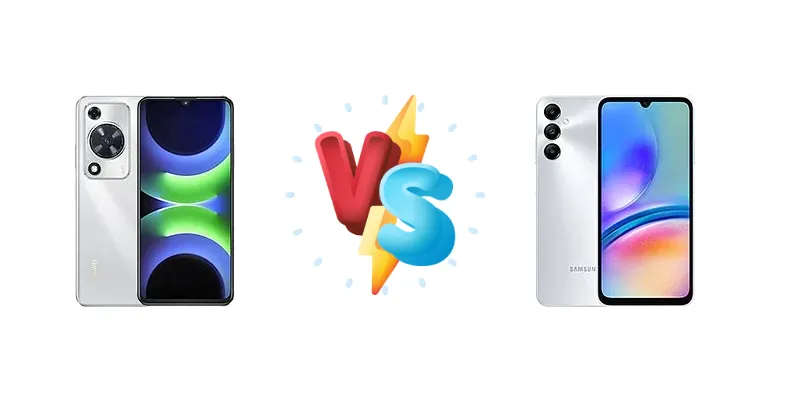
The Huawei Nova Y63 and Samsung Galaxy A05s occupy a similar price bracket, both relying on the Qualcomm Snapdragon 680 chipset to deliver a functional smartphone experience. This comparison dissects the subtle differences between these two devices, focusing on areas where one might offer a more compelling value proposition than the other, particularly regarding display quality and battery performance.
🏆 Quick Verdict
For the average user prioritizing display clarity and slightly faster charging, the Samsung Galaxy A05s emerges as the better choice. Its measured 468 nits of brightness and 1418:1 contrast ratio provide a noticeably more vibrant viewing experience, while the 25W charging offers a marginal speed advantage over the Nova Y63’s 22.5W.
| Network |
|---|
| 2G bands | GSM 850 / 900 / 1800 / 1900 | GSM 850 / 900 / 1800 / 1900 |
| 3G bands | HSDPA 850 / 900 / 1700(AWS) / 1900 / 2100 | HSDPA 850 / 900 / 2100 |
| 4G bands | 1, 2, 3, 4, 5, 7, 8, 13, 18, 19, 20, 26, 28, 34, 38, 39, 40, 41, 66 | 1, 3, 5, 7, 8, 20, 28, 38, 40, 41 |
| Speed | HSPA, LTE | HSPA, LTE |
| Technology | GSM / HSPA / LTE | GSM / HSPA / LTE |
| Launch |
|---|
| Announced | 2025, May 07 | 2023, September 25 |
| Status | Available. Released 2025, May 12 | Available. Released 2023, October 18 |
| Body |
|---|
| Build | - | Glass front, plastic back, plastic frame |
| Dimensions | 168.3 x 77.7 x 8.9 mm (6.63 x 3.06 x 0.35 in) | 168 x 77.8 x 8.8 mm (6.61 x 3.06 x 0.35 in) |
| SIM | Nano-SIM + Nano-SIM | · Nano-SIM· Nano-SIM + Nano-SIM |
| Weight | 207 g (7.30 oz) | 194 g (6.84 oz) |
| Display |
|---|
| Resolution | 720 x 1600 pixels, 20:9 ratio (~260 ppi density) | 1080 x 2400 pixels, 20:9 ratio (~393 ppi density) |
| Size | 6.75 inches, 110.0 cm2 (~84.1% screen-to-body ratio) | 6.7 inches, 108.4 cm2 (~82.9% screen-to-body ratio) |
| Type | IPS LCD, 90Hz | PLS LCD, 90Hz |
| Platform |
|---|
| CPU | Octa-core (4x2.4 GHz Kryo 265 Gold & 4x1.9 GHz Kryo 265 Silver) | Octa-core (4x2.4 GHz Kryo 265 Gold & 4x1.9 GHz Kryo 265 Silver) |
| Chipset | Qualcomm SM6225 Snapdragon 680 4G (6 nm) | Qualcomm SM6225 Snapdragon 680 4G (6 nm) |
| GPU | Adreno 610 | Adreno 610 |
| OS | Android 12, EMUI 14.2, no Google Play Services | Android 13, up to 2 major Android upgrades, One UI 7 |
| Memory |
|---|
| Card slot | No | microSDXC (dedicated slot) |
| Internal | 128GB 4GB RAM, 128GB 6GB RAM | 64GB 4GB RAM, 128GB 4GB RAM, 128GB 6GB RAM |
| Main Camera |
|---|
| Dual | 50 MP, f/1.8, 26mm (wide), PDAF
2 MP (macro) | - |
| Features | LED flash, HDR, panorama | LED flash |
| Triple | - | 50 MP, f/1.8, (wide), 1/2.8", 0.64µm, AF
2 MP (macro)
Auxiliary lens |
| Video | 1080p@30fps | 1080p@30/60fps |
| Selfie camera |
|---|
| Single | 8 MP, f/2.0, (wide) | 13 MP, f/2.0, (wide), 1/3.X", 1.12µm |
| Video | 1080p@30fps | 1080p@30fps |
| Sound |
|---|
| 35mm jack | No | Yes |
| Loudspeaker | Yes | Yes |
| Comms |
|---|
| Bluetooth | 5.0, A2DP, LE | 5.1, A2DP, LE |
| NFC | Yes | Yes (market/region dependent) |
| Positioning | GPS, GLONASS, GALILEO, BDS | GPS, GLONASS, GALILEO, BDS, QZSS |
| Radio | No | Unspecified |
| USB | USB Type-C 2.0 | USB Type-C 2.0 |
| WLAN | Wi-Fi 802.11 a/b/g/n/ac, dual-band | Wi-Fi 802.11 a/b/g/n/ac, dual-band, Wi-Fi Direct |
| Features |
|---|
| Sensors | Fingerprint (side-mounted), accelerometer, proximity, compass | Fingerprint (side-mounted), accelerometer, proximity |
| Battery |
|---|
| Charging | 22.5W wired | 25W wired |
| Type | 6000 mAh | Li-Po 5000 mAh |
| Misc |
|---|
| Colors | Silver, Black | Black, Silver, Light Green, Violet |
| Models | GFY-LX1 | SM-A057F, SM-A057F/DS, SM-A057M, SM-A057M/DS, SM-A057G/DSN, SM-A057G |
| Price | About 240 EUR | $ 134.00 / C$ 146.99 / £ 83.94 / € 100.99 |
| SAR EU | - | 0.58 W/kg (head) 1.31 W/kg (body) |
Huawei Nova Y63
- Potentially cleaner software experience (Huawei Mobile Services)
- Efficient Snapdragon 680 chipset
- Competitive price point
- Limited app ecosystem due to Huawei Mobile Services
- Display specifications likely inferior to A05s
- Charging speed slightly slower than A05s
Samsung Galaxy A05s
- Brighter and higher contrast display (468 nits, 1418:1)
- Longer battery life (11:32h active use)
- Faster 25W charging
- Samsung’s One UI can be resource-intensive
- Snapdragon 680 is not ideal for demanding games
- Potential for bloatware
Display Comparison
The Samsung Galaxy A05s boasts a clear advantage in display specifications. While both phones likely utilize LCD panels (given their price point), the A05s’ measured peak brightness of 468 nits significantly surpasses what is typically found in this segment, making it more usable outdoors. The 1418:1 contrast ratio further enhances image quality, delivering deeper blacks and more vibrant colors. The Nova Y63’s display specifications are currently unknown, but based on its market positioning, it’s reasonable to assume a lower peak brightness and contrast ratio, resulting in a less immersive viewing experience.
Camera Comparison
Detailed camera specifications are limited. Both devices likely feature a multi-camera setup, but the quality will heavily depend on sensor size and image processing algorithms. The presence of a 'Photo / Video' designation for the A05s suggests a focus on versatile camera capabilities. It’s probable that both phones include a primary camera, an ultrawide, and potentially a depth or macro sensor. However, the usefulness of a 2MP macro lens is questionable, offering limited detail and dynamic range. Without specific sensor details, it’s difficult to definitively declare a winner, but Samsung’s generally more refined image processing could give it a slight edge.
Performance
Both the Huawei Nova Y63 and Samsung Galaxy A05s are powered by the Qualcomm Snapdragon 680 4G (6nm). This chipset features an octa-core CPU configuration with 4x2.4 GHz Kryo 265 Gold and 4x1.9 GHz Kryo 265 Silver cores, ensuring similar performance in everyday tasks like browsing, social media, and light gaming. The 6nm process node contributes to improved power efficiency compared to older chipsets. However, neither phone is a gaming powerhouse; demanding titles will require reduced graphics settings. RAM configurations are not specified, but this will be a key factor in multitasking performance. Thermal management will likely be similar, given the shared chipset and target price point.
Battery Life
The Samsung Galaxy A05s demonstrates a clear advantage in battery endurance with an active use score of 11 hours and 32 minutes. While the Nova Y63’s battery capacity is unknown, the A05s’ longer runtime suggests efficient power management. Furthermore, the A05s supports 25W wired charging, slightly faster than the Nova Y63’s 22.5W. This translates to quicker top-ups, reducing downtime. The Snapdragon 680’s 6nm process also contributes to improved battery life compared to older, less efficient chipsets.
Buying Guide
Buy the Huawei Nova Y63 if you prioritize a clean, minimalist software experience and are comfortable with the potential limitations of the Huawei Mobile Services ecosystem. Buy the Samsung Galaxy A05s if you prefer a more established Android experience with wider app compatibility and a brighter, more visually appealing display for everyday use.
Frequently Asked Questions
❓ Does the Snapdragon 680 in either phone struggle with popular apps like TikTok or Instagram?
The Snapdragon 680 is capable of running apps like TikTok and Instagram smoothly for most users. However, prolonged use or multitasking with several other apps open simultaneously may lead to occasional slowdowns. Optimizing app settings and clearing background processes can help mitigate these issues.
❓ Is the 25W charging on the Galaxy A05s significantly faster in real-world use compared to the Nova Y63’s 22.5W?
While the difference of 2.5W may seem small, it can translate to a noticeable reduction in charging time. Expect the Galaxy A05s to charge approximately 10-15% faster from 0 to 100% compared to the Nova Y63, offering a more convenient charging experience.
❓ How does Huawei Mobile Services (HMS) on the Nova Y63 affect app availability compared to the Galaxy A05s’ Google Play Store?
Huawei Mobile Services lacks direct access to the Google Play Store, meaning users must rely on the AppGallery and sideloading apps. While the AppGallery is growing, it still has a limited selection compared to the Play Store. Sideloading can be complex and poses security risks if not done carefully.