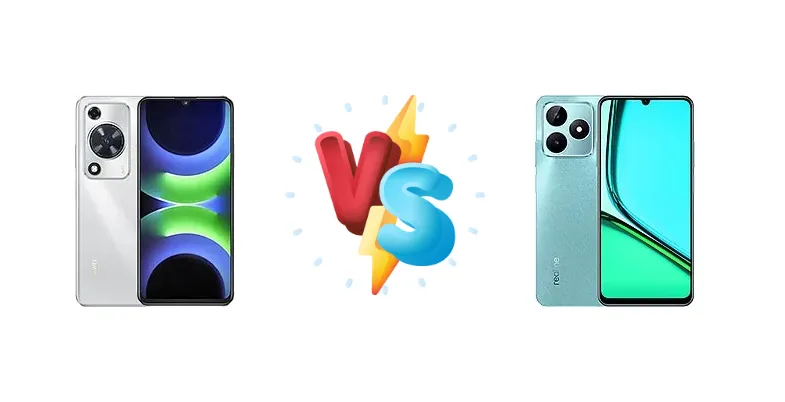
The sub-$200 smartphone market is fiercely competitive. The Huawei Nova Y63, powered by a Qualcomm Snapdragon 680, and the Realme C51s, featuring a Unisoc Tiger T612, both aim to deliver essential smartphone functionality without breaking the bank. This comparison dives deep into their specifications to determine which device offers the best value for your money, focusing on performance, charging speed, and overall user experience.
🏆 Quick Verdict
For the average user prioritizing quick top-ups and a slightly more modern feature set, the Realme C51s is the better choice. Its 33W charging significantly outperforms the Nova Y63’s 22.5W, and while the Unisoc chip isn't as efficient, the difference is unlikely to be noticeable in everyday tasks. However, the Snapdragon 680 in the Nova Y63 offers a more established and potentially smoother software experience.
| Network |
|---|
| 2G bands | GSM 850 / 900 / 1800 / 1900 | GSM 850 / 900 / 1800 / 1900 |
| 3G bands | HSDPA 850 / 900 / 1700(AWS) / 1900 / 2100 | HSDPA 900 / 2100 |
| 4G bands | 1, 2, 3, 4, 5, 7, 8, 13, 18, 19, 20, 26, 28, 34, 38, 39, 40, 41, 66 | 1, 3, 5, 8, 38, 40 |
| Speed | HSPA, LTE | HSPA, LTE |
| Technology | GSM / HSPA / LTE | GSM / HSPA / LTE |
| Launch |
|---|
| Announced | 2025, May 07 | 2024, March 15 |
| Status | Available. Released 2025, May 12 | Available. Released 2024, March 15 |
| Body |
|---|
| Build | - | Glass front, plastic frame, plastic back |
| Dimensions | 168.3 x 77.7 x 8.9 mm (6.63 x 3.06 x 0.35 in) | 167.2 x 76.7 x 7.5 mm (6.58 x 3.02 x 0.30 in) |
| SIM | Nano-SIM + Nano-SIM | Nano-SIM + Nano-SIM |
| Weight | 207 g (7.30 oz) | 182 g (6.42 oz) |
| Display |
|---|
| Resolution | 720 x 1600 pixels, 20:9 ratio (~260 ppi density) | 720 x 1600 pixels, 20:9 ratio (~260 ppi density) |
| Size | 6.75 inches, 110.0 cm2 (~84.1% screen-to-body ratio) | 6.74 inches, 109.7 cm2 (~85.5% screen-to-body ratio) |
| Type | IPS LCD, 90Hz | IPS LCD, 90Hz, 560 nits (peak) |
| Platform |
|---|
| CPU | Octa-core (4x2.4 GHz Kryo 265 Gold & 4x1.9 GHz Kryo 265 Silver) | Octa-core (2x1.8 GHz Cortex-A75 & 6x1.8 GHz Cortex-A55) |
| Chipset | Qualcomm SM6225 Snapdragon 680 4G (6 nm) | Unisoc Tiger T612 (12 nm) |
| GPU | Adreno 610 | Mali-G57 |
| OS | Android 12, EMUI 14.2, no Google Play Services | Android 13, Realme UI |
| Memory |
|---|
| Card slot | No | microSDXC (dedicated slot) |
| Internal | 128GB 4GB RAM, 128GB 6GB RAM | 128GB 6GB RAM |
| Main Camera |
|---|
| Dual | 50 MP, f/1.8, 26mm (wide), PDAF
2 MP (macro) | - |
| Features | LED flash, HDR, panorama | LED flash, HDR, panorama |
| Single | - | 50 MP, f/1.8, 27mm (wide), 1/2.76", 0.64µm, PDAF
Auxiliary lens |
| Video | 1080p@30fps | 1080p@30fps |
| Selfie camera |
|---|
| Features | - | HDR |
| Single | 8 MP, f/2.0, (wide) | 5 MP, f/2.2, 28mm (wide), 1/5.0", 1.12µm |
| Video | 1080p@30fps | 720p@30fps |
| Sound |
|---|
| 35mm jack | No | Yes |
| Loudspeaker | Yes | Yes |
| Comms |
|---|
| Bluetooth | 5.0, A2DP, LE | 5.0, A2DP, LE |
| NFC | Yes | Yes, 360˚ (market/region dependent) |
| Positioning | GPS, GLONASS, GALILEO, BDS | GPS, GLONASS, GALILEO |
| Radio | No | Unspecified |
| USB | USB Type-C 2.0 | USB Type-C |
| WLAN | Wi-Fi 802.11 a/b/g/n/ac, dual-band | Wi-Fi 802.11 a/b/g/n/ac, dual-band |
| Features |
|---|
| Sensors | Fingerprint (side-mounted), accelerometer, proximity, compass | Fingerprint (side-mounted), accelerometer, gyro, proximity, compass |
| Battery |
|---|
| Charging | 22.5W wired | 33W wired, 0-50% in 28 min |
| Type | 6000 mAh | 5000 mAh |
| Misc |
|---|
| Colors | Silver, Black | Shiny Green, Mighty Black |
| Models | GFY-LX1 | RMX3765 |
| Price | About 240 EUR | About 100 EUR |
Huawei Nova Y63
- More efficient Snapdragon 680 chipset
- Potentially better long-term software support (Huawei ecosystem)
- Established Qualcomm Adreno GPU
- Slower 22.5W charging
- Less modern design aesthetic
- Unisoc chipsets have historically had less software optimization
Realme C51s
- Significantly faster 33W charging (0-50% in 28 min)
- More contemporary design
- Potentially lower price point
- Less efficient Unisoc Tiger T612 chipset
- Unisoc’s ISP may result in lower image quality
- Software updates may be less frequent
Display Comparison
Neither Huawei nor Realme provide display specifications beyond the basic resolution. However, given the price point, both likely utilize LCD panels. The Realme C51s benefits from a slightly larger 6.56-inch display, potentially offering a more immersive viewing experience. The key difference lies in the chipset's ability to drive the display efficiently; the Snapdragon 680's Adreno 610 GPU may offer slightly smoother animations, but this is highly dependent on software optimization. Without knowing PWM dimming rates, it's impossible to assess eye strain potential.
Camera Comparison
Both phones likely feature a primary camera paired with auxiliary lenses of limited utility. Without detailed sensor size information, it’s difficult to make a definitive judgment. However, the image signal processor (ISP) within the Snapdragon 680 is generally more sophisticated than that found in Unisoc’s Tiger T612, potentially leading to better image processing, especially in low-light conditions. Expect both phones to struggle with dynamic range and detail in challenging lighting scenarios. Focusing on the primary sensor’s megapixel count is misleading without knowing the sensor size and pixel binning capabilities.
Performance
The core of the difference lies in the chipsets. The Huawei Nova Y63’s Qualcomm Snapdragon 680 (6nm) boasts a more efficient manufacturing process than the Realme C51s’ Unisoc Tiger T612 (12nm). This translates to potentially better thermal management and battery life under sustained load. The Snapdragon 680’s octa-core CPU, with its Kryo 265 Gold and Silver cores clocked at up to 2.4GHz, offers a performance advantage over the Unisoc’s 2x1.8 GHz Cortex-A75 and 6x1.8 GHz Cortex-A55 configuration. While both are capable of handling everyday tasks, the Snapdragon is better suited for moderate gaming and multitasking. The 6nm process also suggests the Snapdragon will throttle less under sustained load.
Battery Life
While battery capacity isn't specified, both phones likely house around a 5000mAh battery, typical for this price segment. The Realme C51s’ 33W wired charging is a significant advantage, promising a 0-50% charge in just 28 minutes. The Huawei Nova Y63’s 22.5W charging is considerably slower, requiring significantly more time to reach a full charge. The Snapdragon 680’s efficiency may partially offset the slower charging, but the convenience of the Realme’s faster charging is undeniable. The difference in charging speed will be far more noticeable in daily use than a minor difference in battery capacity.
Buying Guide
Buy the Huawei Nova Y63 if you prioritize a proven chipset architecture from Qualcomm and potentially better long-term software stability, even if it means slower charging. Buy the Realme C51s if you value faster charging speeds – getting from 0-50% in just 28 minutes – and a more contemporary design, accepting that the Unisoc chipset may not offer the same level of sustained performance as the Snapdragon.
Frequently Asked Questions
❓ Will the Unisoc Tiger T612 in the Realme C51s struggle with demanding games like PUBG Mobile?
While the Unisoc Tiger T612 can run PUBG Mobile, you'll likely need to lower the graphics settings to achieve a smooth frame rate. The Snapdragon 680 in the Nova Y63 offers a more consistent gaming experience, but neither phone is a dedicated gaming device. Expect moderate performance with occasional frame drops on both.
❓ How does Huawei's software experience compare to Realme UI on the C51s?
Huawei's EMUI (or potentially HarmonyOS depending on the region) is known for its feature richness but has historically faced scrutiny regarding Google Mobile Services. Realme UI, based on Android, offers a more open ecosystem with full access to Google apps and services. Users prioritizing a seamless Google experience will likely prefer the Realme C51s.
❓ Is the 28-minute 0-50% charge time on the Realme C51s accurate in real-world usage?
The 28-minute claim is based on ideal conditions. Factors like ambient temperature and the charger used can affect charging speed. However, the 33W charging on the C51s is demonstrably faster than the 22.5W charging on the Nova Y63, and you should still expect a significantly quicker top-up time.