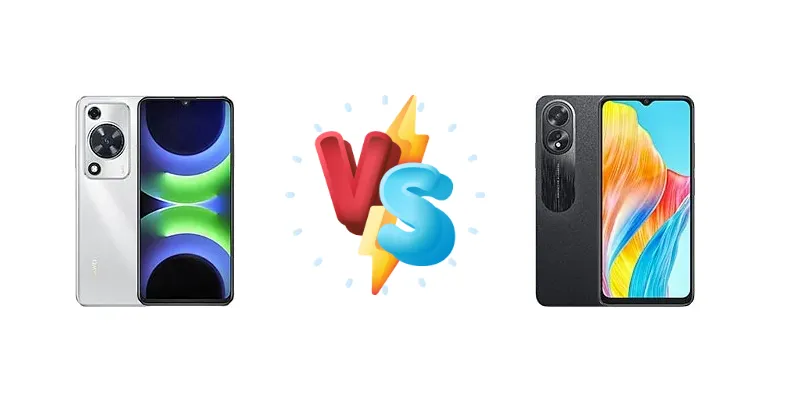
The Huawei Nova Y63 and Oppo A18 represent compelling options in the crowded sub-$200 smartphone market. While both aim to deliver essential features at an accessible price, they take different approaches to achieving this. The Nova Y63 leverages Qualcomm’s Snapdragon 680, prioritizing efficiency, while the Oppo A18 opts for MediaTek’s Helio G85, focusing on a balance of performance and cost. This comparison dissects their key differences to determine which device offers the best value.
🏆 Quick Verdict
For the average user prioritizing consistent performance and potentially better long-term software support, the Huawei Nova Y63 emerges as the stronger choice. Its Snapdragon 680, built on a more efficient 6nm process, offers a smoother experience than the Oppo A18’s Helio G85, despite the latter’s slightly higher clock speeds. However, the A18’s price may be lower, making it a viable option for extremely budget-conscious buyers.
| Network |
|---|
| 2G bands | GSM 850 / 900 / 1800 / 1900 | GSM 850 / 900 / 1800 / 1900 |
| 3G bands | HSDPA 850 / 900 / 1700(AWS) / 1900 / 2100 | HSDPA 850 / 900 / 2100 |
| 4G bands | 1, 2, 3, 4, 5, 7, 8, 13, 18, 19, 20, 26, 28, 34, 38, 39, 40, 41, 66 | 1, 3, 5, 7, 8, 20, 28, 38, 40, 41 |
| Speed | HSPA, LTE | HSPA, LTE |
| Technology | GSM / HSPA / LTE | GSM / HSPA / LTE |
| Launch |
|---|
| Announced | 2025, May 07 | 2023, September 27 |
| Status | Available. Released 2025, May 12 | Available. Released 2023, October 05 |
| Body |
|---|
| Dimensions | 168.3 x 77.7 x 8.9 mm (6.63 x 3.06 x 0.35 in) | 163.7 x 75 x 8.2 mm (6.44 x 2.95 x 0.32 in) |
| SIM | Nano-SIM + Nano-SIM | Nano-SIM + Nano-SIM |
| Weight | 207 g (7.30 oz) | 188 g (6.63 oz) |
| Display |
|---|
| Resolution | 720 x 1600 pixels, 20:9 ratio (~260 ppi density) | 720 x 1612 pixels, 20:9 ratio (~269 ppi density) |
| Size | 6.75 inches, 110.0 cm2 (~84.1% screen-to-body ratio) | 6.56 inches, 103.4 cm2 (~84.2% screen-to-body ratio) |
| Type | IPS LCD, 90Hz | IPS LCD, 90Hz, 720 nits (peak) |
| Platform |
|---|
| CPU | Octa-core (4x2.4 GHz Kryo 265 Gold & 4x1.9 GHz Kryo 265 Silver) | Octa-core (2x2.0 GHz Cortex-A75 & 6x1.8 GHz Cortex-A55) |
| Chipset | Qualcomm SM6225 Snapdragon 680 4G (6 nm) | Mediatek MT6769 Helio G85 (12 nm) |
| GPU | Adreno 610 | Mali-G52 MC2 |
| OS | Android 12, EMUI 14.2, no Google Play Services | Android 13, upgradable to Android 15, ColorOS 15 |
| Memory |
|---|
| Card slot | No | microSDXC |
| Internal | 128GB 4GB RAM, 128GB 6GB RAM | 64GB 4GB RAM, 128GB 4GB RAM |
| Main Camera |
|---|
| Dual | 50 MP, f/1.8, 26mm (wide), PDAF
2 MP (macro) | 8 MP, f/2.0, (wide), AF
Auxiliary lens |
| Features | LED flash, HDR, panorama | LED flash, panorama |
| Video | 1080p@30fps | 1080p@30fps |
| Selfie camera |
|---|
| Features | - | Panorama |
| Single | 8 MP, f/2.0, (wide) | 5 MP, f/2.2, (wide) |
| Video | 1080p@30fps | 1080p@30fps |
| Sound |
|---|
| 35mm jack | No | Yes |
| Loudspeaker | Yes | Yes |
| Comms |
|---|
| Bluetooth | 5.0, A2DP, LE | 5.3, A2DP, LE, aptX HD |
| NFC | Yes | No |
| Positioning | GPS, GLONASS, GALILEO, BDS | GPS, GALILEO, GLONASS, BDS, QZSS |
| Radio | No | No |
| USB | USB Type-C 2.0 | USB Type-C 2.0, OTG |
| WLAN | Wi-Fi 802.11 a/b/g/n/ac, dual-band | Wi-Fi 802.11 a/b/g/n/ac, dual-band |
| Features |
|---|
| Sensors | Fingerprint (side-mounted), accelerometer, proximity, compass | Fingerprint (side-mounted), accelerometer, proximity, compass |
| Battery |
|---|
| Charging | 22.5W wired | - |
| Type | 6000 mAh | Li-Po 5000 mAh |
| Misc |
|---|
| Colors | Silver, Black | Glowing Black, Glowing Blue |
| Models | GFY-LX1 | CPH2591 |
| Price | About 240 EUR | ₹ 10,290 |
Huawei Nova Y63
- More efficient Snapdragon 680 chipset
- Faster 22.5W charging
- Potentially better image processing
- Likely better long-term software support
- May be slightly more expensive
- No specific details on display quality
Oppo A18
- Potentially lower price point
- Higher CPU clock speeds (on paper)
- Adequate performance for basic tasks
- Familiar Oppo UI
- Less efficient Helio G85 chipset
- Likely slower charging
- Potentially shorter battery life
- Less advanced ISP
Display Comparison
Neither Huawei nor Oppo provide display specifications beyond the basic resolution. However, the choice of chipset impacts display performance. The Snapdragon 680’s integrated GPU is likely to provide a smoother scrolling experience, even with a potentially similar panel to the Oppo A18. The 12nm Helio G85 will require more power to drive the display, potentially impacting battery life. Without knowing the panel type (IPS vs. TFT) or refresh rate, it’s difficult to definitively declare a winner, but the Snapdragon 680’s efficiency gives the Nova Y63 a slight edge.
Camera Comparison
Without detailed camera sensor information, a direct comparison is challenging. Both phones likely feature a primary camera and depth/macro sensors. However, the image signal processor (ISP) within the Snapdragon 680 is generally more advanced, offering better image processing capabilities, particularly in low-light conditions. The Oppo A18’s Helio G85 ISP is adequate for basic photography, but will likely struggle to match the Nova Y63’s dynamic range and detail. The absence of Optical Image Stabilization (OIS) on either device suggests reliance on software stabilization, where the Snapdragon 680’s ISP has an advantage.
Performance
The core difference lies in the chipsets. The Qualcomm Snapdragon 680 (6nm) features an octa-core CPU with a Kryo 265 Gold/Silver configuration, emphasizing efficiency. The MediaTek Helio G85 (12nm) also has an octa-core CPU, but with a Cortex-A75/A55 setup. While the Helio G85 boasts higher peak clock speeds (2.0 GHz vs 2.4 GHz), the Snapdragon 680’s smaller 6nm node translates to significantly better power efficiency and thermal management. This means the Nova Y63 is less likely to throttle under sustained load, offering more consistent performance during prolonged use. The 6nm process also suggests a longer lifespan for the chipset. The Snapdragon 680’s Adreno 610 GPU is also generally more capable than the Helio G85’s Mali-G52 MC2, providing a better gaming experience.
Battery Life
Battery capacity isn’t specified, but the Snapdragon 680’s 6nm efficiency is a major advantage. The Oppo A18’s Helio G85, built on a 12nm process, will consume more power for the same tasks. The Nova Y63’s 22.5W charging is also faster than the A18’s likely 18W charging (based on Oppo’s typical offerings), meaning quicker top-ups. Even with a similar battery capacity, the Nova Y63 will likely deliver longer real-world battery life due to its more efficient chipset.
Buying Guide
Buy the Huawei Nova Y63 if you need a phone that prioritizes stable performance for everyday tasks, efficient power consumption for extended battery life, and potentially a more refined software experience. Buy the Oppo A18 if you prefer a device that might offer slightly more raw processing power for light gaming at the lowest possible price point, and are willing to potentially compromise on long-term software updates and overall system smoothness.
Frequently Asked Questions
❓ Will the Helio G85 in the Oppo A18 struggle with demanding games like PUBG Mobile?
While the Helio G85 can run PUBG Mobile, you’ll likely need to lower the graphics settings to achieve a playable frame rate. The Snapdragon 680 in the Nova Y63 offers a more consistent gaming experience, even at medium settings, due to its more efficient GPU and better thermal management.
❓ How does the software update policy differ between Huawei and Oppo on these models?
Historically, Huawei’s software update commitment has been less consistent than Oppo’s, particularly with the ongoing restrictions. While both phones run Android, Oppo generally provides more frequent security patches and potentially one major Android version update. The Nova Y63 may receive fewer updates, impacting long-term security and feature availability.
❓ Is the difference in charging speed (22.5W vs. likely 18W) noticeable in everyday use?
Yes, the 22.5W charging on the Nova Y63 will noticeably reduce charging times. Expect a faster 0-100% charge compared to the Oppo A18, which is particularly useful for users who frequently need to top up their battery quickly.