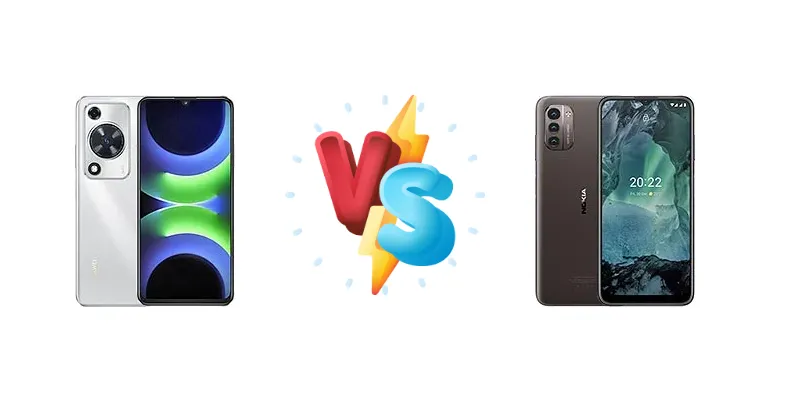
The Huawei Nova Y63 and Nokia G21 represent compelling options in the ultra-budget smartphone space, but cater to different priorities. The Y63 leverages Qualcomm's Snapdragon 680 for a performance boost, while the G21 focuses on maximizing battery endurance and offering a reliable, if less flashy, experience. This comparison dissects their key differences to help you choose the right device.
🏆 Quick Verdict
For users prioritizing responsiveness and smoother app usage, the Huawei Nova Y63 is the better choice thanks to its more powerful Snapdragon 680 chipset. However, the Nokia G21’s excellent 126-hour endurance rating and slightly faster charging (with PD3.0) make it ideal for those who need a phone that lasts for days on a single charge.
| Network |
|---|
| 2G bands | GSM 850 / 900 / 1800 / 1900 | GSM 850 / 900 / 1800 / 1900 |
| 3G bands | HSDPA 850 / 900 / 1700(AWS) / 1900 / 2100 | HSDPA 850 / 900 / 2100 - International |
| 4G bands | 1, 2, 3, 4, 5, 7, 8, 13, 18, 19, 20, 26, 28, 34, 38, 39, 40, 41, 66 | 1, 3, 5, 7, 8, 20, 28, 38, 40, 41 - International |
| Speed | HSPA, LTE | HSPA 42.2/5.76 Mbps, LTE Cat4 150/50 Mbps |
| Technology | GSM / HSPA / LTE | GSM / HSPA / LTE |
| | - | 1, 2, 3, 4, 5, 7, 8, 12, 17, 28, 40, 66 - LATAM |
| Launch |
|---|
| Announced | 2025, May 07 | 2022, February 14 |
| Status | Available. Released 2025, May 12 | Available. Released 2022, February 15 |
| Body |
|---|
| Build | - | Glass front, plastic frame, plastic back |
| Dimensions | 168.3 x 77.7 x 8.9 mm (6.63 x 3.06 x 0.35 in) | 164.6 x 75.9 x 8.5 mm (6.48 x 2.99 x 0.33 in) |
| SIM | Nano-SIM + Nano-SIM | · Nano-SIM· Nano-SIM + Nano-SIM |
| Weight | 207 g (7.30 oz) | 190 g (6.70 oz) |
| Display |
|---|
| Resolution | 720 x 1600 pixels, 20:9 ratio (~260 ppi density) | 720 x 1600 pixels, 20:9 ratio (~270 ppi density) |
| Size | 6.75 inches, 110.0 cm2 (~84.1% screen-to-body ratio) | 6.5 inches, 102.0 cm2 (~81.6% screen-to-body ratio) |
| Type | IPS LCD, 90Hz | IPS LCD, 90Hz, 400 nits (typ) |
| Platform |
|---|
| CPU | Octa-core (4x2.4 GHz Kryo 265 Gold & 4x1.9 GHz Kryo 265 Silver) | Octa-core (2x1.6 GHz Cortex-A75 & 6x1.6 GHz Cortex-A55) |
| Chipset | Qualcomm SM6225 Snapdragon 680 4G (6 nm) | Unisoc T606 (12 nm) |
| GPU | Adreno 610 | Mali-G57 MP1 |
| OS | Android 12, EMUI 14.2, no Google Play Services | Android 11, upgradable to Android 13 |
| Memory |
|---|
| Card slot | No | microSDXC (dedicated slot) |
| Internal | 128GB 4GB RAM, 128GB 6GB RAM | 64GB 3GB RAM, 64GB 4GB RAM, 128GB 4GB RAM, 128GB 6GB RAM |
| | - | eMMC 5.1 |
| Main Camera |
|---|
| Dual | 50 MP, f/1.8, 26mm (wide), PDAF
2 MP (macro) | - |
| Features | LED flash, HDR, panorama | LED flash, HDR, panorama |
| Single | - | 8 MP, f/2.0, (wide) |
| Triple | - | 50 MP, f/1.8, 28mm (wide), 1/2.76", 0.64µm, PDAF
2 MP (macro)
Auxiliary lens |
| Video | 1080p@30fps | 1080p@30fps |
| Selfie camera |
|---|
| Single | 8 MP, f/2.0, (wide) | 8 MP, f/2.0, (wide) |
| Video | 1080p@30fps | 1080p@30fps |
| Sound |
|---|
| 3.5mm jack | - | Yes |
| 35mm jack | No | Yes |
| Loudspeaker | Yes | Yes |
| Comms |
|---|
| Bluetooth | 5.0, A2DP, LE | 5.0, A2DP, LE |
| NFC | Yes | Yes (market/region dependent) |
| Positioning | GPS, GLONASS, GALILEO, BDS | GPS, GLONASS, GALILEO |
| Radio | No | FM radio, RDS |
| USB | USB Type-C 2.0 | USB Type-C 2.0, OTG |
| WLAN | Wi-Fi 802.11 a/b/g/n/ac, dual-band | Wi-Fi 802.11 a/b/g/n/ac, dual-band, Wi-Fi Direct |
| Features |
|---|
| Sensors | Fingerprint (side-mounted), accelerometer, proximity, compass | Fingerprint (side-mounted), accelerometer, proximity |
| Battery |
|---|
| Charging | 22.5W wired | 18W wired, PD3.0 |
| Type | 6000 mAh | Li-Po 5050 mAh |
| Misc |
|---|
| Colors | Silver, Black | Nordic Blue, Dusk |
| Models | GFY-LX1 | TA-1418, TA-1477, TA-1415, TA-1405, TA-1404, TA-1412 |
| Price | About 240 EUR | About 90 EUR |
| SAR | - | 1.00 W/kg (head) 1.10 W/kg (body) |
| SAR EU | - | 0.34 W/kg (head) 1.05 W/kg (body) |
| Tests |
|---|
| Battery life | - |
Endurance rating 126h
|
| Camera | - |
Photo / Video |
| Display | - |
Contrast ratio: 1631:1 (nominal) |
| Loudspeaker | - |
-30.7 LUFS (Below average)
|
| Performance | - |
AnTuTu: 171299 (v9)
GeekBench: 1193 (v5.1)
GFXBench: 8.9fps (ES 3.1 onscreen) |
Huawei Nova Y63
- Superior performance with Snapdragon 680
- More efficient 6nm chipset
- Potentially better image processing
- Charging lacks PD3.0 support
- Battery life likely lower than Nokia G21
Nokia G21
- Exceptional 126-hour battery endurance
- Faster charging with PD3.0
- Brighter display for outdoor visibility
- Significantly weaker processor
- Struggles with demanding apps and games
Display Comparison
Both the Huawei Nova Y63 and Nokia G21 share a contrast ratio of 1631:1, suggesting similar visual pop. However, the Nokia G21 boasts a measured peak brightness of 500 nits, providing better visibility in direct sunlight. While both lack high refresh rates, the G21’s brightness advantage is a practical benefit for outdoor use. Details regarding the panel technology (IPS vs. TFT) are missing, but given the price point, both likely utilize IPS LCDs.
Camera Comparison
Both phones feature 'Photo / Video' capabilities, but lack specific details regarding sensor size, aperture, or image processing. Given the market segment, expect modest camera performance from both. The absence of details suggests neither phone is a standout in the camera department. Focusing on the specs available, it's likely the Y63's ISP (Image Signal Processor) within the Snapdragon 680 will offer slightly better image processing capabilities than the G21's Unisoc equivalent, but this is speculative without further data. The inclusion of a 2MP macro lens on either device is unlikely to significantly impact image quality.
Performance
The core difference lies in the chipsets. The Huawei Nova Y63’s Qualcomm Snapdragon 680 (6nm) significantly outperforms the Nokia G21’s Unisoc T606 (12nm). The Snapdragon 680’s Kryo 265 Gold cores, clocked at 2.4 GHz, provide a substantial CPU performance uplift compared to the G21’s Cortex-A75 cores at 1.6 GHz. The 6nm fabrication process also translates to improved power efficiency and reduced thermal throttling. This means the Y63 will handle demanding apps and games more smoothly and for longer periods. The G21’s Unisoc T606 is adequate for basic tasks, but will struggle with resource-intensive applications.
Battery Life
The Nokia G21 shines in battery endurance, boasting a 126-hour rating. While the Huawei Nova Y63’s battery capacity is unknown, the Snapdragon 680’s 6nm efficiency helps mitigate the power draw. The G21’s 18W charging with PD3.0 support offers faster and more versatile charging compared to the Y63’s 22.5W wired charging, as PD3.0 allows for negotiation of optimal voltage and current. Despite the higher wattage, the Y63’s lack of PD3.0 may result in slower real-world charging times.
Buying Guide
Buy the Huawei Nova Y63 if you need a phone for moderate gaming, frequent multitasking, or simply prefer a snappier user experience. Its 6nm Snapdragon 680 offers a noticeable performance advantage. Buy the Nokia G21 if you prioritize battery life above all else, frequently travel, or need a dependable device that can go days between charges. The G21’s endurance rating and PD3.0 charging are its strongest assets.
Frequently Asked Questions
❓ Does the Unisoc T606 in the Nokia G21 struggle with popular apps like TikTok or Instagram?
The Unisoc T606 is capable of running these apps, but you may experience occasional lag or slowdowns, especially when multitasking or using the apps for extended periods. It's not ideally suited for demanding social media usage.
❓ Is the 22.5W charging on the Huawei Nova Y63 significantly faster than the 18W charging on the Nokia G21 in real-world use?
While 22.5W is higher, the Nokia G21’s PD3.0 support allows it to negotiate optimal charging parameters, potentially resulting in comparable or even faster charging times despite the lower wattage. The Y63’s lack of PD3.0 may limit its charging speed.
❓ Will the Huawei Nova Y63 get timely software updates and security patches?
Huawei's software update track record has been inconsistent in recent years. Expect fewer and slower updates compared to Nokia, which generally provides more reliable software support for its devices.
❓ How does the Snapdragon 680 handle gaming on the Huawei Nova Y63?
The Snapdragon 680 can handle casual gaming reasonably well. However, for graphically intensive titles like PUBG Mobile or Call of Duty Mobile, you'll likely need to lower the graphics settings to achieve a playable frame rate. Don't expect a flagship gaming experience.