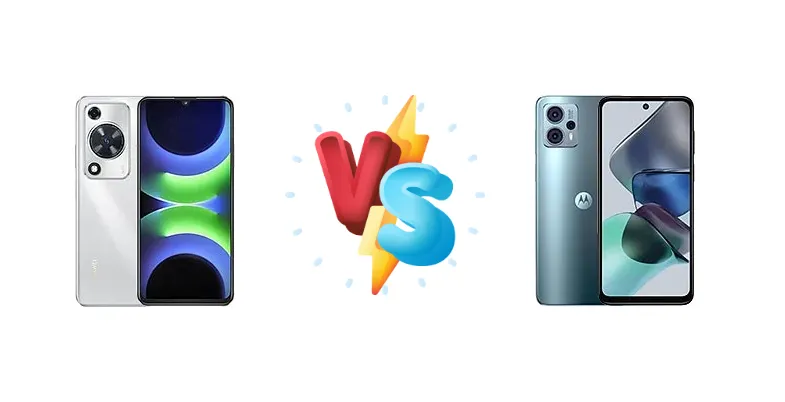
The Huawei Nova Y63 and Motorola Moto G23 represent compelling options in the crowded sub-$200 smartphone market. While both aim to deliver essential features at an accessible price, they take distinctly different approaches to achieving this. The Nova Y63 leverages Qualcomm’s efficiency-focused Snapdragon 680, while the Moto G23 opts for MediaTek’s Helio G85, prioritizing raw processing power. This comparison will dissect these choices and determine which device offers the best overall experience.
🏆 Quick Verdict
For the average user prioritizing efficiency and a smoother, more consistent experience, the Huawei Nova Y63 emerges as the better choice. Its Snapdragon 680, built on a 6nm process, offers superior power efficiency and thermal management compared to the Moto G23’s 12nm Helio G85, despite the latter’s higher clock speeds.
| Network |
|---|
| 2G bands | GSM 850 / 900 / 1800 / 1900 | GSM 850 / 900 / 1800 / 1900 |
| 3G bands | HSDPA 850 / 900 / 1700(AWS) / 1900 / 2100 | HSDPA 850 / 900 / 1900 / 2100 - Europe, AP/MEA |
| 4G bands | 1, 2, 3, 4, 5, 7, 8, 13, 18, 19, 20, 26, 28, 34, 38, 39, 40, 41, 66 | 1, 2, 3, 5, 7, 8, 20, 28, 38, 40, 41 - Europe |
| Speed | HSPA, LTE | HSPA, LTE |
| Technology | GSM / HSPA / LTE | GSM / HSPA / LTE |
| | - | 1, 2, 3, 5, 7, 8, 18, 19, 20, 26, 28, 38, 40, 41 - AP/MEA |
| Launch |
|---|
| Announced | 2025, May 07 | 2023, January 24 |
| Status | Available. Released 2025, May 12 | Available. Released 2023, January 24 |
| Body |
|---|
| Build | - | Glass front, plastic frame, plastic back |
| Dimensions | 168.3 x 77.7 x 8.9 mm (6.63 x 3.06 x 0.35 in) | 162.7 x 74.7 x 8.2 mm (6.41 x 2.94 x 0.32 in) |
| SIM | Nano-SIM + Nano-SIM | · Nano-SIM· Nano-SIM + Nano-SIM |
| Weight | 207 g (7.30 oz) | 184.3 g (6.49 oz) |
| | - | Water-resistant design |
| Display |
|---|
| Protection | - | Panda glass |
| Resolution | 720 x 1600 pixels, 20:9 ratio (~260 ppi density) | 720 x 1600 pixels, 20:9 ratio (~270 ppi density) |
| Size | 6.75 inches, 110.0 cm2 (~84.1% screen-to-body ratio) | 6.5 inches, 102.0 cm2 (~83.9% screen-to-body ratio) |
| Type | IPS LCD, 90Hz | IPS LCD, 90Hz, 400 nits (peak) |
| Platform |
|---|
| CPU | Octa-core (4x2.4 GHz Kryo 265 Gold & 4x1.9 GHz Kryo 265 Silver) | Octa-core (2x2.0 GHz Cortex-A75 & 6x1.8 GHz Cortex-A55) |
| Chipset | Qualcomm SM6225 Snapdragon 680 4G (6 nm) | Mediatek MT6769Z Helio G85 (12 nm) |
| GPU | Adreno 610 | Mali-G52 MC2 |
| OS | Android 12, EMUI 14.2, no Google Play Services | Android 13, planned upgrade to Android 14 |
| Memory |
|---|
| Card slot | No | microSDXC (dedicated slot) |
| Internal | 128GB 4GB RAM, 128GB 6GB RAM | 64GB 4GB RAM, 128GB 4GB RAM, 128GB 8GB RAM |
| Main Camera |
|---|
| Dual | 50 MP, f/1.8, 26mm (wide), PDAF
2 MP (macro) | - |
| Features | LED flash, HDR, panorama | LED flash, HDR, panorama |
| Triple | - | 50 MP, f/1.8, (wide), 0.64µm, PDAF
5 MP, f/2.2, 118˚ (ultrawide)
2 MP (macro) |
| Video | 1080p@30fps | 1080p@30fps |
| Selfie camera |
|---|
| Features | - | HDR |
| Single | 8 MP, f/2.0, (wide) | 16 MP, f/2.5, (wide), 1.0µm |
| Video | 1080p@30fps | 1080p@30fps |
| Sound |
|---|
| 3.5mm jack | - | Yes |
| 35mm jack | No | Yes |
| Loudspeaker | Yes | Yes, with stereo speakers |
| Comms |
|---|
| Bluetooth | 5.0, A2DP, LE | 5.1, A2DP, LE |
| NFC | Yes | Yes (market/region dependent) |
| Positioning | GPS, GLONASS, GALILEO, BDS | GPS, GLONASS, GALILEO |
| Radio | No | FM radio |
| USB | USB Type-C 2.0 | USB Type-C 2.0 |
| WLAN | Wi-Fi 802.11 a/b/g/n/ac, dual-band | Wi-Fi 802.11 a/b/g/n/ac, dual-band |
| Features |
|---|
| Sensors | Fingerprint (side-mounted), accelerometer, proximity, compass | Fingerprint (side-mounted), accelerometer, gyro, proximity |
| Battery |
|---|
| Charging | 22.5W wired | 30W wired |
| Type | 6000 mAh | 5000 mAh |
| Misc |
|---|
| Colors | Silver, Black | Matte Charcoal, Pearl White, Steel Blue |
| Models | GFY-LX1 | XT2333-1 |
| Price | About 240 EUR | About 80 EUR |
Huawei Nova Y63
- More power-efficient Snapdragon 680 chipset
- Likely better sustained performance due to 6nm process
- Potentially longer battery life
- Slower charging speed (22.5W)
- May lack some gaming-specific optimizations
Motorola Moto G23
- Faster 30W wired charging
- Higher CPU clock speeds for burst performance
- Potentially better value if gaming is a priority
- Less power-efficient Helio G85 chipset
- Potential for thermal throttling under sustained load
- Likely shorter battery life
Display Comparison
Neither device boasts a standout display. Details regarding panel type (IPS vs AMOLED) and resolution are missing, suggesting both likely utilize standard LCD panels common in this price bracket. The focus here shifts to processing power, as display quality is unlikely to be a differentiating factor. Bezels are expected to be comparable, typical of budget devices. Color accuracy will likely be standard for the segment, requiring calibration for professional use.
Camera Comparison
Without detailed sensor information, a direct comparison is difficult. However, the market segment suggests both phones will feature primary sensors around the 13-50MP range. The aperture and sensor size will be critical. The Nova Y63’s image processing, leveraging Qualcomm’s ISP, is likely to prioritize color accuracy and dynamic range. Motorola’s image processing tends to lean towards more saturated colors. The presence of 2MP macro/depth sensors on both devices is largely marketing fluff and should be disregarded; image quality from these sensors will be minimal. The absence of OIS on either device means low-light performance will be heavily reliant on software processing.
Performance
The core difference lies in the chipsets. The Huawei Nova Y63’s Qualcomm Snapdragon 680 (6nm) utilizes a more modern fabrication process than the Motorola Moto G23’s MediaTek Helio G85 (12nm). While the Helio G85 boasts higher peak CPU clock speeds (2.0 GHz Cortex-A75 vs 2.4 GHz Kryo 265 Gold), the Snapdragon 680’s architecture and smaller node size translate to better power efficiency and sustained performance. The Snapdragon’s Kryo cores are designed for a balance of performance and efficiency, while the Helio G85’s Cortex-A75 cores are more power-hungry. This means the Moto G23 may exhibit more throttling under sustained load, impacting gaming and demanding applications. The Snapdragon 680’s integrated Adreno GPU will likely provide a smoother gaming experience overall, despite the Helio G85’s slightly higher theoretical GPU clock speed.
Battery Life
The Motorola Moto G23’s 30W wired charging is a clear advantage over the Huawei Nova Y63’s 22.5W charging. This translates to significantly faster 0-100% charge times. However, the Snapdragon 680’s superior power efficiency means the Nova Y63 will likely offer longer battery life on a single charge. The Helio G85’s higher power draw will deplete the battery faster, even with a potentially smaller battery capacity (details missing). The faster charging of the Moto G23 is beneficial for users who frequently need to top up their battery quickly, but the Nova Y63’s efficiency is preferable for all-day usage.
Buying Guide
Buy the Huawei Nova Y63 if you need a phone that prioritizes battery life and consistent performance throughout the day, especially if your usage involves moderate multitasking and media consumption. Buy the Motorola Moto G23 if you prefer a device geared towards occasional gaming and demand the fastest possible charging speeds, understanding that this may come at the cost of longer-term thermal stability and battery longevity.
Frequently Asked Questions
❓ Will the Motorola Moto G23 overheat during extended gaming sessions?
The MediaTek Helio G85, built on a 12nm process, is known to generate more heat than the Snapdragon 680. While the Moto G23 may offer higher peak performance, it's likely to experience thermal throttling during prolonged gaming, leading to reduced frame rates and a less consistent experience.
❓ How long will it take to fully charge each phone?
The Motorola Moto G23, with its 30W charging, will likely charge from 0-100% in approximately 60-75 minutes. The Huawei Nova Y63, with 22.5W charging, will take considerably longer, estimated at 90-120 minutes.
❓ Is the difference in CPU clock speed between the Helio G85 and Snapdragon 680 noticeable in everyday use?
While the Helio G85 has higher peak clock speeds, the Snapdragon 680’s architecture and efficiency are more important for everyday tasks. The difference in clock speed will be less noticeable than the impact of thermal throttling on the Moto G23, resulting in a smoother, more consistent experience on the Nova Y63.