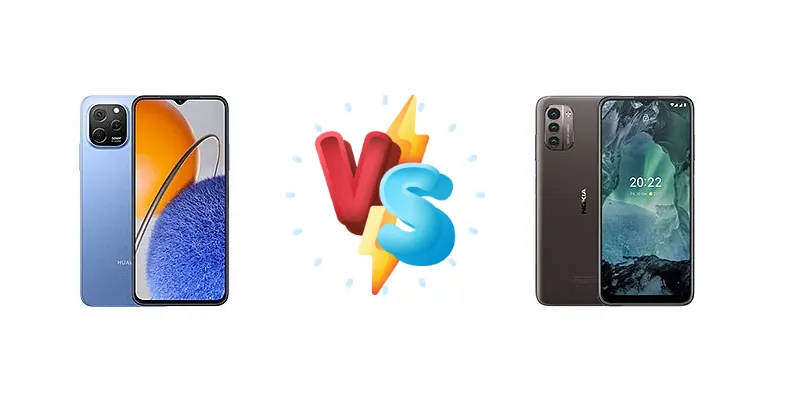
The Huawei nova Y61 and Nokia G21 represent compelling options in the ultra-budget smartphone space, but cater to slightly different priorities. The Nokia G21 emphasizes longevity with its impressive endurance rating, while the Huawei nova Y61 focuses on faster charging capabilities. This comparison dissects their specifications to determine which device delivers the best overall value.
🏆 Quick Verdict
For users prioritizing rapid replenishment, the Huawei nova Y61’s 22.5W charging is a clear advantage. However, the Nokia G21’s exceptional 126-hour endurance rating makes it the better choice for those who need a phone that can reliably last through multiple days on a single charge.
| Network |
|---|
| 2G bands | GSM 850 / 900 / 1800 / 1900 | GSM 850 / 900 / 1800 / 1900 |
| 3G bands | HSDPA 850 / 900 / 1700(AWS) / 1900 / 2100 - EVE-LX3 | HSDPA 850 / 900 / 2100 - International |
| 4G bands | 1, 2, 3, 4, 5, 7, 8, 13, 26, 28, 38, 40, 66 - EVE-LX3 | 1, 3, 5, 7, 8, 20, 28, 38, 40, 41 - International |
| Speed | HSPA, LTE | HSPA 42.2/5.76 Mbps, LTE Cat4 150/50 Mbps |
| Technology | GSM / HSPA / LTE | GSM / HSPA / LTE |
| | 1, 3, 5, 7, 8, 20, 28, 38, 40, 41 - EVE-LX9, EVE-LX9N | 1, 2, 3, 4, 5, 7, 8, 12, 17, 28, 40, 66 - LATAM |
| Launch |
|---|
| Announced | 2022, November 01 | 2022, February 14 |
| Status | Available. Released 2022, November | Available. Released 2022, February 15 |
| Body |
|---|
| Build | - | Glass front, plastic frame, plastic back |
| Dimensions | 164.3 x 75.8 x 8.9 mm (6.47 x 2.98 x 0.35 in) | 164.6 x 75.9 x 8.5 mm (6.48 x 2.99 x 0.33 in) |
| SIM | Nano-SIM + Nano-SIM | · Nano-SIM· Nano-SIM + Nano-SIM |
| Weight | 188 g (6.63 oz) | 190 g (6.70 oz) |
| Display |
|---|
| Resolution | 720 x 1600 pixels, 20:9 ratio (~269 ppi density) | 720 x 1600 pixels, 20:9 ratio (~270 ppi density) |
| Size | 6.52 inches, 102.6 cm2 (~82.4% screen-to-body ratio) | 6.5 inches, 102.0 cm2 (~81.6% screen-to-body ratio) |
| Type | IPS LCD | IPS LCD, 90Hz, 400 nits (typ) |
| Platform |
|---|
| CPU | Octa-core | Octa-core (2x1.6 GHz Cortex-A75 & 6x1.6 GHz Cortex-A55) |
| Chipset | - | Unisoc T606 (12 nm) |
| GPU | - | Mali-G57 MP1 |
| OS | EMUI 12, no Google Play Services | Android 11, upgradable to Android 13 |
| Memory |
|---|
| Card slot | microSDXC | microSDXC (dedicated slot) |
| Internal | 64GB 4GB RAM, 64GB 6GB RAM, 128GB 4GB RAM, 128GB 8GB RAM | 64GB 3GB RAM, 64GB 4GB RAM, 128GB 4GB RAM, 128GB 6GB RAM |
| | - | eMMC 5.1 |
| Main Camera |
|---|
| Features | LED flash, HDR, panorama | LED flash, HDR, panorama |
| Single | 5 MP, f/2.2, (wide) | 8 MP, f/2.0, (wide) |
| Triple | 50 MP, f/1.8, (wide), AF
2 MP (macro)
Auxiliary lens | 50 MP, f/1.8, 28mm (wide), 1/2.76", 0.64µm, PDAF
2 MP (macro)
Auxiliary lens |
| Video | 1080p@30fps | 1080p@30fps |
| Selfie camera |
|---|
| Single | 5 MP, f/2.2, (wide) | 8 MP, f/2.0, (wide) |
| Video | 1080p@30fps | 1080p@30fps |
| Sound |
|---|
| 3.5mm jack | Yes | Yes |
| 35mm jack | Yes | Yes |
| Loudspeaker | Yes | Yes |
| Comms |
|---|
| Bluetooth | 5.1, A2DP, LE | 5.0, A2DP, LE |
| NFC | Yes (EVE-LX9N only) | Yes (market/region dependent) |
| Positioning | GPS, GLONASS, GALILEO, BDS, QZSS | GPS, GLONASS, GALILEO |
| Radio | Unspecified | FM radio, RDS |
| USB | USB Type-C 2.0, OTG | USB Type-C 2.0, OTG |
| WLAN | Wi-Fi 802.11 b/g/n | Wi-Fi 802.11 a/b/g/n/ac, dual-band, Wi-Fi Direct |
| Features |
|---|
| Sensors | Fingerprint (side-mounted), accelerometer, proximity, compass | Fingerprint (side-mounted), accelerometer, proximity |
| Battery |
|---|
| Charging | 22.5W wired | 18W wired, PD3.0 |
| Type | 5000 mAh | Li-Po 5050 mAh |
| Misc |
|---|
| Colors | Sapphire Blue, Mint Green, Midnight Black | Nordic Blue, Dusk |
| Models | EVE-LX9, EVE-LX9N, EVE-LX3 | TA-1418, TA-1477, TA-1415, TA-1405, TA-1404, TA-1412 |
| Price | About 140 EUR | About 90 EUR |
| SAR | - | 1.00 W/kg (head) 1.10 W/kg (body) |
| SAR EU | - | 0.34 W/kg (head) 1.05 W/kg (body) |
| Tests |
|---|
| Battery life | - |
Endurance rating 126h
|
| Camera | - |
Photo / Video |
| Display | - |
Contrast ratio: 1631:1 (nominal) |
| Loudspeaker | - |
-30.7 LUFS (Below average)
|
| Performance | - |
AnTuTu: 171299 (v9)
GeekBench: 1193 (v5.1)
GFXBench: 8.9fps (ES 3.1 onscreen) |
Huawei nova Y61
- Faster 22.5W charging for quicker top-ups
- Potentially more responsive user experience (depending on chipset)
- Sleek design (assumed based on Huawei's design language)
- Limited battery endurance information
- Lack of detailed chipset specifications
- Camera specifications are vague
Nokia G21
- Exceptional 126-hour endurance rating
- Unisoc T606 chipset provides a known performance baseline
- 500 nits brightness offers reasonable visibility
- Slower 18W charging
- Contrast ratio is merely adequate
- Camera specifications are vague
Display Comparison
The Nokia G21 boasts a measured peak brightness of 500 nits and a 1631:1 contrast ratio, providing a reasonably viewable experience, though the 'nominal' contrast ratio suggests potential inconsistencies. The Huawei nova Y61’s display specifications are less detailed, leaving brightness and contrast as unknowns. However, given the price point, neither display is expected to compete with higher-end panels in terms of color accuracy or viewing angles. The G21’s contrast ratio, while not exceptional, is a quantifiable metric that suggests a slightly more visually defined image.
Camera Comparison
Both the Huawei nova Y61 and Nokia G21 offer 'Photo / Video' capabilities, but lack specific details regarding sensor size, aperture, or image processing. This suggests both phones likely employ entry-level camera systems geared towards casual photography. Without further information, it’s difficult to differentiate their camera performance. The prevalence of 2MP macro lenses in this segment suggests both devices may include one, but their utility is limited due to the small sensor size and lack of optical image stabilization (OIS).
Performance
Both devices utilize octa-core CPUs, but the Nokia G21’s chipset, the Unisoc T606 (12nm), provides a more granular understanding of its processing capabilities. The T606’s architecture – 2x1.6 GHz Cortex-A75 & 6x1.6 GHz Cortex-A55 – indicates a focus on balancing performance and efficiency. The Huawei nova Y61’s CPU is simply described as 'octa-core,' lacking the architectural detail needed for a precise performance assessment. The 12nm process node of the Unisoc T606 suggests it will be reasonably efficient, but likely won't match the performance of more modern, smaller-node chipsets. The lack of RAM specifications for both devices makes it difficult to assess multitasking capabilities.
Battery Life
The Nokia G21’s standout feature is its impressive 126-hour endurance rating, indicating exceptional battery life. This suggests a large battery capacity and efficient power management. In contrast, the Huawei nova Y61 prioritizes charging speed with its 22.5W wired charging support. While the G21 supports 18W charging with PD3.0, the faster charging on the Huawei allows for quicker top-ups. The trade-off is clear: the G21 offers longevity, while the Y61 offers convenience. The actual 0-100% charge time for both devices remains unknown without testing.
Buying Guide
Buy the Huawei nova Y61 if you frequently find yourself needing to top up your phone throughout the day and value the convenience of faster charging. Buy the Nokia G21 if you prioritize battery life above all else, often go extended periods without access to a charger, and appreciate a phone that can consistently deliver multi-day performance. Both phones are aimed at users seeking a functional smartphone experience without breaking the bank.
Frequently Asked Questions
❓ How does the Unisoc T606 chipset in the Nokia G21 handle everyday tasks like social media and web browsing?
The Unisoc T606, with its Cortex-A75 and A55 cores, is well-suited for everyday tasks. It provides a smooth experience for social media, web browsing, and light app usage. While not a gaming powerhouse, it’s capable of handling most common smartphone activities without significant lag.
❓ What real-world usage does the 126-hour endurance rating of the Nokia G21 translate to?
The 126-hour endurance rating suggests the Nokia G21 can last for multiple days on a single charge with moderate usage. This typically means several hours of calls, web browsing, and music playback without needing to plug in. Standby time is also exceptionally long, making it ideal for users who don't charge their phones daily.
❓ Is the 22.5W charging on the Huawei nova Y61 significantly faster than the 18W charging on the Nokia G21?
Yes, 22.5W charging is noticeably faster than 18W. While the exact time difference depends on battery capacity (which is unknown for the Huawei), you can expect the Huawei nova Y61 to reach a higher charge percentage in the same amount of time compared to the Nokia G21.
❓ Do either of these phones support NFC for contactless payments?
Neither the provided specifications nor typical marketing materials for these devices indicate NFC support. These phones are firmly positioned in the ultra-budget segment, where NFC is often omitted to reduce costs.