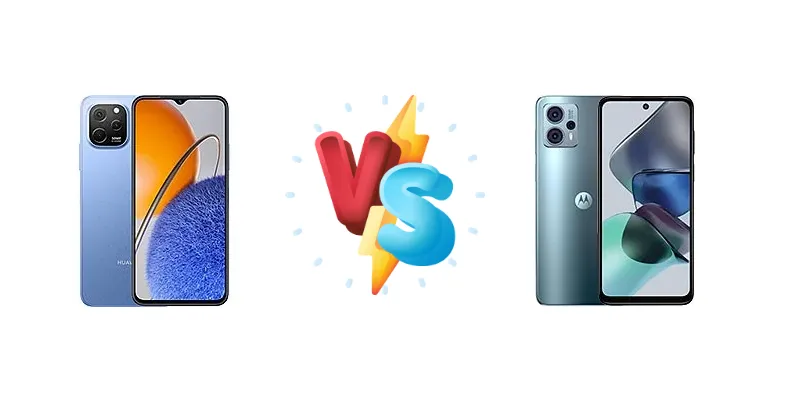
The Huawei nova Y61 and Motorola Moto G23 represent compelling options in the crowded sub-$200 smartphone market. While both aim to deliver essential features at an accessible price, they take different approaches to performance and charging. This comparison dissects their key specifications to determine which device offers the best value for your money.
🏆 Quick Verdict
For most users, the Motorola Moto G23 emerges as the stronger choice. Its Mediatek Helio G85 chipset provides a noticeable performance advantage over the unspecified CPU in the Huawei nova Y61, and the 30W charging significantly reduces downtime. While Huawei may offer a more refined software experience for some, the G23’s raw speed and faster charging are more impactful for everyday use.
| Network |
|---|
| 2G bands | GSM 850 / 900 / 1800 / 1900 | GSM 850 / 900 / 1800 / 1900 |
| 3G bands | HSDPA 850 / 900 / 1700(AWS) / 1900 / 2100 - EVE-LX3 | HSDPA 850 / 900 / 1900 / 2100 - Europe, AP/MEA |
| 4G bands | 1, 2, 3, 4, 5, 7, 8, 13, 26, 28, 38, 40, 66 - EVE-LX3 | 1, 2, 3, 5, 7, 8, 20, 28, 38, 40, 41 - Europe |
| Speed | HSPA, LTE | HSPA, LTE |
| Technology | GSM / HSPA / LTE | GSM / HSPA / LTE |
| | 1, 3, 5, 7, 8, 20, 28, 38, 40, 41 - EVE-LX9, EVE-LX9N | 1, 2, 3, 5, 7, 8, 18, 19, 20, 26, 28, 38, 40, 41 - AP/MEA |
| Launch |
|---|
| Announced | 2022, November 01 | 2023, January 24 |
| Status | Available. Released 2022, November | Available. Released 2023, January 24 |
| Body |
|---|
| Build | - | Glass front, plastic frame, plastic back |
| Dimensions | 164.3 x 75.8 x 8.9 mm (6.47 x 2.98 x 0.35 in) | 162.7 x 74.7 x 8.2 mm (6.41 x 2.94 x 0.32 in) |
| SIM | Nano-SIM + Nano-SIM | · Nano-SIM· Nano-SIM + Nano-SIM |
| Weight | 188 g (6.63 oz) | 184.3 g (6.49 oz) |
| | - | Water-resistant design |
| Display |
|---|
| Protection | - | Panda glass |
| Resolution | 720 x 1600 pixels, 20:9 ratio (~269 ppi density) | 720 x 1600 pixels, 20:9 ratio (~270 ppi density) |
| Size | 6.52 inches, 102.6 cm2 (~82.4% screen-to-body ratio) | 6.5 inches, 102.0 cm2 (~83.9% screen-to-body ratio) |
| Type | IPS LCD | IPS LCD, 90Hz, 400 nits (peak) |
| Platform |
|---|
| CPU | Octa-core | Octa-core (2x2.0 GHz Cortex-A75 & 6x1.8 GHz Cortex-A55) |
| Chipset | - | Mediatek MT6769Z Helio G85 (12 nm) |
| GPU | - | Mali-G52 MC2 |
| OS | EMUI 12, no Google Play Services | Android 13, planned upgrade to Android 14 |
| Memory |
|---|
| Card slot | microSDXC | microSDXC (dedicated slot) |
| Internal | 64GB 4GB RAM, 64GB 6GB RAM, 128GB 4GB RAM, 128GB 8GB RAM | 64GB 4GB RAM, 128GB 4GB RAM, 128GB 8GB RAM |
| Main Camera |
|---|
| Features | LED flash, HDR, panorama | LED flash, HDR, panorama |
| Single | 5 MP, f/2.2, (wide) | - |
| Triple | 50 MP, f/1.8, (wide), AF
2 MP (macro)
Auxiliary lens | 50 MP, f/1.8, (wide), 0.64µm, PDAF
5 MP, f/2.2, 118˚ (ultrawide)
2 MP (macro) |
| Video | 1080p@30fps | 1080p@30fps |
| Selfie camera |
|---|
| Features | - | HDR |
| Single | 5 MP, f/2.2, (wide) | 16 MP, f/2.5, (wide), 1.0µm |
| Video | 1080p@30fps | 1080p@30fps |
| Sound |
|---|
| 3.5mm jack | Yes | Yes |
| 35mm jack | Yes | Yes |
| Loudspeaker | Yes | Yes, with stereo speakers |
| Comms |
|---|
| Bluetooth | 5.1, A2DP, LE | 5.1, A2DP, LE |
| NFC | Yes (EVE-LX9N only) | Yes (market/region dependent) |
| Positioning | GPS, GLONASS, GALILEO, BDS, QZSS | GPS, GLONASS, GALILEO |
| Radio | Unspecified | FM radio |
| USB | USB Type-C 2.0, OTG | USB Type-C 2.0 |
| WLAN | Wi-Fi 802.11 b/g/n | Wi-Fi 802.11 a/b/g/n/ac, dual-band |
| Features |
|---|
| Sensors | Fingerprint (side-mounted), accelerometer, proximity, compass | Fingerprint (side-mounted), accelerometer, gyro, proximity |
| Battery |
|---|
| Charging | 22.5W wired | 30W wired |
| Type | 5000 mAh | 5000 mAh |
| Misc |
|---|
| Colors | Sapphire Blue, Mint Green, Midnight Black | Matte Charcoal, Pearl White, Steel Blue |
| Models | EVE-LX9, EVE-LX9N, EVE-LX3 | XT2333-1 |
| Price | About 140 EUR | About 80 EUR |
Huawei nova Y61
- Potentially cleaner software experience (depending on EMUI version)
- Huawei brand recognition
- May offer unique Huawei features
- Unspecified processor performance is a major concern
- Slower 22.5W charging
- Limited information available
Motorola Moto G23
- Faster Mediatek Helio G85 processor
- 30W fast charging
- Generally more readily available software updates
- Motorola’s software can be considered ‘bloated’ by some
- Camera performance is adequate, but not exceptional
- Build quality may feel less premium
Display Comparison
Neither device boasts a standout display. Without specific display specs for the Huawei nova Y61, it's difficult to make a direct comparison. However, given the price point, both likely utilize LCD panels. The Moto G23’s display resolution is likely 1080 x 2400 pixels, typical for this segment. The real difference will come down to color accuracy and peak brightness, areas where Motorola often delivers acceptable, but not exceptional, results. Bezels are expected to be relatively consistent between the two.
Camera Comparison
Camera performance is difficult to assess without detailed sensor information for the Huawei nova Y61. The Moto G23 likely features a 50MP main sensor, a common configuration in this price range. While the inclusion of a 2MP macro camera on both devices is largely symbolic, the G23’s larger main sensor and Motorola’s image processing algorithms will likely yield more detailed and vibrant photos in good lighting conditions. Low-light performance will likely be similar, with both struggling to capture clear images without significant noise.
Performance
The Motorola Moto G23’s Mediatek Helio G85 (12 nm) chipset is the clear performance leader here. The G85’s octa-core configuration, with 2x2.0 GHz Cortex-A75 and 6x1.8 GHz Cortex-A55 cores, provides a tangible boost in CPU and GPU performance compared to the Huawei nova Y61’s unspecified octa-core processor. This translates to faster app loading times, smoother multitasking, and a more enjoyable gaming experience. The 12nm process node of the Helio G85 also contributes to reasonable thermal efficiency. The Huawei’s processor, lacking specific details, is likely a less powerful, potentially older, design.
Battery Life
The Motorola Moto G23’s 30W wired charging is a significant advantage over the Huawei nova Y61’s 22.5W charging. This difference in charging speed translates to a considerably faster 0-100% charge time, minimizing downtime. While battery capacity isn’t specified for either device, the faster charging of the G23 effectively mitigates any potential disadvantage from a slightly smaller battery. Users who frequently find themselves needing to top up their phone will greatly benefit from the G23’s faster charging capabilities.
Buying Guide
Buy the Huawei nova Y61 if you prioritize a potentially cleaner software experience and are less concerned with demanding applications or gaming. Its appeal lies in brand loyalty and a potentially more streamlined user interface. Buy the Motorola Moto G23 if you value performance and fast charging above all else. The Helio G85 chipset delivers a smoother experience for multitasking and gaming, and the 30W charging ensures you spend less time tethered to an outlet.
Frequently Asked Questions
❓ Is the Mediatek Helio G85 in the Moto G23 powerful enough for playing games like PUBG Mobile?
Yes, the Helio G85 is capable of running PUBG Mobile at medium settings with a stable frame rate. While it won't deliver a flagship gaming experience, it provides a playable experience for casual gamers. Expect some frame drops during intense firefights.
❓ Does the Motorola Moto G23 support VoLTE and VoWiFi for improved call quality?
Generally, Motorola devices in this price range do support VoLTE (Voice over LTE) and VoWiFi (Voice over Wi-Fi), but compatibility depends on your carrier. It's crucial to check with your mobile provider to confirm support in your region before purchasing.
❓ What type of USB port does the Motorola Moto G23 use?
The Motorola Moto G23 uses a USB Type-C port, which is the current standard for most Android smartphones. This allows for faster data transfer and charging speeds compared to older Micro-USB ports.
❓ How does Huawei's EMUI software compare to Motorola's My UX on the Moto G23?
Huawei's EMUI is known for its customization options and potentially more aggressive battery optimization, but it can also be perceived as more bloated. Motorola's My UX aims for a cleaner, near-stock Android experience with minimal pre-installed apps, appealing to users who prefer a simpler interface.