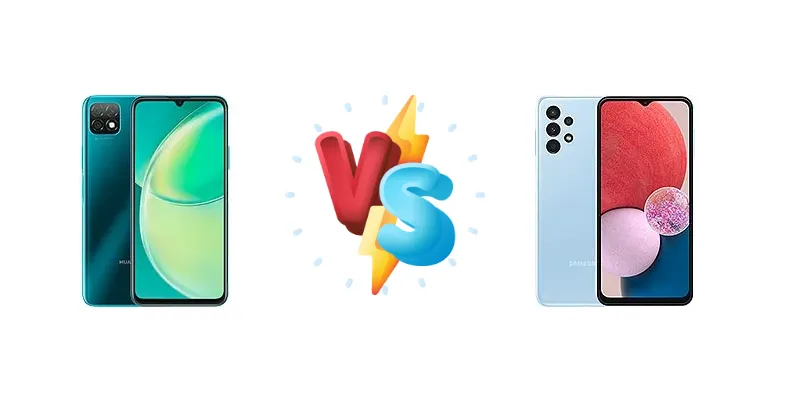
The Huawei nova Y60 and Samsung Galaxy A13 represent the lower end of the smartphone market, targeting users prioritizing affordability. However, even within this segment, key differences exist. This comparison dissects their specifications to determine which device delivers the best value for users seeking a reliable, everyday smartphone.
🏆 Quick Verdict
For the average user, the Samsung Galaxy A13 (SM-A137) is the better choice. While both phones aim for affordability, the A13’s Helio G80 chipset provides a noticeable performance boost over the nova Y60’s Helio P35, making it more capable for multitasking and gaming, despite only a slight charging advantage.
| Network |
|---|
| 2G bands | GSM 850 / 900 / 1800 / 1900 | GSM 850 / 900 / 1800 / 1900 |
| 3G bands | HSDPA 850 / 900 / 1700(AWS) / 1900 / 2100 | HSDPA 850 / 900 / 2100 |
| 4G bands | 2, 3, 4, 5, 7, 8, 20, 26, 38, 40, 41, 66 | 1, 3, 5, 7, 8, 20, 28, 38, 40, 41 |
| Speed | HSPA, LTE | HSPA, LTE |
| Technology | GSM / HSPA / LTE | GSM / HSPA / LTE |
| Launch |
|---|
| Announced | 2021, September 07 | 2022, June |
| Status | Available. Released 2021, September 07 | Available. Released 2022, July |
| Body |
|---|
| Build | - | Glass front (Gorilla Glass 5), plastic frame, plastic back |
| Dimensions | 165.2 x 76 x 9.2 mm (6.50 x 2.99 x 0.36 in) | 165.1 x 76.4 x 8.8 mm (6.5 x 3.01 x 0.35 in) |
| SIM | · Nano-SIM· Nano-SIM + Nano-SIM | · Nano-SIM· Nano-SIM + Nano-SIM |
| Weight | 185 g (6.53 oz) | 195 g (6.88 oz) |
| Display |
|---|
| Protection | - | Corning Gorilla Glass 5 |
| Resolution | 720 x 1600 pixels, 20:9 ratio (~266 ppi density) | 1080 x 2408 pixels, 20:9 ratio (~400 ppi density) |
| Size | 6.6 inches, 105.2 cm2 (~83.8% screen-to-body ratio) | 6.6 inches, 104.9 cm2 (~83.2% screen-to-body ratio) |
| Type | IPS LCD | PLS LCD |
| Platform |
|---|
| CPU | Octa-core (4x2.35 GHz Cortex-A53 & 4x1.8 GHz Cortex-A53) | Octa-core (2x2.0 GHz Cortex-A75 & 6x1.8 GHz Cortex-A55) |
| Chipset | Mediatek MT6765 Helio P35 (12 nm) | Mediatek MT6769V/CU Helio G80 (12 nm) |
| GPU | PowerVR GE8320 | Mali-G52 MC2 |
| OS | Android 10, EMUI 11, no Google Play Services | Android 12, upgradable to Android 14, One UI 6.1 |
| Memory |
|---|
| Card slot | microSDXC (uses shared SIM slot) | microSDXC (dedicated slot) |
| Internal | 64GB 4GB RAM | 32GB 3GB RAM, 32GB 4GB RAM, 64GB 4GB RAM, 128GB 4GB RAM |
| | - | eMMC 5.1 |
| Main Camera |
|---|
| Features | LED flash, HDR, panorama | LED flash, panorama, HDR |
| Quad | - | 50 MP, f/1.8, (wide), PDAF
5 MP, f/2.2, 123˚ (ultrawide), 1/5.0", 1.12µm
2 MP (macro)
Auxiliary lens |
| Single | 8 MP, f/2.0 | 8 MP, f/2.2, (wide) |
| Triple | 13 MP, f/1.8, 26mm (wide), PDAF
5 MP, f/2.2, 120˚ (ultrawide)
Auxiliary lens | - |
| Video | 1080p@30fps | 1080p@30fps |
| Selfie camera |
|---|
| Features | HDR | - |
| Single | 8 MP, f/2.0 | 8 MP, f/2.2, (wide) |
| Video | 1080p@30fps | 1080p@30fps |
| Sound |
|---|
| 3.5mm jack | Yes | Yes |
| 35mm jack | Yes | Yes |
| Loudspeaker | Yes | Yes |
| Comms |
|---|
| Bluetooth | 5.1, A2DP, LE | 5.2, A2DP, LE |
| NFC | No | Yes |
| Positioning | GPS, GLONASS, GALILEO, BDS | GPS, GLONASS, GALILEO, BDS |
| Radio | No | No |
| USB | USB Type-C 2.0, OTG | USB Type-C 2.0, OTG |
| WLAN | Wi-Fi 802.11 b/g/n | Wi-Fi 802.11 a/b/g/n/ac, dual-band, Wi-Fi Direct |
| Features |
|---|
| Sensors | Fingerprint (side-mounted), accelerometer, proximity | Fingerprint (side-mounted), accelerometer, compass |
| | - | Virtual proximity sensing |
| Battery |
|---|
| Charging | 10W wired | 15W wired |
| Type | Li-Po 5000 mAh | Li-Po 5000 mAh |
| Misc |
|---|
| Colors | Midnight Black, Crush Green | Black, White, Blue |
| Models | WKG-LX9, Wukong-L29A | SM-A137F, SM-A137F/DSN, SM-A137F/DS |
| Price | About 150 EUR | About 180 EUR |
| SAR EU | - | 0.35 W/kg (head) 1.22 W/kg (body) |
Huawei nova Y60
- Potentially simpler user interface (depending on EMUI version)
- May receive longer software support within Huawei's ecosystem
- Lower price point (potentially)
- Significantly weaker processor (Helio P35)
- Slower 10W charging
- Limited app compatibility due to Google Mobile Services restrictions
Samsung Galaxy A13 (SM-A137)
- More powerful processor (Helio G80)
- Faster 15W charging
- Full Google Mobile Services support for wider app compatibility
- Samsung’s One UI can be resource-intensive
- Potentially shorter software support lifespan compared to Huawei
Display Comparison
Neither device boasts a standout display. Both likely utilize LCD panels, common in this price bracket. The focus here isn't on visual fidelity, but functionality. While specific display specs (resolution, brightness) are missing, the A13 benefits from Samsung’s generally more refined display calibration. The lack of high refresh rates on either device means scrolling won't be exceptionally smooth, but this is expected at this price point.
Camera Comparison
Without detailed camera specs beyond the chipsets, a direct comparison is limited. Both phones likely feature a primary camera alongside supporting lenses (potentially depth or macro). However, image processing capabilities are heavily tied to the chipset. The Helio G80 in the A13 offers a more powerful ISP (Image Signal Processor), enabling better noise reduction, dynamic range, and overall image quality. The prevalence of 2MP macro lenses on both devices suggests limited utility; users shouldn't expect professional-grade macro photography. The A13’s ISP is likely to produce more usable images in challenging lighting conditions.
Performance
The core difference lies in the chipsets. The Samsung Galaxy A13’s Mediatek Helio G80 (12nm) is a significant upgrade over the Huawei nova Y60’s Helio P35 (12nm). The G80 features a more modern CPU architecture – 2x2.0 GHz Cortex-A75 cores alongside 6x1.8 GHz Cortex-A55 cores – compared to the P35’s 4x2.35 GHz Cortex-A53 and 4x1.8 GHz Cortex-A53 configuration. The Cortex-A75 cores in the G80 provide a substantial performance uplift in single-core tasks, translating to snappier app launches and smoother multitasking. While both use 12nm fabrication, the architectural improvements of the G80 are more impactful than the clock speed difference. The A13 will handle more demanding apps and light gaming with greater ease.
Battery Life
Both devices will likely offer all-day battery life with moderate usage. The Samsung Galaxy A13 has a 15W wired charging capability, while the Huawei nova Y60 is limited to 10W. This translates to a faster 0-100% charge time for the A13, though neither will be exceptionally quick by modern standards. The difference of 5W isn't massive, but it's a tangible benefit for users who frequently need to top up their battery quickly. The actual battery capacity of each device is unknown, but the faster charging of the A13 partially offsets any potential capacity disadvantage.
Buying Guide
Buy the Huawei nova Y60 if you prioritize simplicity and a potentially longer software support lifespan within the Huawei ecosystem, and are comfortable with a more basic user experience. Buy the Samsung Galaxy A13 (SM-A137) if you prefer a more responsive device for everyday tasks, enjoy a wider range of app compatibility through the Google Play Store, and value a slightly more powerful processor for light gaming and multitasking.
Frequently Asked Questions
❓ Does the Huawei nova Y60’s lack of Google Mobile Services (GMS) significantly impact app availability?
Yes, the absence of GMS means the nova Y60 relies on Huawei’s AppGallery and sideloading apps. While AppGallery is growing, it lacks the breadth of apps available on the Google Play Store. Sideloading can be cumbersome and poses security risks for less tech-savvy users.
❓ Will the Samsung Galaxy A13 struggle with popular games like PUBG Mobile or Call of Duty Mobile?
The Helio G80 in the A13 can handle PUBG Mobile and Call of Duty Mobile, but you’ll likely need to play at medium or low graphics settings to maintain a stable frame rate. Don't expect a flagship gaming experience, but it's capable of casual gaming.
❓ Is the 15W charging on the Samsung Galaxy A13 a substantial improvement over the Huawei nova Y60’s 10W charging?
While not a revolutionary difference, 15W charging is noticeably faster than 10W. Expect a roughly 30-60 minute reduction in full charge time, which can be convenient for users who need to quickly top up their battery.