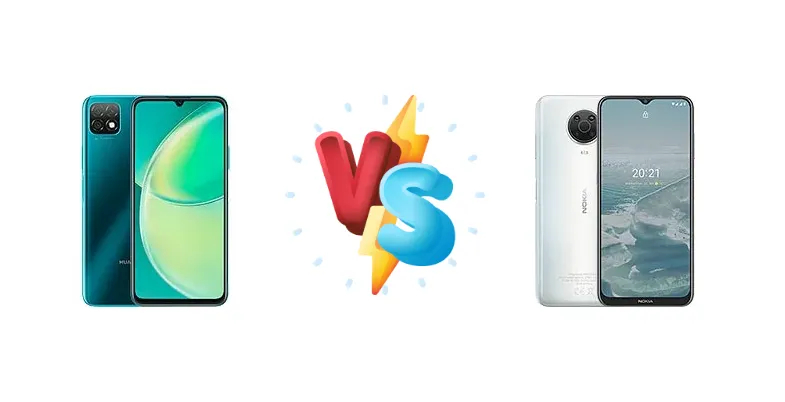
The Huawei nova Y60 and Nokia G20 represent the lower end of the smartphone spectrum, targeting users prioritizing affordability. Both devices rely on Mediatek’s Helio series of chipsets, but subtle differences in their specifications and brand philosophies create distinct user experiences. This comparison dissects these nuances to determine which phone delivers the most value.
🏆 Quick Verdict
For the average user seeking a basic, reliable smartphone, the Nokia G20 edges out the Huawei nova Y60. While both share a similar chipset architecture, the slightly higher CPU clock speed of the G20, coupled with Nokia’s cleaner software experience, provides a marginally smoother user experience. However, the Y60 may appeal to those deeply embedded in the Huawei ecosystem.
| Network |
|---|
| 2G bands | GSM 850 / 900 / 1800 / 1900 | GSM 850 / 900 / 1800 / 1900 |
| 3G bands | HSDPA 850 / 900 / 1700(AWS) / 1900 / 2100 | HSDPA 850 / 900 / 1900 / 2100 - International |
| 4G bands | 2, 3, 4, 5, 7, 8, 20, 26, 38, 40, 41, 66 | 1, 3, 5, 7, 8, 20, 28, 38, 40, 41 - International |
| Speed | HSPA, LTE | HSPA 42.2/5.76 Mbps, LTE Cat4 150/50 Mbps |
| Technology | GSM / HSPA / LTE | GSM / HSPA / LTE |
| | - | 1, 2, 3, 4, 5, 7, 8, 12, 17, 28, 66 - LATAM |
| Launch |
|---|
| Announced | 2021, September 07 | 2021, April 08 |
| Status | Available. Released 2021, September 07 | Available. Released 2021, May 17 |
| Body |
|---|
| Dimensions | 165.2 x 76 x 9.2 mm (6.50 x 2.99 x 0.36 in) | 164.9 x 76 x 9.2 mm (6.49 x 2.99 x 0.36 in) |
| SIM | · Nano-SIM· Nano-SIM + Nano-SIM | · Nano-SIM· Nano-SIM + Nano-SIM |
| Weight | 185 g (6.53 oz) | 197 g (6.95 oz) |
| | - | Splash protection |
| Display |
|---|
| Resolution | 720 x 1600 pixels, 20:9 ratio (~266 ppi density) | 720 x 1600 pixels, 20:9 ratio (~269 ppi density) |
| Size | 6.6 inches, 105.2 cm2 (~83.8% screen-to-body ratio) | 6.52 inches, 102.6 cm2 (~81.9% screen-to-body ratio) |
| Type | IPS LCD | IPS LCD |
| Platform |
|---|
| CPU | Octa-core (4x2.35 GHz Cortex-A53 & 4x1.8 GHz Cortex-A53) | Octa-core (4x2.3 GHz Cortex-A53 & 4x1.8 GHz Cortex-A53) |
| Chipset | Mediatek MT6765 Helio P35 (12 nm) | Mediatek MT6765G Helio G35 (12 nm) |
| GPU | PowerVR GE8320 | PowerVR GE8320 |
| OS | Android 10, EMUI 11, no Google Play Services | Android 11, upgradable to Android 13 |
| Memory |
|---|
| Card slot | microSDXC (uses shared SIM slot) | microSDXC (dedicated slot) |
| Internal | 64GB 4GB RAM | 64GB 4GB RAM, 128GB 4GB RAM |
| Main Camera |
|---|
| Features | LED flash, HDR, panorama | LED flash, HDR, panorama |
| Quad | - | 48 MP, f/1.8, (wide), PDAF
5 MP, (ultrawide)
2 MP (macro)
Auxiliary lens |
| Single | 8 MP, f/2.0 | 8 MP, (wide) |
| Triple | 13 MP, f/1.8, 26mm (wide), PDAF
5 MP, f/2.2, 120˚ (ultrawide)
Auxiliary lens | - |
| Video | 1080p@30fps | 1080p@30fps |
| Selfie camera |
|---|
| Features | HDR | - |
| Single | 8 MP, f/2.0 | 8 MP, (wide) |
| Video | 1080p@30fps | 1080p@30fps |
| Sound |
|---|
| 3.5mm jack | Yes | Yes |
| 35mm jack | Yes | Yes |
| Loudspeaker | Yes | Yes |
| Comms |
|---|
| Bluetooth | 5.1, A2DP, LE | 5.0, A2DP, LE |
| NFC | No | Yes (market/region dependent) |
| Positioning | GPS, GLONASS, GALILEO, BDS | GPS, GLONASS, BDS |
| Radio | No | FM radio |
| USB | USB Type-C 2.0, OTG | USB Type-C 2.0, OTG |
| WLAN | Wi-Fi 802.11 b/g/n | Wi-Fi 802.11 b/g/n |
| Features |
|---|
| Sensors | Fingerprint (side-mounted), accelerometer, proximity | Fingerprint (side-mounted), accelerometer, gyro, proximity |
| Battery |
|---|
| Charging | 10W wired | 10W wired |
| Type | Li-Po 5000 mAh | Li-Po 5050 mAh |
| Misc |
|---|
| Colors | Midnight Black, Crush Green | Glacier, Night |
| Models | WKG-LX9, Wukong-L29A | TA-1336, TA-1343, TA-1347, TA-1372, TA-1365 |
| Price | About 150 EUR | About 90 EUR |
| SAR | - | 1.01 W/kg (head) 1.02 W/kg (body) |
| SAR EU | - | 0.49 W/kg (head) 1.13 W/kg (body) |
Huawei nova Y60
- Familiar Huawei user interface
- Potential for Huawei ecosystem integration
- Generally lower price point (depending on region)
- Limited Google Mobile Services support
- Slightly slower CPU clock speed compared to G20
- Potentially more aggressive image processing
Nokia G20
- Full Google Mobile Services access
- Cleaner Android experience
- Slightly more efficient chipset (Helio G35)
- Potentially higher price point
- Less brand recognition in some markets
- Basic camera system
Display Comparison
Neither Huawei nor Nokia provide detailed display specifications beyond the basic resolution. Both likely utilize LCD panels, common in this price bracket. The absence of high refresh rates or advanced features like LTPO is expected. The real-world impact will be similar viewing experiences, with color accuracy and brightness being average for the segment. Bezels are likely to be substantial on both devices, maximizing screen real estate within a budget.
Camera Comparison
Camera performance on both devices is expected to be basic. Detailed sensor information is unavailable, but both likely feature a primary camera alongside depth and macro sensors. The usefulness of the 2MP macro sensors on both phones is questionable, offering limited detail and image quality. Image processing will be a key differentiator, with Huawei historically employing more aggressive image enhancement algorithms. Nokia typically aims for a more natural look. The G20’s slightly newer chipset *may* offer marginally improved image signal processing capabilities, but real-world differences will likely be minimal.
Performance
Both the Huawei nova Y60 and Nokia G20 are powered by Mediatek’s Helio series, but with key distinctions. The Y60 features the Helio P35 (12nm), while the G20 uses the Helio G35 (12nm). The G35, despite being a slightly newer chip, offers a marginal performance uplift with its 4x2.3 GHz Cortex-A53 cores compared to the Y60’s 4x2.35 GHz cores. This difference is unlikely to be noticeable in everyday tasks, but the G35’s optimized GPU may provide a slightly better gaming experience. Both phones will struggle with demanding games, but the G35 has a small advantage. Both devices will likely be paired with 3-4GB of RAM, further limiting multitasking capabilities.
Battery Life
Both the Huawei nova Y60 and Nokia G20 feature 10W wired charging, indicating a similar charging experience – slow by modern standards. A full 0-100% charge will likely take over 2.5 hours. Battery capacity is not specified, but both likely house around a 5000mAh battery, typical for this price point. The slightly more efficient Helio G35 in the Nokia G20 *could* translate to marginally longer battery life, but usage patterns will be the dominant factor. Users should expect all-day battery life with moderate use on both devices.
Buying Guide
Buy the Huawei nova Y60 if you prioritize a familiar Huawei interface and are comfortable with potential limitations in Google Mobile Services. This phone is best suited for users who primarily use Huawei’s app ecosystem and value brand loyalty. Buy the Nokia G20 if you prefer a cleaner Android experience with full Google Mobile Services access and a focus on software updates and long-term support. This is the better choice for users who rely heavily on Google apps and want a more straightforward Android experience.
Frequently Asked Questions
❓ Will I be able to use all of my favorite Google apps on the Huawei nova Y60?
The Huawei nova Y60 has limited support for Google Mobile Services (GMS). While you may be able to sideload some Google apps, the experience won't be seamless, and some apps may not function correctly. You'll primarily rely on Huawei's AppGallery and alternative app stores.
❓ Is the Nokia G20 a good choice for mobile gaming?
The Nokia G20, with its Helio G35 chipset, is capable of handling basic mobile games. However, it will struggle with graphically demanding titles. Expect low to medium settings and potentially choppy frame rates in more intensive games. It's best suited for casual gaming rather than hardcore mobile gamers.
❓ How long will software updates be supported on the Nokia G20?
Nokia is known for its commitment to software updates, even on its budget devices. The G20 is promised at least two years of security updates, providing a level of security and reliability not always found in this price range. Huawei's update policy is less predictable.
❓ Does either phone support fast charging?
Unfortunately, neither the Huawei nova Y60 nor the Nokia G20 supports fast charging. Both are limited to 10W wired charging, meaning a full charge will take a significant amount of time – over 2.5 hours is typical.