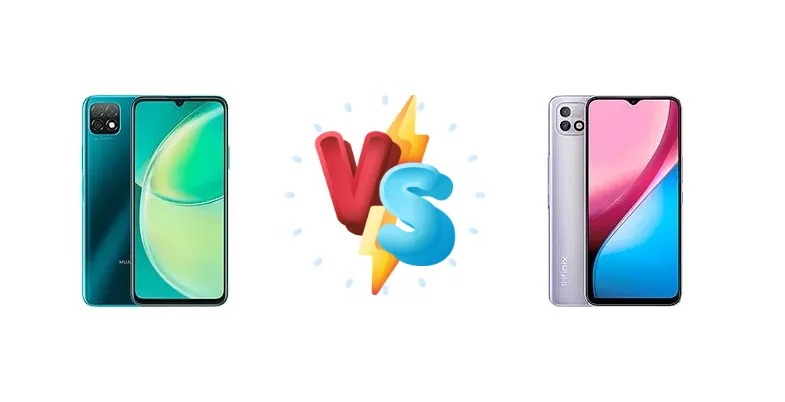
The Huawei nova Y60 and Infinix Hot 10i represent two compelling options in the ultra-budget smartphone segment. Both aim to deliver essential smartphone functionality at a low price point, but they take different approaches to achieving this. This comparison dives deep into their specifications, focusing on performance, charging, and overall user experience to determine which device offers the best value.
🏆 Quick Verdict
For the average user prioritizing responsiveness and faster charging, the Infinix Hot 10i emerges as the better choice. Its Helio G70 chipset provides a noticeable performance uplift over the nova Y60’s Helio P35, and the 18W charging significantly reduces downtime. While the nova Y60 is a capable device, it struggles to keep pace in demanding tasks.
| Network |
|---|
| 2G bands | GSM 850 / 900 / 1800 / 1900 | GSM 850 / 900 / 1800 / 1900 |
| 3G bands | HSDPA 850 / 900 / 1700(AWS) / 1900 / 2100 | HSDPA 850 / 900 / 1700(AWS) / 1900 / 2100 |
| 4G bands | 2, 3, 4, 5, 7, 8, 20, 26, 38, 40, 41, 66 | 1, 2, 3, 4, 5, 7, 8, 20, 28, 38, 40, 41, 66 |
| Speed | HSPA, LTE | HSPA 42.2/5.76 Mbps, LTE Cat4 150/50 Mbps |
| Technology | GSM / HSPA / LTE | GSM / HSPA / LTE |
| | - | 1, 3, 5, 8, 38, 40, 41 |
| Launch |
|---|
| Announced | 2021, September 07 | 2021, May 20 |
| Status | Available. Released 2021, September 07 | Available. Released 2021, May 20 |
| Body |
|---|
| Dimensions | 165.2 x 76 x 9.2 mm (6.50 x 2.99 x 0.36 in) | 164.3 x 76 x 9.6 mm (6.47 x 2.99 x 0.38 in) |
| SIM | · Nano-SIM· Nano-SIM + Nano-SIM | Nano-SIM + Nano-SIM |
| Weight | 185 g (6.53 oz) | - |
| Display |
|---|
| Resolution | 720 x 1600 pixels, 20:9 ratio (~266 ppi density) | 720 x 1600 pixels, 20:9 ratio (~269 ppi density) |
| Size | 6.6 inches, 105.2 cm2 (~83.8% screen-to-body ratio) | 6.52 inches, 102.6 cm2 (~82.2% screen-to-body ratio) |
| Type | IPS LCD | IPS LCD, 500 nits (peak) |
| Platform |
|---|
| CPU | Octa-core (4x2.35 GHz Cortex-A53 & 4x1.8 GHz Cortex-A53) | Octa-core (2x2.0 GHz Cortex-A75 & 6x1.7 GHz Cortex-A55) |
| Chipset | Mediatek MT6765 Helio P35 (12 nm) | Mediatek MT6769V Helio G70 (12 nm) |
| GPU | PowerVR GE8320 | Mali-G52 MC2 |
| OS | Android 10, EMUI 11, no Google Play Services | Android 11, XOS 7.5 |
| Memory |
|---|
| Card slot | microSDXC (uses shared SIM slot) | microSDXC (dedicated slot) |
| Internal | 64GB 4GB RAM | 32GB 3GB RAM, 64GB 2GB RAM, 64GB 4GB RAM, 128GB 6GB RAM |
| | - | eMMC 5.1 |
| Main Camera |
|---|
| Dual | - | 13 MP, f/1.8, (wide), AF
Auxiliary lens |
| Features | LED flash, HDR, panorama | Quad-LED flash |
| Single | 8 MP, f/2.0 | 5 MP, (wide) |
| Triple | 13 MP, f/1.8, 26mm (wide), PDAF
5 MP, f/2.2, 120˚ (ultrawide)
Auxiliary lens | - |
| Video | 1080p@30fps | 1440p@30fps |
| Selfie camera |
|---|
| Features | HDR | - |
| Single | 8 MP, f/2.0 | 5 MP, (wide) |
| Video | 1080p@30fps | Unspecified |
| Sound |
|---|
| 3.5mm jack | Yes | Yes |
| 35mm jack | Yes | Yes |
| Loudspeaker | Yes | Yes |
| Comms |
|---|
| Bluetooth | 5.1, A2DP, LE | Yes |
| NFC | No | No |
| Positioning | GPS, GLONASS, GALILEO, BDS | GPS |
| Radio | No | FM radio |
| USB | USB Type-C 2.0, OTG | microUSB 2.0 |
| WLAN | Wi-Fi 802.11 b/g/n | Wi-Fi 802.11 a/b/g/n/ac, dual-band, Wi-Fi Direct |
| Features |
|---|
| Sensors | Fingerprint (side-mounted), accelerometer, proximity | Fingerprint (rear-mounted), accelerometer, proximity |
| Battery |
|---|
| Charging | 10W wired | 18W wired |
| Type | Li-Po 5000 mAh | 6000 mAh |
| Misc |
|---|
| Colors | Midnight Black, Crush Green | Black, Purple, Morandi Green, Heart of Ocean |
| Models | WKG-LX9, Wukong-L29A | X659B, PR652B, X658E, PR652C, X658B, X659 |
| Price | About 150 EUR | About 100 EUR |
Huawei nova Y60
- Potentially better software support (despite US restrictions)
- Simple and straightforward user interface
- Reliable brand reputation
- Significantly weaker performance due to Helio P35 chipset
- Slow 10W charging
- Limited multitasking capabilities
Infinix Hot 10i
- Faster and more responsive performance with Helio G70
- 18W fast charging for quicker top-ups
- Better suited for gaming and demanding apps
- Less established brand recognition
- Software updates may be less frequent
- Potentially more pre-installed bloatware
Display Comparison
Neither device boasts a standout display. Both likely utilize LCD panels, common in this price bracket. Without specific brightness data, it's reasonable to assume both offer adequate visibility indoors, but may struggle in direct sunlight. The focus here isn't on display quality, but rather on the core functionality each phone provides.
Camera Comparison
Without detailed camera specs beyond the chipsets, a direct comparison is difficult. Both phones likely feature a primary camera and potentially depth/macro sensors. However, image processing capabilities are heavily tied to the chipset. The Helio G70 in the Infinix Hot 10i benefits from a more powerful ISP (Image Signal Processor), potentially leading to better image quality, especially in low-light conditions. The presence of a more capable chipset suggests the Hot 10i will offer more effective noise reduction and dynamic range optimization.
Performance
The core difference lies in the chipsets. The Infinix Hot 10i’s Mediatek Helio G70 (12nm) is a significant upgrade over the Huawei nova Y60’s Helio P35 (12nm). The G70 features a more modern CPU architecture – 2x2.0 GHz Cortex-A75 cores alongside 6x1.7 GHz Cortex-A55 cores – compared to the P35’s 4x2.35 GHz Cortex-A53 and 4x1.8 GHz Cortex-A53 configuration. The Cortex-A75 cores in the G70 provide a substantial boost in single-core performance, translating to snappier app launches and smoother multitasking. While both are 12nm chips, the architectural improvements of the G70 outweigh the clock speed difference. This means the Hot 10i will handle more demanding apps and games with greater ease.
Battery Life
Both devices likely feature similar battery capacities, typical for this price range (around 5000mAh is expected). However, the Infinix Hot 10i’s 18W wired charging is a clear advantage over the Huawei nova Y60’s 10W charging. This translates to significantly faster charging times – potentially reducing a full charge from over 3 hours with the nova Y60 to around 2 hours with the Hot 10i. This difference is crucial for users who rely heavily on their phones throughout the day and need to quickly top up their battery.
Buying Guide
Buy the Huawei nova Y60 if you prioritize a brand with established software support (though limited by the US ban) and are primarily focused on basic tasks like calls, messaging, and light social media use. Buy the Infinix Hot 10i if you prefer a more responsive experience for gaming, multitasking, and appreciate the convenience of faster charging, even if it means sacrificing some brand recognition.
Frequently Asked Questions
❓ Will the Infinix Hot 10i struggle with popular games like PUBG Mobile?
While the Helio G70 isn't a high-end gaming chip, it's capable of running PUBG Mobile at medium settings with reasonable frame rates. Expect some occasional frame drops during intense action, but it's a playable experience. The Huawei nova Y60 with its Helio P35 will likely struggle to maintain stable frame rates even at lower settings.
❓ How much bloatware comes pre-installed on the Infinix Hot 10i?
Infinix phones are known to include some pre-installed apps, often referred to as bloatware. While the amount varies, users can typically uninstall or disable most of these apps to free up storage space and improve performance. Huawei's EMUI also includes pre-installed apps, but the extent may differ.
❓ Does the Huawei nova Y60 support Google Mobile Services (GMS)?
Due to ongoing US restrictions, the Huawei nova Y60 likely does *not* natively support Google Mobile Services (GMS). Instead, it relies on Huawei Mobile Services (HMS) and the AppGallery. This means access to popular apps like Google Maps, Gmail, and YouTube requires workarounds or alternative apps.
❓ Is the 18W charging on the Infinix Hot 10i compatible with any USB charger?
The Infinix Hot 10i supports standard USB Power Delivery (PD) and Quick Charge protocols. While it will charge with any USB charger, you'll only achieve the full 18W charging speed with a compatible charger that supports these protocols. Using a standard 5W charger will result in significantly slower charging times.