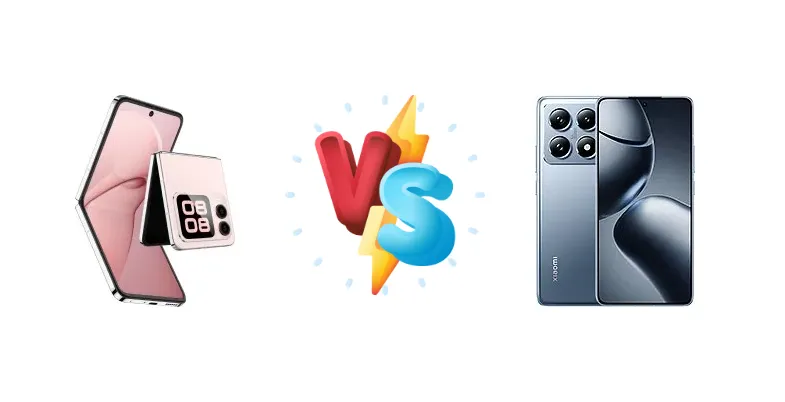
The Huawei nova Flip and Xiaomi 14T Pro represent distinct approaches to the modern smartphone. The nova Flip embraces the resurgent flip phone form factor, prioritizing style and portability, while the 14T Pro aims for a more traditional flagship experience with a focus on raw performance and rapid charging. This comparison dissects their key differences to determine which device best suits your needs.
🏆 Quick Verdict
For the average user prioritizing performance and battery longevity, the Xiaomi 14T Pro is the clear winner. Its Mediatek Dimensity 9300+ chipset and 120W charging significantly outperform the Huawei nova Flip’s Kirin 8000 and 66W charging, despite the Flip’s unique form factor.
| Network |
|---|
| 2G bands | GSM 850 / 900 / 1800 / 1900 | GSM 850 / 900 / 1800 / 1900 |
| 3G bands | HSDPA 800 / 850 / 900 / 1700(AWS) / 1900 / 2100 | HSDPA 800 / 850 / 900 / 1700(AWS) / 1900 / 2100 |
| 4G bands | LTE | 1, 2, 3, 4, 5, 7, 8, 12, 13, 17, 18, 19, 20, 25, 26, 28, 32, 38, 39, 40, 41, 42, 48, 66 |
| 5G bands | 5G | 1, 2, 3, 5, 7, 8, 12, 20, 25, 26, 28, 38, 40, 41, 48, 66, 75, 77, 78 SA/NSA |
| Speed | HSPA, LTE | HSPA, LTE, 5G |
| Technology | GSM / CDMA / HSPA / CDMA2000 / LTE / 5G | GSM / HSPA / LTE / 5G |
| Launch |
|---|
| Announced | 2024, August 05 | 2024, September 26 |
| Status | Available. Released 2024, August 10 | Available. Released 2024, September 26 |
| Body |
|---|
| Build | - | Glass front (Gorilla Glass 5), aluminum frame, glass back (Panda X) |
| Dimensions | Unfolded: 169.8 x 75.4 x 6.9 mmFolded: 87.6 x 75.4 x 15.1 mm | 160.4 x 75.1 x 8.4 mm (6.31 x 2.96 x 0.33 in) |
| SIM | Nano-SIM + Nano-SIM | · Nano-SIM + eSIM· eSIM + eSIM· Nano-SIM + Nano-SIM |
| Weight | 195 g or 199 g (6.88 oz) | 209 g (7.37 oz) |
| Display |
|---|
| Protection | - | Corning Gorilla Glass 5 |
| Resolution | 1136 x 2690 pixels (~421 ppi density) | 1220 x 2712 pixels, 20:9 ratio (~446 ppi density) |
| Size | 6.94 inches, 111.4 cm2 (~87.0% screen-to-body ratio) | 6.67 inches, 107.4 cm2 (~89.1% screen-to-body ratio) |
| Type | Foldable LTPO OLED, 120Hz | AMOLED, 68B colors, 144Hz, 3840Hz PWM, Dolby Vision, HDR10+, 1600 nits (HBM), 4000 nits (peak) |
| Platform |
|---|
| CPU | Octa-core | Octa-core (1x3.4 GHz Cortex-X4 & 3x2.85 GHz Cortex-X4 & 4x2.0 GHz Cortex-A720) |
| Chipset | Kirin 8000 (7 nm) | Mediatek Dimensity 9300+ (4 nm) |
| GPU | - | Immortalis-G720 MC12 |
| OS | HarmonyOS 4.2 | Android 14, HyperOS |
| Memory |
|---|
| Card slot | No | No |
| Internal | 256GB 12GB RAM, 512GB 12GB RAM, 1TB 12GB RAM | 256GB 12GB RAM, 512GB 12GB RAM, 512GB 16GB RAM, 1TB 12GB RAM |
| Main Camera |
|---|
| Dual | 50 MP, f/1.9, 23mm (wide), 1/1.56", PDAF, OIS
8 MP, f/2.2, 112˚ (ultrawide) | - |
| Features | Color spectrum sensor, LED flash, HDR, panorama | Leica lens, Ultra HDR, LED flash, HDR, panorama |
| Triple | - | 50 MP, f/1.6, 23mm (wide), 1/1.31", 1.2µm, PDAF, OIS
50 MP, f/2.0, 60mm (telephoto), 1/2.88", 0.61µm, PDAF, 2.6x optical zoom
12 MP, f/2.2, 15mm (ultrawide), 1/3.06", 1.12µm |
| Video | 4K, 1080p, gyro-EIS | 8K@24/30fps, 4K@24/30/60fps, 1080p@30/60/120/240/960fps, gyro-EIS, 10-bit Rec. 2020, HDR10+ |
| Selfie camera |
|---|
| Features | HDR, panorama | HDR |
| Single | 32 MP, f/2.2, 21mm (ultrawide) | 32 MP, f/2.0, 25mm (wide), 1/3.44", 0.64µm |
| Video | 4K, 1080p | 4K@30fps, 1080p@30/60fps, HDR10+ |
| Sound |
|---|
| 35mm jack | No | No |
| Loudspeaker | Yes, with stereo speakers | Yes, with stereo speakers |
| Comms |
|---|
| Bluetooth | 5.2, A2DP, LE, L2HC | 5.4, A2DP, LE, LHDC |
| Infrared port | - | Yes |
| NFC | Yes | Yes (market/region dependent) |
| Positioning | GPS (L1+L5), GLONASS (L1), BDS (B1I+B1c+B2a+B2b), GALILEO (E1+E5a+E5b), QZSS (L1+L5), NavIC | GPS (L1+L5), BDS (B1I+B1C+B2a+B2b), GALILEO (E1+E5a+E5b), QZSS (L1+L5), NavIC (L5), GLONASS |
| Radio | No | No |
| USB | USB Type-C 2.0, OTG | USB Type-C 2.0, OTG |
| WLAN | Wi-Fi 802.11 a/b/g/n/ac/6, dual-band, Wi-Fi Direct | Wi-Fi 802.11 a/b/g/n/ac/6e/7, dual-band, Wi-Fi Direct |
| Features |
|---|
| Sensors | Fingerprint (side-mounted), accelerometer, gyro, compass | Fingerprint (under display, optical), accelerometer, gyro, proximity, compass |
| Battery |
|---|
| Charging | 66W wired, 100% in 40 min
5W reverse wired | 120W wired, PD3.0, QC4, 100% in 19 min
50W wireless, 100% in 45 min |
| Type | Li-Po 4400 mAh | Li-Po 5000 mAh |
| Misc |
|---|
| Colors | Green, Pink, White, Black | Titan Gray, Titan Blue, Titan Black |
| Models | PSD-AL00 | 2407FPN8EG |
| Price | About 680 EUR | $ 550.00 / £ 498.00 / € 539.99 |
| SAR EU | - | 0.99 W/kg (head) 1.00 W/kg (body) |
Huawei nova Flip
- Unique and stylish flip phone design
- Compact and portable form factor
- 66W fast charging
- Less powerful Kirin 8000 chipset
- Slower charging compared to the 14T Pro
- Potentially lower display brightness
Xiaomi 14T Pro
- Powerful Mediatek Dimensity 9300+ chipset
- 120W wired and 50W wireless charging
- Bright and vibrant display (1228 nits)
- More conventional design
- Larger and less portable than the nova Flip
- May lack the unique appeal of a flip phone
Display Comparison
The Xiaomi 14T Pro boasts a significantly brighter display, reaching a measured peak of 1228 nits, ensuring excellent visibility even in direct sunlight. While the nova Flip’s display specifications are not provided, flip phone displays often prioritize durability over peak brightness. The 14T Pro’s higher brightness and likely higher resolution (based on its pro positioning) will deliver a more immersive viewing experience. The absence of LTPO technology in either device suggests both will rely on adaptive refresh rates to balance smoothness and power consumption.
Camera Comparison
Without detailed camera specifications for the nova Flip, a direct comparison is challenging. However, the Xiaomi 14T Pro is expected to feature a more advanced camera system, likely with a larger main sensor and more sophisticated image processing algorithms. The 14T Pro’s focus on flagship features suggests the inclusion of Optical Image Stabilization (OIS) for sharper photos and videos, particularly in low-light conditions. While the nova Flip may offer a decent camera for casual use, the 14T Pro is likely to excel in demanding scenarios.
Performance
The Xiaomi 14T Pro’s Mediatek Dimensity 9300+ chipset, fabricated on a 4nm process, represents a substantial leap in performance and efficiency compared to the Huawei nova Flip’s 7nm Kirin 8000. The Dimensity 9300+’s CPU configuration – 1x3.4 GHz Cortex-X4, 3x2.85 GHz Cortex-X4, and 4x2.0 GHz Cortex-A720 – provides a significant advantage in both single-core and multi-core tasks. This translates to faster app loading times, smoother multitasking, and improved gaming performance. The 4nm node also contributes to better thermal management, reducing the likelihood of performance throttling during sustained workloads.
Battery Life
The Xiaomi 14T Pro’s 12:32h active use score demonstrates impressive battery life, despite not having a specified mAh capacity. This is likely due to the efficiency of the 4nm Dimensity 9300+ chipset. The 14T Pro’s charging capabilities are a standout feature, with 120W wired charging achieving a full charge in just 19 minutes. It also supports 50W wireless charging, reaching 100% in 45 minutes. In contrast, the nova Flip’s 66W wired charging (40 minutes to 100%) and 5W reverse wired charging are significantly slower. The 14T Pro’s faster charging is a major convenience factor for users who are always on the go.
Buying Guide
Buy the Huawei nova Flip if you prioritize a compact, stylish design and enjoy the nostalgia of a flip phone. It’s ideal for users who value portability and don’t demand the absolute highest performance. Buy the Xiaomi 14T Pro if you need a powerhouse for gaming, multitasking, and content creation, and if minimizing charging downtime is crucial. It’s the better choice for power users and those who demand a flagship-level experience.
Frequently Asked Questions
❓ Does the Kirin 8000 in the Huawei nova Flip struggle with demanding games like Genshin Impact?
While the Kirin 8000 is a capable chipset, it’s likely to exhibit some performance throttling and reduced frame rates in graphically intensive games like Genshin Impact compared to the Xiaomi 14T Pro’s Dimensity 9300+. The 4nm process of the Dimensity chip offers superior thermal efficiency, allowing for sustained peak performance.
❓ How does the 120W charging on the Xiaomi 14T Pro impact long-term battery health?
Xiaomi employs intelligent charging algorithms and battery protection features to mitigate the potential impact of 120W charging on long-term battery health. The charging speed is dynamically adjusted based on battery level and temperature, minimizing stress on the battery cells. While all fast charging technologies can contribute to some degradation over time, Xiaomi’s implementation aims to minimize this effect.
❓ Is the flip phone form factor of the Huawei nova Flip practical for everyday use?
The practicality of the flip phone form factor is subjective. While it offers a unique aesthetic and improved portability, the crease in the display may be noticeable to some users. Additionally, certain cases and screen protectors may not be compatible with the flip design.