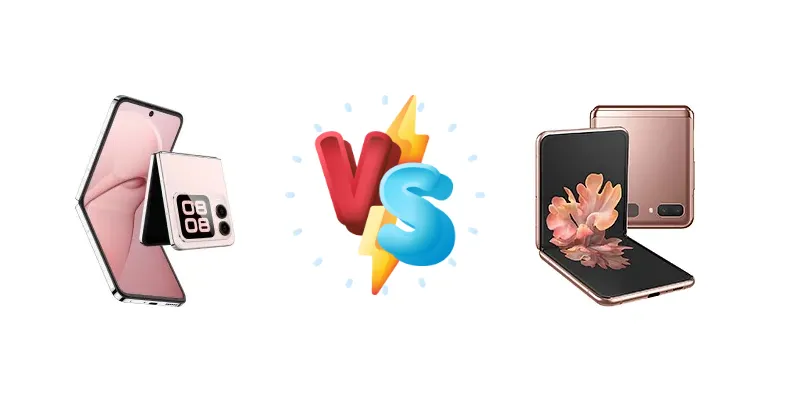
The foldable market is maturing, offering consumers increasingly refined clamshell designs. The Huawei nova Flip enters the arena challenging Samsung’s established Galaxy Z Flip 5G. While both aim for pocketable portability, they diverge significantly in their internal hardware and charging capabilities, creating a compelling comparison for users prioritizing speed versus established ecosystem features.
🏆 Quick Verdict
For the average user, the Samsung Galaxy Z Flip 5G offers a more polished experience thanks to its Snapdragon 865 5G+ chipset and wider software support. However, the Huawei nova Flip’s significantly faster 66W charging is a game-changer for those who value minimizing downtime.
| Network |
|---|
| 2G bands | GSM 850 / 900 / 1800 / 1900 | GSM 850 / 900 / 1800 / 1900 |
| 3G bands | HSDPA 800 / 850 / 900 / 1700(AWS) / 1900 / 2100 | HSDPA 850 / 900 / 1700(AWS) / 1900 / 2100 - International, Canada |
| 4G bands | LTE | 1, 2, 3, 4, 5, 7, 8, 12, 13, 14, 18, 19, 20, 25, 26, 28, 29, 30, 38, 39, 40, 41, 66, 71 - International |
| 5G bands | 5G | 1, 41, 77, 78, 79 Sub6 - China, Hong Kong |
| Speed | HSPA, LTE | HSPA 42.2/5.76 Mbps, LTE (6CA) Cat20 2000/200 Mbps, 5G |
| Technology | GSM / CDMA / HSPA / CDMA2000 / LTE / 5G | GSM / CDMA / HSPA / EVDO / LTE / 5G |
| | - | 41, 66, 71 Sub6 - Canada |
| Launch |
|---|
| Announced | 2024, August 05 | 2020, July 22 |
| Status | Available. Released 2024, August 10 | Available. Released 2020, August 07 |
| Body |
|---|
| Build | - | Plastic front, glass back (Gorilla Glass 6), aluminum frame |
| Dimensions | Unfolded: 169.8 x 75.4 x 6.9 mmFolded: 87.6 x 75.4 x 15.1 mm | Unfolded: 167.3 x 73.6 x 7.2 mm Folded: 87.4 x 73.6 x 17.3 mm |
| SIM | Nano-SIM + Nano-SIM | Nano-SIM + eSIM |
| Weight | 195 g or 199 g (6.88 oz) | 183 g (6.46 oz) |
| Display |
|---|
| Resolution | 1136 x 2690 pixels (~421 ppi density) | 1080 x 2636 pixels (~425 ppi density) |
| Size | 6.94 inches, 111.4 cm2 (~87.0% screen-to-body ratio) | 6.7 inches, 101.6 cm2 (~82.5% screen-to-body ratio) |
| Type | Foldable LTPO OLED, 120Hz | Foldable Dynamic AMOLED, HDR10+ |
| | - | Cover display:
Super AMOLED, 1.1 inches, 112 x 300 pixels |
| Platform |
|---|
| CPU | Octa-core | Octa-core (1x3.09 GHz Cortex-A77 & 3x2.40 GHz Cortex-A77 & 4x1.80 GHz Cortex-A55) |
| Chipset | Kirin 8000 (7 nm) | Qualcomm SM8250 Snapdragon 865 5G+ (7 nm+) |
| GPU | - | Adreno 650 |
| OS | HarmonyOS 4.2 | Android 10, upgradable to Android 13, One UI 5 |
| Memory |
|---|
| Card slot | No | No |
| Internal | 256GB 12GB RAM, 512GB 12GB RAM, 1TB 12GB RAM | 256GB 8GB RAM |
| | - | UFS 3.0 |
| Main Camera |
|---|
| Dual | 50 MP, f/1.9, 23mm (wide), 1/1.56", PDAF, OIS
8 MP, f/2.2, 112˚ (ultrawide) | 12 MP, f/1.8, 27mm (wide), 1/2.55", 1.4µm, dual pixel PDAF, OIS
12 MP, f/2.2, 123˚ (ultrawide), 1.12µm |
| Features | Color spectrum sensor, LED flash, HDR, panorama | LED flash, HDR, panorama |
| Video | 4K, 1080p, gyro-EIS | 4K@30/60fps, 1080p@60/240fps, 720p@960fps, HDR10+ |
| Selfie camera |
|---|
| Features | HDR, panorama | HDR |
| Single | 32 MP, f/2.2, 21mm (ultrawide) | 10 MP, f/2.4, 26mm (wide), 1.22µm |
| Video | 4K, 1080p | 4K@30fps |
| Sound |
|---|
| 3.5mm jack | - | No |
| 35mm jack | No | No |
| Loudspeaker | Yes, with stereo speakers | Yes |
| | - | 32-bit/384kHz audio
Tuned by AKG |
| Comms |
|---|
| Bluetooth | 5.2, A2DP, LE, L2HC | 5.0, A2DP, LE |
| NFC | Yes | Yes |
| Positioning | GPS (L1+L5), GLONASS (L1), BDS (B1I+B1c+B2a+B2b), GALILEO (E1+E5a+E5b), QZSS (L1+L5), NavIC | GPS, GLONASS, GALILEO, BDS |
| Radio | No | No |
| USB | USB Type-C 2.0, OTG | USB Type-C 2.0, OTG |
| WLAN | Wi-Fi 802.11 a/b/g/n/ac/6, dual-band, Wi-Fi Direct | Wi-Fi 802.11 a/b/g/n/ac/6, dual-band, Wi-Fi Direct |
| Features |
|---|
| Sensors | Fingerprint (side-mounted), accelerometer, gyro, compass | Fingerprint (side-mounted), accelerometer, gyro, proximity, compass, barometer |
| | - | Samsung Pay (Visa, MasterCard certified) |
| Battery |
|---|
| Charging | 66W wired, 100% in 40 min
5W reverse wired | 15W wired
9W wireless |
| Type | Li-Po 4400 mAh | Li-Po 3300 mAh |
| Misc |
|---|
| Colors | Green, Pink, White, Black | Mystic Grey, Mystic Bronze, Mystic White |
| Models | PSD-AL00 | SM-F707B, SM-F707N, SM-F7070, SM-F707U, SM-F707U1, SM-F707W |
| Price | About 680 EUR | About 800 EUR |
| SAR | - | 0.80 W/kg (head) 1.01 W/kg (body) |
| SAR EU | - | 0.80 W/kg (head) 1.45 W/kg (body) |
Huawei nova Flip
- Blazing-fast 66W wired charging
- Potentially more affordable price point
- Huawei’s aesthetic design language
- Kirin 8000 chipset is less powerful than Snapdragon 865
- Limited software support and ecosystem compared to Samsung
- Uncertainty regarding 5G band compatibility
Samsung Galaxy Z Flip 5G
- Powerful Snapdragon 865 5G+ chipset
- Mature software experience and Samsung ecosystem
- Wider 5G band support
- Slow 15W wired charging
- Higher price point
- Potential for software bloat
Display Comparison
Both devices feature foldable OLED displays, but detailed specifications like peak brightness and refresh rate are not provided. However, given Samsung’s display leadership, the Z Flip 5G likely boasts superior color accuracy and potentially higher peak brightness. The hinge mechanism is a critical factor, and Samsung has a head start in durability and refinement with its multi-generation foldable experience. The nova Flip’s display quality will be a key area to assess in real-world testing.
Camera Comparison
Detailed camera specs are unavailable, but the image processing capabilities will be a key differentiator. Samsung typically emphasizes vibrant, social media-ready images, while Huawei often leans towards more natural color reproduction. The Snapdragon 865’s ISP (Image Signal Processor) is generally considered more advanced, potentially leading to better dynamic range and low-light performance on the Z Flip 5G. Without sensor size information, it’s difficult to definitively declare a winner, but the Snapdragon’s processing power gives Samsung an edge.
Performance
The core difference lies in the chipsets. The Samsung Galaxy Z Flip 5G utilizes the Qualcomm SM8250 Snapdragon 865 5G+, built on a 7nm+ process, offering robust performance and 5G connectivity. The Huawei nova Flip is powered by the Kirin 8000 (7nm). While both are octa-core CPUs, the Snapdragon 865’s Cortex-A77 cores clocked at 3.09 GHz provide a performance advantage, particularly in demanding tasks and gaming. The Snapdragon’s Adreno 650 GPU also surpasses the Kirin 8000’s GPU, offering a smoother gaming experience. The Z Flip 5G benefits from a more mature software optimization for its chipset.
Battery Life
The battery capacity of both devices is not specified. However, the charging speeds are dramatically different. The Huawei nova Flip’s 66W wired charging can fully charge the device in just 40 minutes, a significant advantage over the Samsung Galaxy Z Flip 5G’s 15W wired charging. While a larger battery capacity on the Z Flip 5G might partially offset this, the convenience of the nova Flip’s rapid charging is undeniable. The 5W reverse wired charging on the nova Flip is a niche feature, while the Z Flip 5G offers 9W wireless charging, providing more versatile charging options.
Buying Guide
Buy the Huawei nova Flip if you prioritize incredibly fast charging and are comfortable with the Huawei ecosystem. Its 66W charging capability drastically reduces charging times, making it ideal for users constantly on the go. Buy the Samsung Galaxy Z Flip 5G if you value a more established software experience, broader 5G band support, and the benefits of the Samsung ecosystem, even if it means slower 15W charging.
Frequently Asked Questions
❓ Does the Kirin 8000 chipset in the Huawei nova Flip struggle with graphically intensive games like Genshin Impact?
While the Kirin 8000 is a capable chipset, the Snapdragon 865 in the Z Flip 5G offers a noticeable performance advantage in demanding games. Expect lower frame rates and potentially more noticeable throttling on the nova Flip during extended gaming sessions. Optimizations will play a role, but the hardware difference is significant.
❓ Is the lack of Google Mobile Services (GMS) on the Huawei nova Flip a major inconvenience for most users?
The absence of GMS is a significant consideration. Users heavily reliant on Google apps like Gmail, YouTube, and Google Maps will need to utilize workarounds or Huawei’s AppGallery, which has a limited selection compared to the Google Play Store. This impacts the overall user experience and app compatibility.
❓ How does the hinge durability of the Huawei nova Flip compare to the Samsung Galaxy Z Flip 5G, given Samsung's experience with foldable phones?
Samsung has a multi-generational lead in foldable phone hinge technology. The Z Flip 5G’s hinge is known for its robustness and refined design. While Huawei has made strides, the nova Flip’s long-term hinge durability remains to be seen and will require extensive real-world testing to assess its reliability.
❓ Will the 66W charging of the Huawei nova Flip degrade the battery health faster than the 15W charging of the Samsung Galaxy Z Flip 5G?
While faster charging generates more heat, modern battery management systems mitigate potential degradation. Huawei’s charging algorithms likely incorporate safeguards to protect battery health. The convenience of rapid charging often outweighs the minimal potential for slightly accelerated degradation, especially for users who frequently top up their devices.