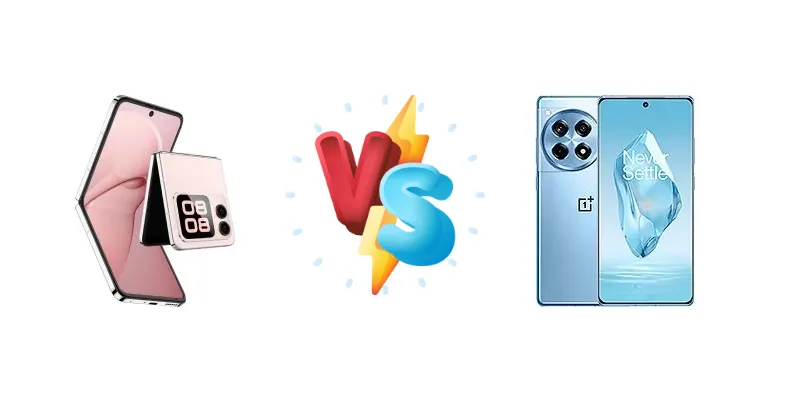
The Huawei nova Flip and OnePlus 12R represent distinct approaches to the smartphone market. The nova Flip offers a fashionable, compact flip-phone experience, while the OnePlus 12R prioritizes raw performance and extended battery life at a competitive price. This comparison dissects their key differences to determine which device delivers the best value for your needs.
🏆 Quick Verdict
For the average user prioritizing sustained performance and all-day battery life, the OnePlus 12R emerges as the stronger contender. Its Snapdragon 8 Gen 2 chipset and impressive 14:32 hour active use battery score significantly outperform the Huawei nova Flip, despite the latter's stylish form factor.
| Network |
|---|
| 2G bands | GSM 850 / 900 / 1800 / 1900 | GSM 850 / 900 / 1800 / 1900 |
| 3G bands | HSDPA 800 / 850 / 900 / 1700(AWS) / 1900 / 2100 | HSDPA 850 / 900 / 1700(AWS) / 1900 / 2100 |
| 4G bands | LTE | 1, 2, 3, 4, 5, 7, 8, 12, 17, 18, 19, 20, 26, 28, 32, 38, 39, 40, 41, 66 |
| 5G bands | 5G | 1, 2, 3, 5, 7, 8, 12, 20, 28, 38, 40, 41, 66, 77, 78 SA/NSA |
| Speed | HSPA, LTE | HSPA, LTE, 5G |
| Technology | GSM / CDMA / HSPA / CDMA2000 / LTE / 5G | GSM / CDMA / HSPA / LTE / 5G |
| Launch |
|---|
| Announced | 2024, August 05 | 2024, January 23 |
| Status | Available. Released 2024, August 10 | Available. Released 2024, February 06 |
| Body |
|---|
| Build | - | Glass front (Gorilla Glass Victus 2), aluminum frame, glass back |
| Dimensions | Unfolded: 169.8 x 75.4 x 6.9 mmFolded: 87.6 x 75.4 x 15.1 mm | 163.3 x 75.3 x 8.8 mm (6.43 x 2.96 x 0.35 in) |
| SIM | Nano-SIM + Nano-SIM | · Nano-SIM + Nano-SIM + eSIM (max 2 at a time)· Nano-SIM + Nano-SIM |
| Weight | 195 g or 199 g (6.88 oz) | 207 g (7.30 oz) |
| Display |
|---|
| Protection | - | Corning Gorilla Glass Victus 2 |
| Resolution | 1136 x 2690 pixels (~421 ppi density) | 1264 x 2780 pixels (~450 ppi density) |
| Size | 6.94 inches, 111.4 cm2 (~87.0% screen-to-body ratio) | 6.78 inches, 111.7 cm2 (~90.9% screen-to-body ratio) |
| Type | Foldable LTPO OLED, 120Hz | LTPO4 AMOLED, 1B colors, 120Hz, HDR10+, Dolby Vision, 1600 nits (HBM), 4500 nits (peak) |
| Platform |
|---|
| CPU | Octa-core | Octa-core (1x3.2 GHz Cortex-X3 & 2x2.8 GHz Cortex-A715 & 2x2.8 GHz Cortex-A710 & 3x2.0 GHz Cortex-A510) |
| Chipset | Kirin 8000 (7 nm) | Qualcomm SM8550-AB Snapdragon 8 Gen 2 (4 nm) |
| GPU | - | Adreno 740 |
| OS | HarmonyOS 4.2 | Android 14, up to 3 major Android upgrades, OxygenOS 15 |
| Memory |
|---|
| Card slot | No | No |
| Internal | 256GB 12GB RAM, 512GB 12GB RAM, 1TB 12GB RAM | 128GB 8GB RAM, 256GB 8GB RAM, 256GB 12GB RAM, 256GB 16GB RAM |
| Main Camera |
|---|
| Dual | 50 MP, f/1.9, 23mm (wide), 1/1.56", PDAF, OIS
8 MP, f/2.2, 112˚ (ultrawide) | - |
| Features | Color spectrum sensor, LED flash, HDR, panorama | Laser AF, color spectrum sensor, LED flash, HDR, panorama |
| Triple | - | 50 MP, f/1.8, 24mm (wide), 1/1.56", 1.0µm, multi-directional PDAF, OIS
8 MP, f/2.2, 16mm, 112˚ (ultrawide), 1/4.0", 1.12µm
2 MP (macro) |
| Video | 4K, 1080p, gyro-EIS | 4K@30/60fps, 1080p@30/60/120/240fps, gyro-EIS, OIS |
| Selfie camera |
|---|
| Features | HDR, panorama | HDR, panorama |
| Single | 32 MP, f/2.2, 21mm (ultrawide) | 16 MP, f/2.4, 26mm (wide), 1/3", 1.0µm |
| Video | 4K, 1080p | 1080p@30fps, gyro-EIS |
| Sound |
|---|
| 35mm jack | No | No |
| Loudspeaker | Yes, with stereo speakers | Yes, with stereo speakers |
| Comms |
|---|
| Bluetooth | 5.2, A2DP, LE, L2HC | 5.3, A2DP, LE, aptX HD |
| Infrared port | - | Yes |
| NFC | Yes | Yes |
| Positioning | GPS (L1+L5), GLONASS (L1), BDS (B1I+B1c+B2a+B2b), GALILEO (E1+E5a+E5b), QZSS (L1+L5), NavIC | GPS, GALILEO, GLONASS, BDS, QZSS |
| Radio | No | No |
| USB | USB Type-C 2.0, OTG | USB Type-C 2.0 |
| WLAN | Wi-Fi 802.11 a/b/g/n/ac/6, dual-band, Wi-Fi Direct | Wi-Fi 802.11 a/b/g/n/ac/6/7, dual-band |
| Features |
|---|
| Sensors | Fingerprint (side-mounted), accelerometer, gyro, compass | Fingerprint (under display, optical), accelerometer, gyro, proximity, compass |
| Battery |
|---|
| Charging | 66W wired, 100% in 40 min
5W reverse wired | 100W wired, 100% in 26 min |
| Type | Li-Po 4400 mAh | Li-Ion 5500 mAh |
| Misc |
|---|
| Colors | Green, Pink, White, Black | Iron Gray, Cool Blue, Electric Violet, Sunset Dune |
| Models | PSD-AL00 | CPH2609, CPH2585, CPH2611 |
| Price | About 680 EUR | € 410.84 / $ 399.95 / £ 649.00 |
| SAR | - | 1.19 W/kg (head) 0.82 W/kg (body) |
Huawei nova Flip
- Unique and stylish flip-phone design
- Compact and portable form factor
- 66W fast charging is still relatively quick
- Kirin 8000 chipset is less powerful than Snapdragon 8 Gen 2
- Likely smaller battery capacity
- Limited display information suggests potential compromises in brightness and resolution
OnePlus 12R
- Powerful Snapdragon 8 Gen 2 processor
- Exceptional battery life (14:32h active use)
- Ultra-fast 100W charging (26 minutes to 100%)
- Larger and less portable than the flip phone
- More conventional design
- May lack the unique appeal of a flip phone
Display Comparison
The OnePlus 12R boasts a significantly brighter display, reaching a measured 1181 nits, ensuring excellent visibility even in direct sunlight. While the nova Flip’s display specifications are not provided, flip phones generally prioritize compactness over screen size and brightness. The OnePlus 12R’s larger display also benefits from a likely higher resolution and potentially a more advanced panel technology, contributing to a superior viewing experience. The absence of LTPO information for the nova Flip suggests it may not have the same adaptive refresh rate capabilities as many modern flagships.
Camera Comparison
Without detailed camera specifications for the nova Flip, a direct comparison is limited. However, Huawei historically emphasizes camera capabilities, so it's reasonable to expect a focus on computational photography. The OnePlus 12R, while not explicitly detailed in the provided data, likely features a more conventional camera setup. The Snapdragon 8 Gen 2’s ISP (Image Signal Processor) is highly capable, but sensor size and lens quality are crucial. The absence of information regarding OIS (Optical Image Stabilization) on either device makes it difficult to assess low-light performance. We can assume the OnePlus 12R will have a more versatile camera system given its flagship positioning.
Performance
The core difference lies in the chipsets: the OnePlus 12R utilizes the Qualcomm Snapdragon 8 Gen 2 (4nm), a flagship-level processor with a sophisticated octa-core configuration (1x3.2 GHz Cortex-X3, 2x2.8 GHz Cortex-A715, 2x2.8 GHz Cortex-A710, 3x2.0 GHz Cortex-A510). This 4nm process node delivers superior power efficiency and thermal management compared to the Huawei nova Flip’s Kirin 8000 (7nm). The Snapdragon 8 Gen 2’s architecture allows for sustained peak performance during demanding tasks like gaming and video editing, while the Kirin 8000, while capable, will likely exhibit more throttling under prolonged load. The OnePlus 12R’s LPDDR5x RAM further enhances performance.
Battery Life
The OnePlus 12R excels in battery performance, achieving an impressive 14 hours and 32 minutes of active use. This is coupled with incredibly fast 100W wired charging, replenishing the battery to 100% in just 26 minutes. The Huawei nova Flip offers 66W wired charging, reaching 100% in 40 minutes, which is still respectable but noticeably slower. While the nova Flip’s battery capacity isn’t specified, its compact form factor likely necessitates a smaller battery, making the OnePlus 12R’s endurance a significant advantage for power users.
Buying Guide
Buy the Huawei nova Flip if you prioritize portability, a unique aesthetic, and enjoy the nostalgia of a flip-phone design. It’s ideal for users who value fashion and convenience over peak performance. Buy the OnePlus 12R if you demand a powerful processor for gaming and demanding applications, coupled with exceptional battery endurance and rapid 100W charging. This phone is for power users and mobile gamers.
Frequently Asked Questions
❓ Does the Kirin 8000 in the Huawei nova Flip struggle with graphically intensive games like Genshin Impact?
The Kirin 8000 is a capable chipset, but the Snapdragon 8 Gen 2 in the OnePlus 12R offers significantly more graphical processing power. While the nova Flip can likely run Genshin Impact, expect lower frame rates and potentially more noticeable thermal throttling during extended gaming sessions compared to the OnePlus 12R.
❓ How does the 100W charging on the OnePlus 12R compare to other fast charging solutions in terms of heat generation?
OnePlus has refined its 100W SuperVOOC charging technology to minimize heat generation. While fast charging inherently produces some heat, the OnePlus 12R incorporates multiple safety features and optimized charging algorithms to keep temperatures within safe limits. It's generally considered a very efficient and safe fast-charging implementation.
❓ Is the flip phone form factor of the Huawei nova Flip practical for everyday use, or is it more of a novelty?
The practicality of the flip phone form factor is subjective. It offers a more compact and pocketable experience when closed, and the act of flipping to answer calls can be satisfying. However, it also means a crease in the display and potentially less convenient one-handed operation when open compared to a traditional slab phone.
❓ What kind of software experience can I expect on the OnePlus 12R, and how long will it receive updates?
The OnePlus 12R runs OxygenOS, based on Android. OxygenOS is known for its clean interface, customization options, and relatively fast updates. OnePlus typically provides at least 3 major Android updates and 4 years of security patches for its flagship and upper-midrange devices, ensuring long-term software support.