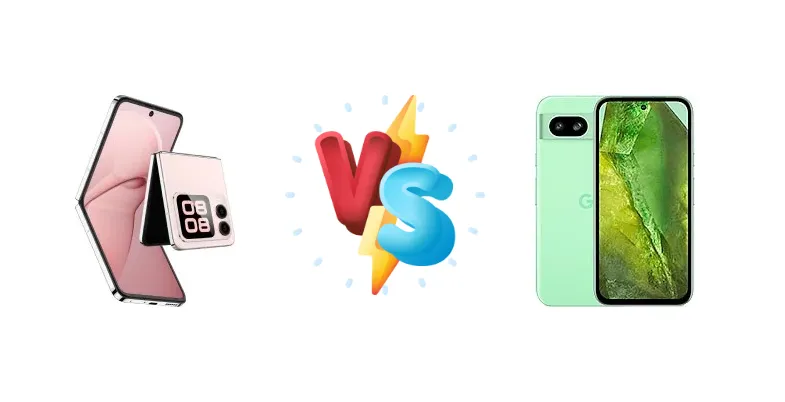
The Huawei nova Flip introduces a fresh take on the foldable form factor at a competitive price, while the Google Pixel 8a continues the Pixel tradition of delivering exceptional software and camera capabilities in a mid-range package. This comparison dissects the core differences between these two devices, focusing on performance, battery life, and user experience.
🏆 Quick Verdict
For the average user prioritizing long-term software support and consistent performance, the Google Pixel 8a is the stronger choice. Its Tensor G3 chipset and impressive 40:06h battery endurance outweigh the nova Flip’s faster charging and unique form factor.
| Network |
|---|
| 2G bands | GSM 850 / 900 / 1800 / 1900 | GSM 850 / 900 / 1800 / 1900 |
| 3G bands | HSDPA 800 / 850 / 900 / 1700(AWS) / 1900 / 2100 | HSDPA 800 / 850 / 900 / 1700(AWS) / 1900 / 2100 |
| 4G bands | LTE | 1, 2, 3, 4, 5, 7, 8, 12, 17, 18, 19, 20, 26, 28, 32, 38, 40, 41, 42, 66 - G6GPR (International) |
| 5G bands | 5G | 1, 2, 3, 5, 7, 8, 12, 20, 26, 28, 38, 40, 41, 66, 75, 76, 77, 78 SA/NSA/Sub6 - G6GPR (International) |
| Speed | HSPA, LTE | HSPA, LTE, 5G |
| Technology | GSM / CDMA / HSPA / CDMA2000 / LTE / 5G | GSM / HSPA / LTE / 5G |
| Launch |
|---|
| Announced | 2024, August 05 | 2024, May 07 |
| Status | Available. Released 2024, August 10 | Available. Released 2024, May 14 |
| Body |
|---|
| Build | - | Glass front (Gorilla Glass 3), aluminum frame, plastic back |
| Dimensions | Unfolded: 169.8 x 75.4 x 6.9 mmFolded: 87.6 x 75.4 x 15.1 mm | 152.1 x 72.7 x 8.9 mm (5.99 x 2.86 x 0.35 in) |
| SIM | Nano-SIM + Nano-SIM | Nano-SIM + eSIM |
| Weight | 195 g or 199 g (6.88 oz) | 188 g (6.63 oz) |
| Display |
|---|
| Protection | - | Corning Gorilla Glass 3, Mohs level 5 |
| Resolution | 1136 x 2690 pixels (~421 ppi density) | 1080 x 2400 pixels, 20:9 ratio (~430 ppi density) |
| Size | 6.94 inches, 111.4 cm2 (~87.0% screen-to-body ratio) | 6.1 inches, 90.3 cm2 (~81.6% screen-to-body ratio) |
| Type | Foldable LTPO OLED, 120Hz | OLED, HDR, 120Hz, 2000 nits (peak) |
| Platform |
|---|
| CPU | Octa-core | Nona-core (1x3.0 GHz Cortex-X3 & 4x2.45 GHz Cortex-A715 & 4x2.15 GHz Cortex-A510) |
| Chipset | Kirin 8000 (7 nm) | Google Tensor G3 (4 nm) |
| GPU | - | Immortalis-G715s MC10 |
| OS | HarmonyOS 4.2 | Android 14, upgradable to Android 16, up to 7 major Android upgrades |
| Memory |
|---|
| Card slot | No | No |
| Internal | 256GB 12GB RAM, 512GB 12GB RAM, 1TB 12GB RAM | 128GB 8GB RAM, 256GB 8GB RAM |
| Main Camera |
|---|
| Dual | 50 MP, f/1.9, 23mm (wide), 1/1.56", PDAF, OIS
8 MP, f/2.2, 112˚ (ultrawide) | 64 MP (16 MP eff.), f/1.9, 26mm (wide), 1/1.73", 0.8µm, dual pixel PDAF, OIS
13 MP, f/2.2, 120˚ (ultrawide), 1.12µm |
| Features | Color spectrum sensor, LED flash, HDR, panorama | Dual-LED flash, Pixel Shift, Ultra HDR, panorama, Best Take |
| Video | 4K, 1080p, gyro-EIS | 4K@30/60fps, 1080p@30/60/120/240fps, OIS |
| Selfie camera |
|---|
| Features | HDR, panorama | HDR, panorama |
| Single | 32 MP, f/2.2, 21mm (ultrawide) | 13 MP, f/2.2, 20mm (ultrawide), 1.12µm |
| Video | 4K, 1080p | 4K@30fps, 1080p@30/60fps |
| Sound |
|---|
| 35mm jack | No | No |
| Loudspeaker | Yes, with stereo speakers | Yes, with stereo speakers |
| Comms |
|---|
| Bluetooth | 5.2, A2DP, LE, L2HC | 5.3, A2DP, LE |
| NFC | Yes | Yes |
| Positioning | GPS (L1+L5), GLONASS (L1), BDS (B1I+B1c+B2a+B2b), GALILEO (E1+E5a+E5b), QZSS (L1+L5), NavIC | GPS, GLONASS, GALILEO, BDS, QZSS, NavIC |
| Radio | No | No |
| USB | USB Type-C 2.0, OTG | USB Type-C 3.2 |
| WLAN | Wi-Fi 802.11 a/b/g/n/ac/6, dual-band, Wi-Fi Direct | Wi-Fi 802.11 a/b/g/n/ac/6e, dual/tri-band (market/region dependent) |
| Features |
|---|
| Sensors | Fingerprint (side-mounted), accelerometer, gyro, compass | Fingerprint (under display, optical), accelerometer, gyro, proximity, compass, barometer |
| Battery |
|---|
| Charging | 66W wired, 100% in 40 min
5W reverse wired | 18W wired, PD3.0
7.5W wireless
Bypass charging |
| Type | Li-Po 4400 mAh | Li-Po 4492 mAh |
| Misc |
|---|
| Colors | Green, Pink, White, Black | Obsidian, Porcelain, Bay, Aloe |
| Models | PSD-AL00 | GKV4X, G6GPR, G8HHN, G576D |
| Price | About 680 EUR | $ 229.98 / C$ 417.99 / £ 279.00 / € 299.99 / ₹ 33,300 |
| EU LABEL |
|---|
| Battery | - | 40:06h endurance, 1000 cycles |
| Energy | - | Class B |
| Free fall | - | Class A (270 falls) |
| Repairability | - | Class B |
Huawei nova Flip
- Faster 66W wired charging
- Unique and stylish flip phone design
- Potentially more affordable price point
- HarmonyOS ecosystem limitations
- Uncertain long-term software support
- Performance likely lags behind Tensor G3
Google Pixel 8a
- Exceptional battery life (40:06h endurance)
- Google Tensor G3 for AI and performance
- Guaranteed software updates and Android experience
- Slower 18W wired charging
- Less visually striking design
- No expandable storage
Display Comparison
The Pixel 8a boasts a measured peak brightness of 1508 nits, significantly exceeding what we’d expect from a phone in this price bracket, ensuring excellent outdoor visibility. While the nova Flip’s display specs are not provided, its foldable nature inherently introduces a crease, a trade-off for the unique form factor. The Pixel 8a’s flat display also avoids potential issues with accidental touches common on curved screens. The Pixel 8a’s display is likely to offer superior color accuracy and viewing angles due to Google’s display calibration.
Camera Comparison
Without detailed camera specs for the nova Flip, it’s difficult to make a direct comparison. However, the Pixel 8a is renowned for its computational photography prowess, leveraging the Tensor G3’s image signal processor. Google’s software algorithms excel at dynamic range, noise reduction, and detail preservation. The Pixel 8a’s image processing style prioritizes realistic colors and natural-looking images, while Huawei often leans towards more saturated and stylized results. The absence of detailed camera information for the nova Flip suggests it may not compete with the Pixel 8a’s consistently high image quality.
Performance
The Google Pixel 8a’s Google Tensor G3, built on a 4nm process, offers a nona-core CPU configuration (1x3.0 GHz Cortex-X3, 4x2.45 GHz Cortex-A715, 4x2.15 GHz Cortex-A510) designed for AI and machine learning tasks. This contrasts with the Huawei nova Flip’s Kirin 8000 (7nm). The 4nm node of the Tensor G3 provides a clear advantage in thermal efficiency, reducing the likelihood of throttling during sustained workloads like gaming or video editing. While the Kirin 8000 is a capable chip, the Tensor G3’s dedicated AI cores will provide a smoother experience with Google’s smart features.
Battery Life
The Pixel 8a’s battery endurance is a standout feature, achieving a remarkable 40:06h rating and 11:25h of active use. This longevity is a significant advantage over the nova Flip, which, while offering a rapid 66W wired charging (100% in 40 minutes), lacks the Pixel 8a’s overall stamina. The Pixel 8a also supports 7.5W wireless charging and 'bypass charging', allowing it to function even while charging, features absent in the nova Flip. The Pixel 8a’s 1000 cycle battery life also suggests greater long-term reliability.
Buying Guide
Buy the Huawei nova Flip if you prioritize a head-turning design and rapid 66W charging, and are comfortable with the potential limitations of the HarmonyOS ecosystem. Buy the Google Pixel 8a if you value a clean Android experience, guaranteed software updates, and a consistently reliable camera system, even if it means slower charging speeds.
Frequently Asked Questions
❓ Does the Huawei nova Flip’s HarmonyOS have access to the Google Play Store?
No, the Huawei nova Flip runs on HarmonyOS and does not natively support the Google Play Store. Users will need to rely on Huawei’s AppGallery and potentially sideload apps, which can be a less convenient and secure experience.
❓ How does the Google Tensor G3 handle demanding games like Genshin Impact on the Pixel 8a?
The Google Tensor G3 is capable of running Genshin Impact, but users should expect to adjust graphics settings to medium or low for a consistently smooth framerate. The Tensor G3 prioritizes efficiency and AI tasks over raw GPU power, so it won't match the performance of flagship Snapdragon chips.
❓ Is the 66W charging on the nova Flip significantly faster in real-world use than the Pixel 8a’s 18W?
Yes, the 66W charging on the nova Flip is considerably faster. It can charge from 0-100% in approximately 40 minutes, while the Pixel 8a takes significantly longer. However, the Pixel 8a’s superior battery life means you’ll likely need to charge it less frequently.
❓ What are the long-term software support commitments for both devices?
Google guarantees at least 7 years of software updates for the Pixel 8a, including security patches and OS upgrades. Huawei’s software support for the nova Flip is less certain, and typically shorter than Google’s, potentially leaving users with an outdated OS after a few years.