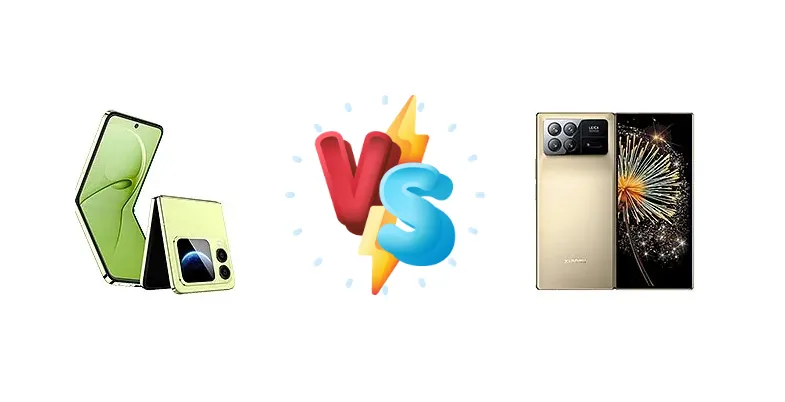
The foldable market is heating up, with distinct approaches emerging. Huawei's nova Flip S offers a stylish, compact flip-phone experience, while Xiaomi's Mix Fold 3 aims for a full-fledged tablet replacement with its larger form factor. This comparison dissects their key differences, focusing on performance, battery life, and display quality to determine which foldable best suits your needs.
🏆 Quick Verdict
For the average user prioritizing a blend of style and affordability, the Huawei nova Flip S presents a compelling package. However, the Xiaomi Mix Fold 3 dominates in raw performance and display quality, making it the superior choice for power users and those demanding a more immersive foldable experience.
| Network |
|---|
| 2G bands | GSM 850 / 900 / 1800 / 1900 | GSM 850 / 900 / 1800 / 1900 |
| 3G bands | HSDPA 800 / 850 / 900 / 1700(AWS) / 1900 / 2100 | HSDPA 800 / 850 / 900 / 1700(AWS) / 1900 / 2100 |
| 4G bands | LTE | 1, 2, 3, 4, 5, 7, 8, 12, 17, 18, 19, 26, 34, 38, 39, 40, 41, 42 |
| 5G bands | SA/NSA | 1, 3, 5, 8, 28, 38, 40, 41, 77, 78, 79 SA/NSA |
| Speed | HSPA, LTE | HSPA, LTE, 5G |
| Technology | GSM / CDMA / HSPA / CDMA2000 / LTE / 5G | GSM / CDMA / HSPA / EVDO / LTE / 5G |
| Launch |
|---|
| Announced | 2025, October 17 | 2023, August 14 |
| Status | Available. Released 2025, October 25 | Available. Released 2023, August 14 |
| Body |
|---|
| Build | Aluminum alloy frame, glass back or silicone polymer (eco leather) back | Glass front (folded), plastic front (unfolded), glass back or aramid fiber back, aluminum frame |
| Dimensions | Unfolded: 169.8 x 75.4 x 6.9 mmFolded: 87.8 x 75.4 x 15.1 mm | Unfolded: 161.2 x 143.3 x 5.3 mm Folded: 161.2 x 73.5 x 10.9 mm |
| SIM | Nano-SIM + Nano-SIM | Nano-SIM + Nano-SIM |
| Weight | 195 g or 199 g (6.88 oz) | 255 g or 259 g (8.99 oz) |
| Display |
|---|
| Resolution | 1136 x 2690 pixels (~421 ppi density) | 1916 x 2160 pixels (~360 ppi density) |
| Size | 6.94 inches, 111.4 cm2 (~87.0% screen-to-body ratio) | 8.03 inches, 206.5 cm2 (~89.4% screen-to-body ratio) |
| Type | Foldable LTPO OLED, 120Hz, HDR | Foldable LTPO OLED+, 1B colors, 120Hz, HDR10+, Dolby Vision, 1300 nits (peak) |
| Platform |
|---|
| CPU | Octa-core | Octa-core (1x3.36 GHz Cortex-X3 & 2x2.8 GHz Cortex-A715 & 2x2.8 GHz Cortex-A710 & 3x2.0 GHz Cortex-A510) |
| Chipset | Kirin 8030 | Qualcomm SM8550-AC Snapdragon 8 Gen 2 (4 nm) |
| GPU | - | Adreno 740 |
| OS | HarmonyOS 5.1 | Android 13, upgradable to Android 14, HyperOS |
| Memory |
|---|
| Card slot | No | No |
| Internal | 256GB 12GB RAM, 512GB 12GB RAM | 256GB 12GB RAM, 512GB 16GB RAM, 1TB 16GB RAM |
| Main Camera |
|---|
| Dual | 50 MP, f/1.9, 23mm (wide), 1/1.56", PDAF, OIS
8 MP, f/2.2, 112˚ (ultrawide) | - |
| Features | Laser AF, color spectrum sensor, LED flash, HDR, panorama | Color spectrum sensor, LED flash, HDR, panorama, Leica lenses |
| Quad | - | 50 MP, f/1.8, 23mm (wide), 1/1.49", 1.0µm, PDAF, OIS
10 MP, f/2.0, 75mm (telephoto), 1/3.94", 1.0µm, PDAF, OIS, 3.2x optical zoom
10 MP, f/2.9, 115mm (telephoto), 1/3.94", 1.0µm, PDAF, OIS, 5x optical zoom
12 MP, f/2.2, 15mm, 120˚ (ultrawide), 1/3.1", 1.12µm |
| Video | 4K, 1080p, gyro-EIS | 8K@24fps, 4K@24/30/60fps, 1080p@30/60/120/240/960/1920fps, Dolby Vision HDR |
| Selfie camera |
|---|
| Features | HDR, panorama | HDR, panorama |
| Single | 32 MP, f/2.2, 21mm (ultrawide) | 20 MP, f/2.3, 23mm (wide), 1/4.0", 0.8µm
Cover camera:
20 MP, f/2.3, 23mm (wide), 1/4.0", 0.8µm |
| Video | 4K, 1080p | 1080p@30/60fps |
| Sound |
|---|
| 35mm jack | No | No |
| Loudspeaker | Yes, with stereo speakers | Yes, with stereo speakers |
| Comms |
|---|
| Bluetooth | 5.2, A2DP, LE, L2HC | 5.3, A2DP, LE |
| Infrared port | - | Yes |
| NFC | Yes | Yes |
| Positioning | GPS (L1+L5), GLONASS (L1), BDS (B1I+B1c+B2a+B2b), GALILEO (E1+E5a+E5b), QZSS (L1+L5), NavIC | GPS (L1+L5), GLONASS (G1), BDS (B1I+B1c+B2a), GALILEO (E1+E5a), QZSS (L1+L5), NavIC (L5) |
| Radio | No | No |
| USB | USB Type-C 2.0, OTG | USB Type-C 3.2, OTG |
| WLAN | Wi-Fi 802.11 a/b/g/n/ac/6, dual-band, Wi-Fi Direct | Wi-Fi 802.11 a/b/g/n/ac/6e/7, dual-band (tri-band after future SW update) |
| Features |
|---|
| Sensors | Fingerprint (side-mounted), accelerometer, gyro, compass | Fingerprint (side-mounted), accelerometer, gyro, proximity, compass, barometer |
| Battery |
|---|
| Charging | 66W wired, 100% in 40 min
5W reverse wired | 67W wired, PD3.0, QC4, 100% in 40 min
50W wireless, 100% in 55 min |
| Type | Li-Po 4400 mAh | Li-Po 4800 mAh |
| Misc |
|---|
| Colors | Green, Pink, White, Black, Nova Black, Blue | Black, Gold |
| Models | PSD-AL80 | 2308CPXD0C |
| Price | About 410 EUR | About 1150 EUR |
Huawei nova Flip S
- More affordable price point
- Compact and pocketable design
- Stylish flip phone aesthetic
- Less powerful processor
- Likely inferior display quality
- Limited camera information
Xiaomi Mix Fold 3
- Flagship Snapdragon 8 Gen 2 performance
- Brighter and larger display
- Faster and more versatile charging options (wired & wireless)
- Higher price tag
- Larger and less pocketable form factor
- Potential for more significant weight
Display Comparison
The Xiaomi Mix Fold 3 boasts a significantly brighter display, reaching a measured 1277 nits, ensuring excellent visibility even in direct sunlight. While the nova Flip S’s display specs are not provided, flip phones generally prioritize compactness over screen real estate. The Mix Fold 3’s larger panel is likely to offer a more immersive viewing experience, especially for video consumption and gaming. The absence of LTPO information for the nova Flip S suggests it may not dynamically adjust refresh rates for power saving like the Mix Fold 3 likely does.
Camera Comparison
Detailed camera specs for the nova Flip S are missing, but Huawei typically focuses on computational photography. The Mix Fold 3’s camera system, while details are limited in the provided data, benefits from the Snapdragon 8 Gen 2’s advanced ISP (Image Signal Processor). This allows for faster image processing and improved low-light performance. Without specific sensor details for the nova Flip S, it’s difficult to assess its capabilities, but the Mix Fold 3’s chipset advantage suggests superior image and video quality, particularly in challenging conditions.
Performance
The core difference lies in the chipsets. The Xiaomi Mix Fold 3’s Snapdragon 8 Gen 2 (4nm) is a flagship powerhouse, featuring a Cortex-X3 prime core clocked at 3.36 GHz, alongside A715 and A710 performance cores, and efficient A510 cores. This architecture delivers substantial performance gains over the Huawei nova Flip S’s Kirin 8030. The 4nm process node of the Snapdragon 8 Gen 2 also translates to superior thermal efficiency, minimizing throttling during sustained workloads. While both are octa-core CPUs, the Snapdragon’s architecture is demonstrably more advanced, benefiting demanding users.
Battery Life
The Xiaomi Mix Fold 3’s endurance rating of 117 hours indicates a robust battery life, despite its larger display. Both devices offer 67W wired charging, achieving a full charge in 40 minutes. However, the Mix Fold 3 adds 50W wireless charging, reaching 100% in 55 minutes, providing greater charging flexibility. The larger battery capacity (implied by the endurance rating) of the Mix Fold 3, combined with the Snapdragon 8 Gen 2’s efficiency, likely results in longer real-world usage compared to the nova Flip S.
Buying Guide
Buy the Huawei nova Flip S if you need a pocketable, fashionable foldable that excels at social media and quick tasks, and value a lower price point. Buy the Xiaomi Mix Fold 3 if you prefer a larger screen for multitasking, gaming, and content creation, and demand top-tier performance from the Snapdragon 8 Gen 2 chipset.
Frequently Asked Questions
❓ Does the Kirin 8030 in the Huawei nova Flip S struggle with demanding games like Genshin Impact?
The Kirin 8030 is a capable mid-range chipset, but it will likely exhibit more noticeable frame drops and throttling in graphically intensive games like Genshin Impact compared to the Snapdragon 8 Gen 2 in the Xiaomi Mix Fold 3. Expect to lower graphics settings for a smoother experience.
❓ How does the larger size of the Xiaomi Mix Fold 3 affect one-handed usability?
The Xiaomi Mix Fold 3’s larger form factor makes one-handed operation challenging. It’s designed for two-handed use, especially when unfolded. The Huawei nova Flip S, being a flip phone, remains relatively compact and more manageable with one hand.
❓ Is the 50W wireless charging on the Xiaomi Mix Fold 3 significantly faster than standard wireless charging?
Yes, 50W wireless charging is considerably faster than typical wireless charging speeds (often 15-25W). It allows for a full charge in approximately 55 minutes, making it a convenient alternative to wired charging, especially for topping up the battery throughout the day.
❓ Given the lack of detailed camera specs for the Huawei nova Flip S, should I expect a significant difference in photo quality compared to the Xiaomi Mix Fold 3?
Based on the chipset difference and Xiaomi’s history of strong camera performance, it’s reasonable to expect the Mix Fold 3 to deliver superior photo and video quality, particularly in low-light conditions and with dynamic range. The Snapdragon 8 Gen 2’s ISP provides a significant advantage in image processing.