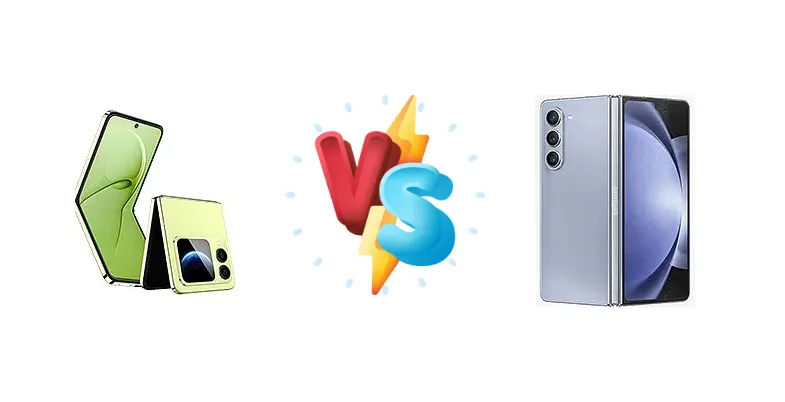
The foldable market is diversifying. While Samsung continues to refine the book-style foldable with the Galaxy Z Fold5, Huawei enters the arena with the more accessible, flip-phone format of the nova Flip S. This comparison dissects these two approaches, examining how their differing philosophies translate into real-world performance, battery life, and user experience.
🏆 Quick Verdict
For the average user prioritizing style and rapid charging, the Huawei nova Flip S offers compelling value. However, the Samsung Galaxy Z Fold5 wins for power users demanding top-tier performance, a larger, brighter display, and extended battery endurance, justifying its premium price.
| Network |
|---|
| 2G bands | GSM 850 / 900 / 1800 / 1900 | GSM 850 / 900 / 1800 / 1900 |
| 3G bands | HSDPA 800 / 850 / 900 / 1700(AWS) / 1900 / 2100 | HSDPA 850 / 900 / 1700(AWS) / 1900 / 2100 |
| 4G bands | LTE | 1, 2, 3, 4, 5, 7, 8, 12, 13, 17, 18, 19, 20, 25, 26, 28, 38, 39, 40, 41, 66 - International |
| 5G bands | SA/NSA | 1, 2, 3, 5, 7, 8, 12, 20, 25, 28, 38, 40, 41, 66, 77, 78 SA/NSA/Sub6 - International |
| Speed | HSPA, LTE | HSPA, LTE, 5G |
| Technology | GSM / CDMA / HSPA / CDMA2000 / LTE / 5G | GSM / CDMA / HSPA / EVDO / LTE / 5G |
| Launch |
|---|
| Announced | 2025, October 17 | 2023, July 26 |
| Status | Available. Released 2025, October 25 | Available. Released 2023, August 11 |
| Body |
|---|
| Build | Aluminum alloy frame, glass back or silicone polymer (eco leather) back | Glass front (Gorilla Glass Victus 2) (folded), plastic front (unfolded), glass back (Gorilla Glass Victus 2), aluminum frame |
| Dimensions | Unfolded: 169.8 x 75.4 x 6.9 mmFolded: 87.8 x 75.4 x 15.1 mm | Unfolded: 154.9 x 129.9 x 6.1 mmFolded: 154.9 x 67.1 x 13.4 mm |
| SIM | Nano-SIM + Nano-SIM | · Nano-SIM + eSIM· Nano-SIM + Nano-SIM + eSIM (max 2 at a time) |
| Weight | 195 g or 199 g (6.88 oz) | 253 g (8.92 oz) |
| Display |
|---|
| Resolution | 1136 x 2690 pixels (~421 ppi density) | 1812 x 2176 pixels (~373 ppi density) |
| Size | 6.94 inches, 111.4 cm2 (~87.0% screen-to-body ratio) | 7.6 inches, 183.2 cm2 (~91.1% screen-to-body ratio) |
| Type | Foldable LTPO OLED, 120Hz, HDR | Foldable Dynamic AMOLED 2X, 120Hz, HDR10+ |
| Platform |
|---|
| CPU | Octa-core | Octa-core (1x3.36 GHz Cortex-X3 & 2x2.8 GHz Cortex-A715 & 2x2.8 GHz Cortex-A710 & 3x2.0 GHz Cortex-A510) |
| Chipset | Kirin 8030 | Qualcomm SM8550-AC Snapdragon 8 Gen 2 (4 nm) |
| GPU | - | Adreno 740 |
| OS | HarmonyOS 5.1 | Android 13, up to 4 major Android upgrades, One UI 6.1.1 |
| Memory |
|---|
| Card slot | No | No |
| Internal | 256GB 12GB RAM, 512GB 12GB RAM | 256GB 12GB RAM, 512GB 12GB RAM, 1TB 12GB RAM |
| Main Camera |
|---|
| Dual | 50 MP, f/1.9, 23mm (wide), 1/1.56", PDAF, OIS
8 MP, f/2.2, 112˚ (ultrawide) | - |
| Features | Laser AF, color spectrum sensor, LED flash, HDR, panorama | LED flash, HDR, panorama |
| Triple | - | 50 MP, f/1.8, 23mm (wide), 1/1.56", 1.0µm, dual pixel PDAF, OIS
10 MP, f/2.4, 66mm (telephoto), 1/3.94", 1.0µm, PDAF, OIS, 3x optical zoom
12 MP, f/2.2, 12mm, 123˚ (ultrawide), 1/3.06", 1.12µm |
| Video | 4K, 1080p, gyro-EIS | 8K@30fps, 4K@60fps, 1080p@60/240fps (gyro-EIS), HDR10+ |
| Selfie camera |
|---|
| Features | HDR, panorama | HDR |
| Single | 32 MP, f/2.2, 21mm (ultrawide) | 4 MP, f/1.8, 26mm (wide), 1/3.0", 2.0µm, under display
Cover camera:
10 MP, f/2.2, 24mm (wide), 1/3.0", 1.22µm |
| Video | 4K, 1080p | 4K@30/60fps, 1080p@30/60fps, gyro-EIS |
| Sound |
|---|
| 35mm jack | No | No |
| Loudspeaker | Yes, with stereo speakers | Yes, with stereo speakers |
| Comms |
|---|
| Bluetooth | 5.2, A2DP, LE, L2HC | 5.3, A2DP, LE, aptX HD |
| NFC | Yes | Yes |
| Positioning | GPS (L1+L5), GLONASS (L1), BDS (B1I+B1c+B2a+B2b), GALILEO (E1+E5a+E5b), QZSS (L1+L5), NavIC | GPS, GLONASS, GALILEO, BDS |
| Radio | No | No |
| USB | USB Type-C 2.0, OTG | USB Type-C 3.2, OTG |
| WLAN | Wi-Fi 802.11 a/b/g/n/ac/6, dual-band, Wi-Fi Direct | Wi-Fi 802.11 a/b/g/n/ac/6e, tri-band, Wi-Fi Direct |
| Features |
|---|
| Sensors | Fingerprint (side-mounted), accelerometer, gyro, compass | Fingerprint (side-mounted), accelerometer, gyro, proximity, compass, barometer |
| Battery |
|---|
| Charging | 66W wired, 100% in 40 min
5W reverse wired | 25W wired, 50% in 30 min
15W wireless
4.5W reverse wireless |
| Type | Li-Po 4400 mAh | Li-Po 4400 mAh |
| Misc |
|---|
| Colors | Green, Pink, White, Black, Nova Black, Blue | Icy Blue, Phantom Black, Cream, Gray, Blue |
| Models | PSD-AL80 | SM-F946B, SM-F946B/DS, SM-F946U, SM-F946U1, SM-F946N, SM-F946W, SM-F9460 |
| Price | About 410 EUR | € 660.00 / $ 607.00 / £ 520.69 / ₹ 86,000 |
| SAR | - | 1.16 W/kg (head) |
| SAR EU | - | 1.24 W/kg (head) 1.19 W/kg (body) |
Huawei nova Flip S
- 66W fast charging significantly reduces charging time.
- More affordable price point makes it accessible to a wider audience.
- Compact and stylish flip phone design is highly portable.
- Kirin 8030 chipset offers lower performance than the Snapdragon 8 Gen 2.
- Limited battery endurance compared to the Z Fold5.
- Camera specifications are unknown, potentially limiting image quality.
Samsung Galaxy Z Fold5
- Snapdragon 8 Gen 2 delivers flagship-level performance.
- Excellent battery life with a 95-hour endurance rating.
- Bright and immersive display with LTPO technology.
- Significantly higher price point.
- Slower 25W wired charging compared to the Flip S.
- Larger form factor may be less convenient for some users.
Display Comparison
The Z Fold5 boasts a significantly larger and brighter display, peaking at 1257 nits, crucial for outdoor visibility. While the nova Flip S’s external and internal displays are not specified, the Z Fold5’s dynamic refresh rate LTPO panel optimizes battery consumption. The Z Fold5’s larger canvas is ideal for multitasking and content creation, while the Flip S prioritizes compactness. The Z Fold5’s panel technology is geared towards productivity, while the Flip S focuses on portability.
Camera Comparison
Detailed camera specs for the nova Flip S are missing, but the Z Fold5’s camera system, while not detailed in the provided data, is expected to offer a more versatile experience. The Z Fold5 likely features a larger main sensor and advanced image processing capabilities. The absence of specific details for the nova Flip S suggests a focus on social media-friendly shots rather than professional-grade photography. The Z Fold5’s camera is geared towards capturing high-quality photos and videos in various conditions, while the Flip S likely prioritizes convenience and ease of use.
Performance
The Samsung Galaxy Z Fold5’s Qualcomm Snapdragon 8 Gen 2 (4nm) chipset represents a substantial performance leap over the Huawei nova Flip S’s Kirin 8030. The Snapdragon 8 Gen 2’s Cortex-X3 prime core, clocked at 3.36 GHz, delivers superior single-core performance, vital for responsive app launches and smooth UI navigation. The 4nm fabrication process also contributes to better thermal efficiency, minimizing throttling during sustained workloads. While the Kirin 8030 is an octa-core processor, it lacks the architectural advantages of the Snapdragon, impacting gaming and demanding applications.
Battery Life
The Samsung Galaxy Z Fold5’s endurance rating of 95 hours and 12:01h active use score demonstrate superior battery life compared to the Huawei nova Flip S. While the Flip S offers faster 66W wired charging (100% in 40 minutes), the Z Fold5’s larger battery capacity and optimized power management provide longer usage between charges. The Z Fold5 also supports 15W wireless and 4.5W reverse wireless charging, adding convenience. The Flip S’s faster charging is beneficial for quick top-ups, but the Z Fold5 excels in overall longevity.
Buying Guide
Buy the Huawei nova Flip S if you need a fashionable, pocketable device with incredibly fast 66W charging and are comfortable with a mid-range chipset. Buy the Samsung Galaxy Z Fold5 if you prefer a tablet-like experience, require the best possible performance for demanding tasks, and value a brighter, more immersive display with longer battery life.
Frequently Asked Questions
❓ Does the Kirin 8030 in the Huawei nova Flip S struggle with graphically intensive games?
While the Kirin 8030 is a capable processor, the Snapdragon 8 Gen 2 in the Z Fold5 offers a substantial performance advantage in gaming. Expect lower frame rates and potential graphical compromises in demanding titles on the nova Flip S, especially at higher settings.
❓ How does the 25W charging on the Z Fold5 compare to the 66W on the nova Flip S in real-world usage?
Although the nova Flip S charges much faster (100% in 40 minutes), the Z Fold5’s larger battery means you’ll still get a significant amount of usage from a 30-minute charge. The Flip S is ideal for quick top-ups, while the Z Fold5 prioritizes overall battery longevity.
❓ Is the lack of detailed camera specs for the nova Flip S a major concern?
It suggests the camera isn't a primary focus. While it will likely be adequate for casual photography and social media, it won't compete with the expected image quality and versatility of the Z Fold5's camera system.
❓ How does the larger size of the Z Fold5 affect its usability as a daily driver?
The Z Fold5 is considerably larger and heavier than the Flip S. While it offers a tablet-like experience when unfolded, it may be less comfortable to use one-handed or carry in a pocket compared to the more compact Flip S.