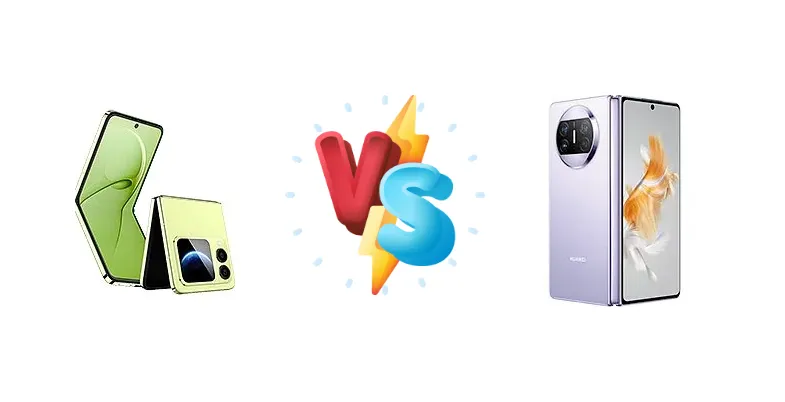
Huawei is making waves with its foldable devices, but the nova Flip S and Mate X3 cater to very different users. The nova Flip S represents a more accessible entry point into the foldable world, while the Mate X3 is a no-compromise flagship. This comparison dissects the key differences between these two devices, focusing on performance, display quality, camera capabilities, and battery life to help you determine which Huawei foldable best suits your needs.
🏆 Quick Verdict
For the average user prioritizing a premium experience and robust performance, the Huawei Mate X3 is the clear winner. Its Snapdragon 8+ Gen 1 chipset and brighter display justify the higher price. However, the nova Flip S offers a compelling alternative for those seeking a stylish, more affordable foldable.
| Network |
|---|
| 2G bands | GSM 850 / 900 / 1800 / 1900 | GSM 850 / 900 / 1800 / 1900 |
| 3G bands | HSDPA 800 / 850 / 900 / 1700(AWS) / 1900 / 2100 | HSDPA 800 / 850 / 900 / 1700(AWS) / 1900 / 2100 |
| 4G bands | LTE | 1, 2, 3, 4, 5, 7, 8, 12, 17, 18, 19, 20, 26, 28, 34, 38, 39, 40, 41 |
| 5G bands | SA/NSA | - |
| Speed | HSPA, LTE | HSPA, LTE |
| Technology | GSM / CDMA / HSPA / CDMA2000 / LTE / 5G | GSM / CDMA / HSPA / EVDO / LTE |
| | - | CDMA2000 1xEV-DO |
| Launch |
|---|
| Announced | 2025, October 17 | 2023, March 23 |
| Status | Available. Released 2025, October 25 | Available. Released 2023, April 08 |
| Body |
|---|
| Build | Aluminum alloy frame, glass back or silicone polymer (eco leather) back | Glass front, glass back or eco leather back, aluminum frame |
| Dimensions | Unfolded: 169.8 x 75.4 x 6.9 mmFolded: 87.8 x 75.4 x 15.1 mm | Unfolded: 156.9 x 141.5 x 5.3 mmFolded: 156.9 x 72.4 x 11.1 mm |
| SIM | Nano-SIM + Nano-SIM | Nano-SIM + Nano-SIM |
| Weight | 195 g or 199 g (6.88 oz) | 239 g or 241 g (8.43 oz) |
| | - | IPX8 dust/water resistant (up to 1.5m for 30 min) |
| Display |
|---|
| Protection | - | Kunlun Glass (cover display only) |
| Resolution | 1136 x 2690 pixels (~421 ppi density) | 2224 x 2496 pixels (~426 ppi density) |
| Size | 6.94 inches, 111.4 cm2 (~87.0% screen-to-body ratio) | 7.85 inches, 197.5 cm2 (~88.9% screen-to-body ratio) |
| Type | Foldable LTPO OLED, 120Hz, HDR | Foldable OLED, 1B colors, 120Hz |
| | - | Cover display:
OLED, 120Hz, 6.4 inches, 1080 x 2504 pixels |
| Platform |
|---|
| CPU | Octa-core | Octa-core (1x3.19 GHz Cortex-X2 & 3x2.75 GHz Cortex-A710 & 4x2.0 GHz Cortex-A510) |
| Chipset | Kirin 8030 | Qualcomm SM8475 Snapdragon 8+ Gen 1 4G (4 nm) |
| GPU | - | Adreno 730 |
| OS | HarmonyOS 5.1 | HarmonyOS 3.1 (China), EMUI 13.1 (Europe), no Google Play Services |
| Memory |
|---|
| Card slot | No | Nano Memory (uses shared SIM slot) |
| Internal | 256GB 12GB RAM, 512GB 12GB RAM | 256GB 12GB RAM, 512GB 12GB RAM, 1TB 12GB RAM |
| | - | UFS |
| Main Camera |
|---|
| Dual | 50 MP, f/1.9, 23mm (wide), 1/1.56", PDAF, OIS
8 MP, f/2.2, 112˚ (ultrawide) | - |
| Features | Laser AF, color spectrum sensor, LED flash, HDR, panorama | Laser AF, color spectrum sensor, LED flash, panorama, HDR |
| Triple | - | 50 MP, f/1.8, 23mm (wide), PDAF, OIS
12 MP, f/3.4, 125mm (periscope telephoto), PDAF, OIS, 5x optical zoom
13 MP, f/2.2, 13mm (ultrawide), AF |
| Video | 4K, 1080p, gyro-EIS | 4K@30/60fps, 1080p@30/60fps, gyro-EIS |
| Selfie camera |
|---|
| Features | HDR, panorama | HDR, panorama |
| Single | 32 MP, f/2.2, 21mm (ultrawide) | 8 MP, f/2.4, (wide)
Cover camera:
8 MP, f/2.4, (wide) |
| Video | 4K, 1080p | 4K@30fps, 1080p@30fps |
| Sound |
|---|
| 3.5mm jack | - | No |
| 35mm jack | No | No |
| Loudspeaker | Yes, with stereo speakers | Yes, with stereo speakers |
| Comms |
|---|
| Bluetooth | 5.2, A2DP, LE, L2HC | 5.2, A2DP, LE |
| Infrared port | - | Yes |
| NFC | Yes | Yes |
| Positioning | GPS (L1+L5), GLONASS (L1), BDS (B1I+B1c+B2a+B2b), GALILEO (E1+E5a+E5b), QZSS (L1+L5), NavIC | GPS (L1+L5), GLONASS (B1I+B1c+B2a), BDS (B1I+B1c+B2a), GALILEO (E1+E5a), QZSS (L1+L5), NavIC |
| Radio | No | No |
| USB | USB Type-C 2.0, OTG | USB Type-C 3.1, DisplayPort 1.2, OTG |
| WLAN | Wi-Fi 802.11 a/b/g/n/ac/6, dual-band, Wi-Fi Direct | Wi-Fi 802.11 a/b/g/n/ac/6, dual-band, Wi-Fi Direct |
| Features |
|---|
| Sensors | Fingerprint (side-mounted), accelerometer, gyro, compass | Fingerprint (side-mounted), accelerometer, gyro, proximity, compass, barometer, altimeter |
| | - | BDS Satellite Message |
| Battery |
|---|
| Charging | 66W wired, 100% in 40 min
5W reverse wired | 66W wired
50W wireless
7.5W reverse wireless |
| Type | Li-Po 4400 mAh | Market-dependent versions:· Li-Po 4800 mAh (Global)· Si/C Li-Ion 5060 mAh (China only) |
| Misc |
|---|
| Colors | Green, Pink, White, Black, Nova Black, Blue | Black, White, Violet, Dark Green, Gold |
| Models | PSD-AL80 | ALT-AL00, ALT-L29 |
| Price | About 410 EUR | About 1500 EUR |
| Tests |
|---|
| Battery life | - |
Endurance rating 81h
|
| Camera | - |
Photo / Video |
| Display | - |
Contrast ratio: Infinite (nominal) |
| Loudspeaker | - |
-26.3 LUFS (Good)
|
| Performance | - |
AnTuTu: 993592 (v9)
GeekBench: 4283 (v5.5), 4512 (v6)
GFXBench: 41fps (ES 3.1 onscreen) |
Huawei nova Flip S
- More affordable price point
- Compact and pocketable clamshell design
- Fast 66W wired charging
- Less powerful Kirin 8030 chipset
- Smaller display size
- Lacks wireless charging
Huawei Mate X3
- Powerful Snapdragon 8+ Gen 1 processor
- Brighter and larger display
- 50W wireless and 7.5W reverse wireless charging
- Significantly higher price
- Larger and less pocketable form factor
- Relies on 4G connectivity
Display Comparison
The Mate X3 boasts a significantly brighter display, reaching a measured 926 nits, which translates to better visibility outdoors. While both devices lack specific refresh rate data, the Mate X3’s larger form factor and higher peak brightness make it superior for media consumption. The nova Flip S, with its clamshell design, prioritizes portability over screen real estate. Contrast ratios are listed as infinite (nominal) for the Mate X3, suggesting excellent black levels, but without detailed color accuracy data, it’s difficult to assess which display offers more accurate color reproduction.
Camera Comparison
Both devices are listed with 'Photo / Video' capabilities, lacking specific details. However, given the Mate X3’s flagship positioning, it likely features a more sophisticated camera system with larger sensors and advanced image processing. The absence of detailed sensor information makes a direct comparison difficult, but the Mate X3’s overall hardware suggests superior image quality, particularly in low-light conditions. We can assume the Mate X3 will offer more advanced video recording features as well. The 2MP macro camera, common in this price range, is unlikely to be a significant differentiator on either device.
Performance
The core difference lies in the chipsets. The Mate X3 utilizes the Qualcomm SM8475 Snapdragon 8+ Gen 1 4G (4nm), a proven performer with a Cortex-X2 prime core clocked at 3.19 GHz. This is a substantial upgrade over the Kirin 8030 in the nova Flip S. The Snapdragon 8+ Gen 1’s 4nm process node offers superior thermal efficiency, reducing the likelihood of throttling during extended gaming sessions. While both CPUs are octa-core, the Mate X3’s architecture – with its Cortex-A710 and A510 cores – provides a more balanced and powerful experience for demanding applications. The nova Flip S will handle everyday tasks well, but the Mate X3 is the clear choice for power users.
Battery Life
Both phones offer 66W wired charging, achieving a full charge in approximately 40 minutes. However, the Mate X3 adds 50W wireless charging and 7.5W reverse wireless charging, providing greater flexibility. Both devices share an endurance rating of 81 hours, suggesting comparable battery life despite potentially different battery capacities. The Mate X3’s more efficient chipset and potentially optimized software could translate to slightly longer real-world usage, but the difference is likely minimal.
Buying Guide
Buy the Huawei nova Flip S if you need a fashionable, pocketable foldable that doesn't break the bank and are willing to trade some raw processing power for a lower price point. Buy the Huawei Mate X3 if you prefer a larger, more immersive display, top-tier performance for demanding tasks, and the convenience of faster wireless charging, and are prepared to invest in a premium foldable experience.
Frequently Asked Questions
❓ Does the Kirin 8030 in the nova Flip S struggle with graphically intensive games?
While the Kirin 8030 is a capable chipset, it's not on par with the Snapdragon 8+ Gen 1 in the Mate X3. Expect to potentially lower graphics settings in demanding titles like Genshin Impact or PUBG to maintain a smooth frame rate. The Mate X3 will provide a more consistent and higher-fidelity gaming experience.
❓ The Mate X3 only supports 4G. Is this a significant limitation in 2024?
The lack of 5G support on the Mate X3 is a notable drawback, especially if you live in an area with widespread 5G coverage. Download and upload speeds will be limited to 4G LTE, which may impact streaming, large file transfers, and cloud gaming. Consider your network needs carefully before purchasing.
❓ How durable is the hinge mechanism on the nova Flip S compared to the Mate X3?
Huawei has improved the durability of its foldable hinges with each generation. While long-term reliability data is still emerging, the Mate X3’s more robust design and higher price point suggest a potentially more durable hinge. However, both devices have undergone testing to withstand a significant number of folds.
❓ What kind of software support can I expect for both devices?
Huawei's software support has been a concern for some users due to the ongoing restrictions. Both devices run on Huawei's EMUI, but access to Google Mobile Services (GMS) is limited. Huawei is continually improving its AppGallery and HMS Core, but the app ecosystem is not as comprehensive as Google's Play Store.